

Saudi Investment Bank announced that it had signed an agreement with American Express (Middle East) to sell its entire 50% stake in the share capital of American Express Saudi Arabia.
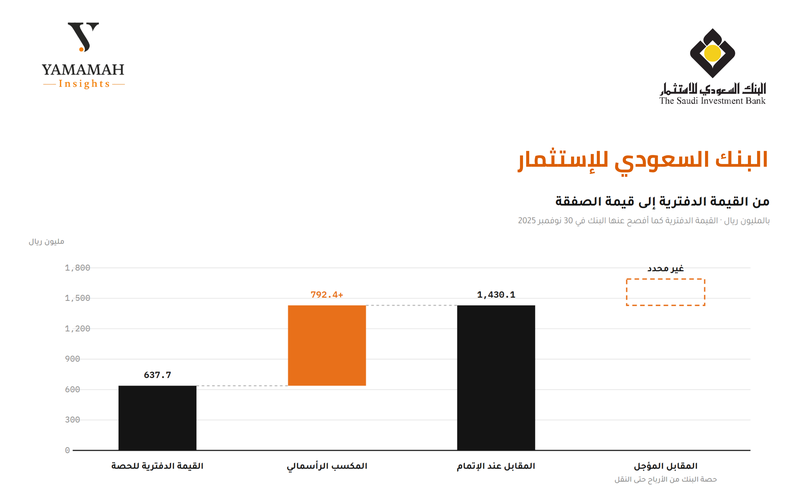
According to the announcement, the total transaction value amounted to SAR 1,430.11 million (equivalent to USD 381.36 million), payable upon completion of the transaction, in addition to an additional deferred amount in accordance with the Shareholders’ Agreement.
This exit represents a strategic step that could help strengthen the bank’s financial position and redirect cash liquidity toward its core investment opportunities and expansion objectives in the banking sector.
Students from Al Yamamah University discussed the financial and strategic dimensions of the exit and its implications for the bank’s financial position, as follows:
Maximizing investment value and directing liquidity toward the bank’s core activities
Student Rimas Almashali @Rimas Almashali explained her view, saying: "In my opinion, the transaction is positive for the bank because it generates significant capital gains and provides liquidity that can be directed toward supporting its core activities and growth opportunities.
Selling the investment for more than twice its book value also reflects the bank’s success in maximizing the value of its investment over the long term."
Structuring contracts to protect rights and redirect sustainable capital
Student Jumana Al-Shehri @Jumana Alshehri also shared her opinion, stating: "I think the transaction is positive for the bank, especially since the exit generated gains of approximately SAR 792.4 million, which is higher than the book value of its stake.
Receiving SAR 1.43 billion also gives it additional liquidity that it can use to support its financial position or direct toward other investments and growth opportunities.
Regarding the exit, selling a non-core stake could help the bank focus more on its main banking business.
I also believe that the existence of a deferred purchase consideration highlights the importance of structuring the agreement precisely, particularly in defining each party’s rights and the profits during the transitional period.
In general, the transaction reflects a reallocation of capital and the exploitation of a previous investment at a value higher than its book value."
Effective investment portfolio management and the importance of legal drafting
Student Shahad Al-Khamis @Shahad Alkhamis detailed the strategic dimensions, saying: "In my opinion, this transaction should not be viewed solely from the perspective of generating an accounting profit; rather, it reflects the bank’s success in managing its investment portfolio and converting a long-term investment into actual cash value.
Achieving a return exceeding twice the book value of the stake indicates that the investment was held until it reached an appropriate exit level. Accordingly, the decision reflects efficiency in managing capital and timing the exit.
From a financial perspective, the profits and liquidity generated by the transaction give the bank greater flexibility to direct capital toward higher-return growth opportunities, whether by expanding banking services, investing in digital transformation and financial technology, or improving operational efficiency. They also provide an opportunity to support the financial position and take advantage of future investment opportunities.
Strategically, I believe that exiting certain non-core investments does not necessarily indicate that the investment was weak. Rather, it may be part of reallocating capital toward activities in which the bank has a clear competitive advantage.
This aligns with the approach of financial institutions to focus on core banking businesses instead of scattering capital across investments that do not serve the main strategy over the long term.
From a legal perspective, such transactions demonstrate the importance of drafting partnership and investment agreements precisely, particularly with regard to the mechanism for selling shares, the parties’ rights upon exit, the method for calculating and distributing deferred profits, and obligations that continue after completion of the transaction.
Clarity in these provisions reduces the likelihood of disputes and protects the rights of each party, especially when the transaction value is substantial and involves multiple financial interests.
Therefore, I believe that the success of the transaction should not be measured solely by the size of the profit achieved, but also by the bank’s ability to convert this investment into liquidity and then redeploy it efficiently in areas that generate sustainable value for shareholders.
If this approach to capital management and the selective exit from non-core investments continues, it could contribute to strengthening the bank’s profitability, competitiveness, and strategic focus over the long term."
Balancing capital gains with the challenges of redeploying liquidity
Student Mohammad Alghaihab @Mohammad Alghaihab noted: "I think the exit is financially positive, but it needs to be viewed cautiously from an operational perspective.
The bank will generate a gain of approximately SAR 792 million and provide substantial liquidity, but at the same time it is giving up an investment that was generating growing profits.
Therefore, the transaction’s actual success depends on the bank’s ability to redeploy the SAR 1.43 billion at a return higher than the return it was earning from American Express Saudi Arabia."
Capturing gains and providing liquidity to support future plans
Student Dina @Dina Alarjani added: "I think the exit is a smart decision because the bank benefited from the increase in the value of its investment, achieved a strong gain, and at the same time provided liquidity that it can use in its upcoming plans."
Realizing capital gains and choosing the optimal timing for the exit
Student Noof Al-Anazi @Noof Alanazi said: "In my opinion, the transaction to sell Saudi Investment Bank’s stake in American Express is a positive step, particularly because the bank achieved a good capital gain from the exit.
I think the transaction provides the bank with additional liquidity that it can use to finance new projects or expand into areas generating higher returns.
Selling the investment above its book value also indicates that the bank benefited from the increase in the investment’s value and chose an appropriate time to exit.
In general, I believe that redirecting capital toward new investments and growth opportunities could support the bank’s performance and shareholder returns over the long term."
Exceeding book value as an indication of investment quality and efficiency
Student Arwa Al-Huwaiti @Arwa Alhuwaiti shared her view, explaining: "I think selling the stake for more than twice its book value is a good indicator of investment success, especially since the bank achieved expected gains of approximately SAR 792.41 million against an investment book value of SAR 637.70 million.
More importantly, the transaction provides the bank with liquidity and enables it to redirect capital toward investment opportunities that may generate better returns in the future."
Redirecting resources from profitable investments to support the banking strategy
Student Albatool Bedairi @Albatool Bedairi confirmed: "I think the transaction represents a successful strategic exit for the bank, especially since the sale value amounted to approximately SAR 1.43 billion compared with a book value of the stake of SAR 637.7 million, resulting in an expected gain of approximately SAR 792.4 million.
More importantly, the bank did not exit because the investment was underperforming; rather, it exited a company generating strong profits, which indicates the bank’s desire to redirect capital and liquidity toward opportunities more aligned with its strategy.
Therefore, the transaction’s long-term success will depend on the bank’s ability to invest these proceeds and achieve better returns in the future."
Focusing on the core banking business to enhance competitive efficiency
Student Lujain Al-Qurashi @Lujain Algorashi added: "The transaction carries positive implications for the bank, particularly because it generates investment value significantly exceeding the book value, reflecting the investment’s long-term success.
The liquidity generated by the transaction also gives the bank an opportunity to direct its funds toward new investments and projects that support its growth.
More broadly, exiting non-core investments helps the bank focus on its main business and use its capital more efficiently, strengthening its ability to compete in the Saudi banking sector."
Financial impact and implications of valuation and legal regulation for restructuring
Student Amal Al-Mansi @Amal Mansi elaborated in her analysis:
"1- Financial impact and growth opportunities:
- Immediate cash injection: The transaction provides the bank with a direct cash flow of SAR 1,430.11 million upon completion. This liquidity supports working capital and increases the bank’s ability to expand lending and financing.
- Generating substantial capital gains: The transaction is expected to produce net profits and gains of SAR 792.41 million (based on the book value as of November 2025).
- Supporting the strategic direction: The announcement explicitly states that these proceeds will be used to support and strengthen the bank’s financial position in line with its strategic direction of serving the best interests of the bank and its shareholders. This will enable it to invest in modern banking technologies and expand its market share in the retail and corporate sectors.
2- The exit and investment valuation:
- Implications of the transaction valuation: The asset’s book value was SAR 637.70 million, while the stake was sold for SAR 1,430.11 million. Selling the asset for more than twice its book value reflects significant investment success and the bank’s ability to build and develop high-quality assets that are attractive to buyers.
- Confirmation of the success of long-term investments: This price difference demonstrates the hidden value realized over the years. The accompanying financial statements indicate steady growth in American Express Saudi Arabia’s profits, from SAR 88.16 million in 2023 to SAR 151.97 million in 2025. This sustained growth gave the bank the negotiating power to secure an excellent price premium, capturing the asset’s future profits today.
3- Legal aspects and contract regulation:
- Protecting rights through the “Shareholders’ Agreement”: The announcement states that the purchase price and exit mechanism were determined in accordance with the “Shareholders’ Agreement” concluded on September 25, 2018. This demonstrates that prior contractual arrangements prevent disputes and provide each party with a smooth and fair exit.
- Importance of the “deferred purchase consideration”: The contract includes a provision granting the bank the right to receive deferred profits reflecting its share of distributable profits from the signing of the transaction until completion of the share transfer. This legal provision protects the bank from losing any financial returns during the transitional period (between signing and actual closing) and ensures a dynamic and fair valuation of the asset until the final moment.
4- Restructuring investments in the banking sector:
- Focusing on core banking activities: This exit represents a clear example of banks’ shift toward “Core Business” focus. Instead of spreading capital across minority stakes or non-core associates, banks prefer to monetize these investments and reinvest the proceeds in direct banking operations, such as loans, digital services, and wealth management.
- Enhancing competitiveness: The Saudi banking sector is experiencing intense competition in line with the objectives of Saudi Vision 2030. This restructuring gives Saudi Investment Bank greater agility and excellent capital efficiency, enabling it to compete strongly with a balance sheet supported by robust cash resources and new retained earnings."
A strategic step toward restructuring and aligning with future trends
Student Ghadah Alwallan @Ghadah Alwallan noted: "In my view, the exit appears to be a strategic step, particularly because the bank will receive a substantial cash amount in addition to a deferred purchase consideration.
This could help the bank redirect its resources toward its core banking businesses and investments that are more closely aligned with its future direction."
The comprehensive impact of the exit: strengthening solvency while ensuring contractual protection
Student Fay Aldossari @Fay Aldossari concluded the comprehensive analysis by saying:
"Financial impact and growth opportunities: The cash liquidity (SAR 1.43 billion) and realized profits enable the bank to strengthen its capital adequacy, expand financing for major projects, and invest in digital transformation in the banking sector.
Exit and investment valuation: Selling the stake for more than twice its book value proves the success of the long-term investment and the bank’s ability to seize the ideal exit timing to achieve the maximum return on capital.
Legal aspects and contract regulation: Including the “deferred consideration” and exit terms protects the bank’s rights, ensures that it receives a share of the company’s future growth, and reduces legal and financial risks.
Investment restructuring: This approach reflects banks’ focus on core banking activities and improving operating and capital efficiency, rather than retaining non-controlling stakes."
Two notable exits and nearly SAR 1.6 billion in nonrecurring gains
Expert Abdulaziz Khrais believes that Saudi Investment Bank is executing notable investment moves. The bank announced its exit from its investment in American Express Saudi Arabia by selling its entire 50% stake, making this the second investment or asset exit completed by the bank within a year.
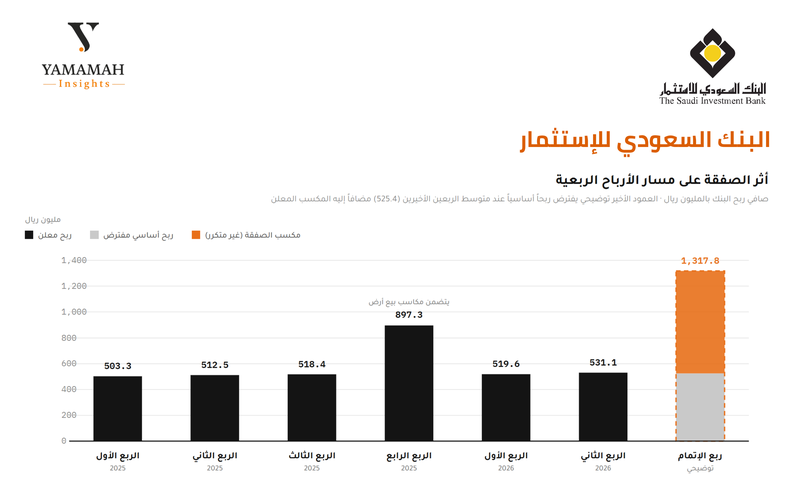
Khrais explained that the book value of the investment in American Express Saudi Arabia was SAR 637.70 million (based on data as of November 30, 2025), while the transaction value was SAR 1.43 billion, in addition to deferred purchase consideration, resulting in nonrecurring gains of approximately SAR 792.41 million.
In connection with the first exit, Khrais highlighted the bank’s announcement last November that it had completed the sale of a plot of land in which it held a 44.4% ownership interest. The land is located on Khurais Road in Riyadh and has a total area of 2.7 million square meters. The bank recorded gains of SAR 801.1 million from the sale.
An examination of the financial dimensions and operational risks of the exit
In an analytical assessment, financial and economic analyst “Hamad Alsaeed” @Hamad Alsaeed adds: Saudi Investment Bank is exiting a credit-card business whose growth has reached maturity. The company being exited achieved revenue growth of only 5.8% in 2025, at a time when digital payment systems and buy-now-pay-later solutions are reshaping sector margins.
At the same time, approximately SAR 1.43 billion is entering the balance sheet of a bank whose annual profit does not exceed SAR 2.43 billion. The transaction’s impact extends beyond the gain. The stake sold was consuming more regulatory capital than cash would, because investments in the capital of a financial institution are subject to stricter treatment. Converting it into cash will release additional capital and expand the room for growth in the financing portfolio.
However, the quality of the bank’s income will change. SAR 76 million had been received as ready income from an associate that bore its risks on its own books. Replacing it with lending income will transfer those risks to the bank’s books and consume some of its capital.

 Ask Yamami
Comments (7)
No comments yet. Be the first to comment!