

The financial results announcement period for the second quarter of 2026 for listed companies in the Saudi financial market begins, amid widespread anticipation from investment circles to monitor profit trends and assess the solvency of various sectors based on this quarter's data.
Attention is directed towards evaluating the impact of several variables and macro drivers; primarily the seasonal benefit of the services and retail sectors from the Hajj season, alongside the positive implications of rising global oil prices in energy markets and their varying effects on the profitability margins of the petrochemical sector.
Investors aim to measure the sustainability of operational performance in the banking sector, the strength of cash flows for energy companies, as well as monitoring the stability of the telecommunications sector and its ability to meet the continuous growth in demand, contributing to a clearer vision of investment opportunities and risks during the second half of the year.
Students from Al Yamamah University discussed the dimensions of this season and the expected prospects for the main sectors as follows:
Operational Factors vs. Seasonal Effects
Student "Ghadah Alwallan" @Ghadah Alwallan opened the discussion by focusing on performance sustainability, stating: "The most significant point to follow in this quarter is not limited to identifying the real growth sectors, but in sorting and determining whether this growth is due to sustainable operational factors or seasonal and temporary data.
For example, the Hajj season provides direct support to the consumption, telecommunications, and services sectors, but the main criterion lies in how this reflects on profitability margins and generating cash flows, avoiding it being merely a transient increase in revenues. Similarly, in the petrochemical sector, the rise in oil does not automatically guarantee improved results if weak demand rates and inventory accumulation persist.
Accordingly, financial reading requires a precise sorting between companies temporarily benefiting from current conditions and those capable of converting current data into sustainable profits during the second half of the year."
Profit Quality and Global Demand Determinants
For her part, student "Rimas Almashali" @Rimas Almashali emphasized the importance of financial performance quality, stating: "Investment focus should not solely be on absolute profit growth, but on the quality of those profits and their structural sustainability.
Sectors that intersected with seasonal stimuli like Hajj, or benefited from price surges in energy markets, face a real test regarding their sustainability after these temporary influences fade.
Moreover, the ongoing pressures on petrochemical companies despite oil prices exceeding 100 dollars illustrate that profitability has become closely linked to global demand strength, inventory management efficiency, and control over operational costs, not just oil prices; leading to a clear disparity in results among companies within the same sector.
Companies that succeed in improving their operational margins and free cash flows will be better positioned to gain the trust of investment funds."
Divergence in Impact Transmission Speed and Future Expectations
In a related context, student "Jumana Alshehri" @Jumana Alshehri analyzed the variation in economic drivers, stating: "The critical variable in this quarter is the divergence in the speed of impact transmission of macro variables across different sectors; the effect of the Hajj season appears immediately in the results of consumption and telecommunications companies, while the reflection of rising oil prices is delayed and does not automatically translate into profit growth in related companies, especially petrochemicals that struggle against weak global demand and inventory pressures. This divergence will create varied performance within the market despite the unity of the economic driver.
Accordingly, investors' reading will not stop at the announced quarterly figures, but will focus more on the updates and future expectations that executive management will reveal for the second half of the year, as it represents the true indicator of sustainability."
Geopolitical Tensions and Operational Activity Dynamics
Student @Shahad Almuhaisen reviewed the impact of the external environment on the market, stating: "Geopolitical tensions remain the most influential variable on the overall scene, due to their direct intersection with energy prices, transportation and logistics costs, and overall investor confidence.
Although the Hajj season provides a strong operational boost to the retail and telecommunications sectors, its nature remains seasonal; while the banking sector is expected to maintain its positive performance pace based on the stability of its profits and the strength of its financing portfolios.
In the petrochemical sector, the lack of reflection of rising oil prices on profits is primarily due to global demand remaining at low levels with continued inventory accumulation, making the results of this quarter a reflection of the uniqueness of each sector and the nature of its independent activity."
Separation of Local Revenues and Global Slowdown Pressures
Student "Abdulaziz Alhamid" concluded the discussion by providing a structural reading of economic linkages, stating: "Despite oil prices trading above 100 dollars per barrel, the petrochemical sector still faces pressures resulting from inventory accumulation and weak demand rates; as product pricing in this sector is structurally linked to the level of global demand for final goods, which is currently affected by signs of economic slowdown in major markets like China and Europe.
Conversely, the banking sector appears to benefit from a high-interest rate environment and the continuous expansion of lending operations directed towards projects linked to the Kingdom's Vision, representing internal growth driven by local liquidity levels, supporting the continuation of its strong performance at a stable pace. Operationally, the efficiency demonstrated by the 'East-West' pipeline confirms that the energy sector is now managed with a strategic perspective focused on mitigating and reducing geopolitical risks alongside usual operational efficiency.
In summary, the market's performance in this quarter will be influenced by the sectors' ability to separate their profitability and local revenues from global demand fluctuations and risks."
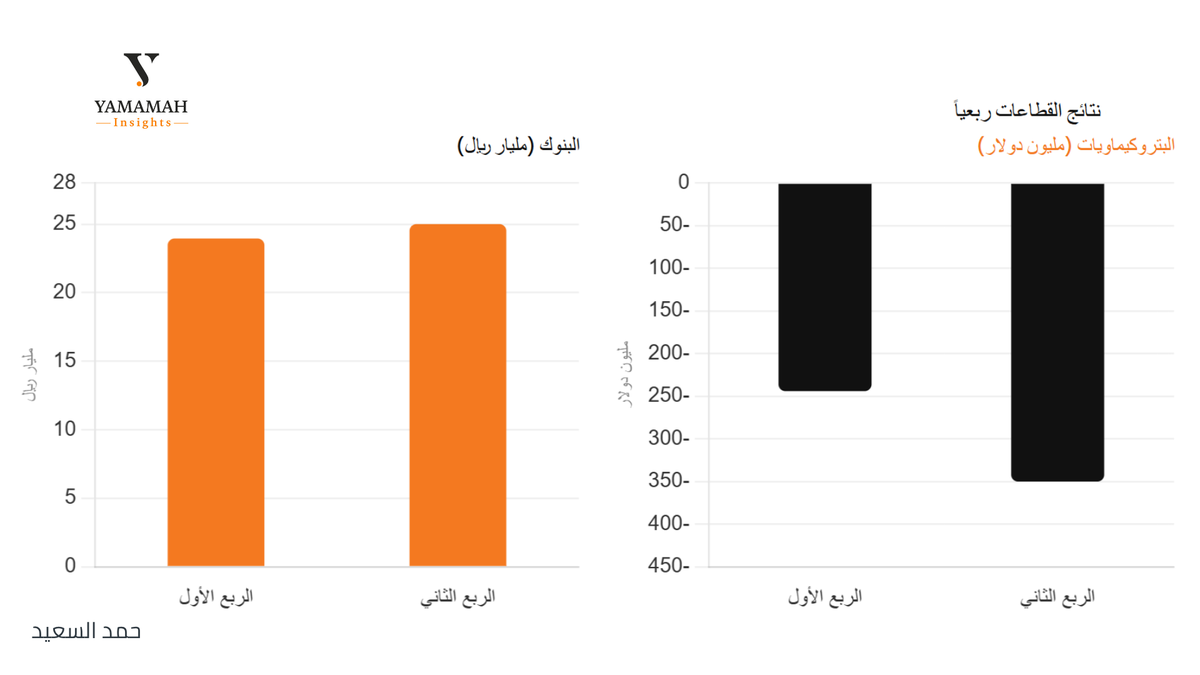
Financial and Economic Analyst "Hamad Alsaeed" @Hamad Alsaeed concluded the discussion with his comment:
The financial scene for the second quarter of 2026 will reflect a sharp sectoral sorting that redraws the concentration map, as this quarter has witnessed significant political and economic events.
It is expected that the petrochemical sector will be the most affected in this cycle, with expectations of its cumulative losses inflating to a range of 300-350 million dollars. The sector has been at the center of logistical tensions for two and a half months, rising costs of alternative land shipping, and pricing of feedstock above 100 dollars for most of the quarter, amid ongoing Asian demand stagnation.
Conversely, the energy sector has proven its efficiency as a structural hedge; with the infrastructure of the "East-West" pipelines operating at full capacity (7 million barrels/day), Red Sea loadings jumped to 4 million barrels. Despite crude collapsing from a peak of 140 dollars in April to 73 by the end of June, the record expansion in refining and downstream margins absorbed the shock of fluctuating direct export revenues.
Locally, the consumption and services sectors formed a safe haven for liquidity, supported by the complete overlap of the Hajj season within the quarter. This, in turn, injected direct returns nearing 10 to 15 billion dollars for 1.707 million pilgrims, enabling operational sectors to pass on inflation and absorb cost shocks with high efficiency.
Banking-wise, the burden of financing costs continues to pressure net interest margins. Accordingly, we expect a slowdown in the growth rate of lending portfolios to fall below last year's levels (17%), stabilizing the expected growth of cumulative profits for the banking sector between 4% and 7%, recording about 24.5 to 25.5 billion riyals.
 Ask Yamami
Comments (7)
No comments yet. Be the first to comment!