

Saudi Exchange announced its approval of the request submitted by the Ministry of Finance to list government debt instruments from a previously listed category, with a total value of SAR 5,349,001,000.
This step follows previous issuances and complies with the approved Listing Rules, reflecting the government's continued efforts to manage public debt effectively and provide diverse investment options that help deepen the local sukuk and bond market and enhance its liquidity.
Al Yamamah University students discussed the economic and financial dimensions of this additional listing and its implications for the local market, as follows:
Building a Benchmark Yield Curve and Improving Financing Cost Efficiency
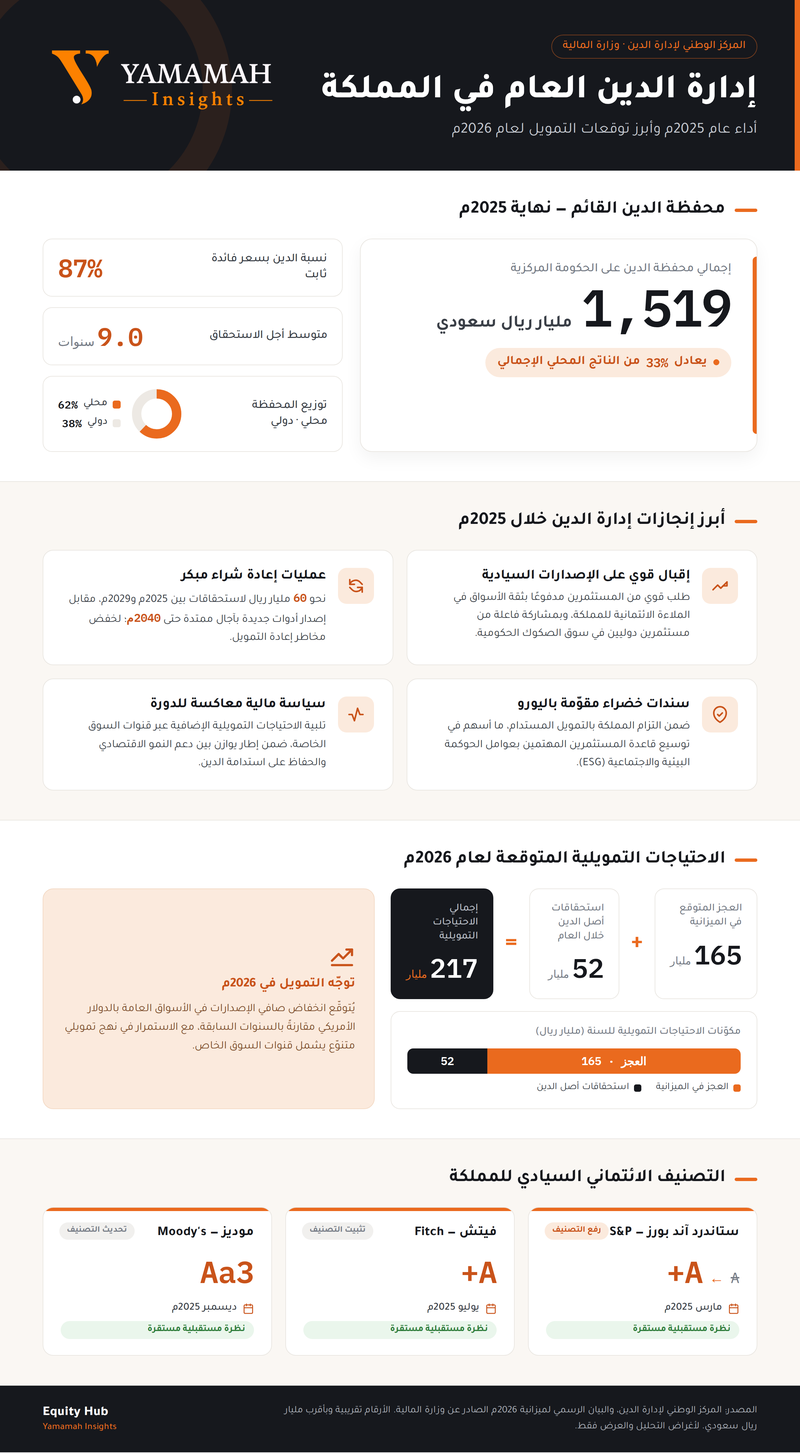
Student @Fahad Al-Tayeb explained that the Kingdom does not use debt instruments solely to cover deficits, but also to manage and diversify its financing structure and build a benchmark yield curve for the domestic market. He noted that with the improvement in the credit rating to A+ and the stability of the debt ratio, financing costs have become more efficient.
He expected that if the Federal Reserve raises interest rates, required yields would rise and liquidity would move into fixed-income instruments, emphasizing that the strength of the Kingdom's financial position limits the impact on debt sustainability.
Protecting Debt Costs and the Impact of Interest Rates on the Secondary Market
Student Rana Al-Shamrani @Rana Alshamrani highlighted a key point, noting that 87% of Saudi Arabia's debt carries fixed interest rates, which protects against an increase in the cost of existing debt. She added, however, that this does not protect sukuk prices in the secondary market, explaining that if a long-term sukuk with an average maturity of 9 years is sold before maturity, its price will fall if interest rates rise, even if the coupon remains unchanged.
Liquidity Flows and the Impact of Yields on the Stock Market
Student Rimas Al-Mashali @Rimas Almashali explained that if debt instrument yields rise, part of the liquidity is expected to move from the stock market into these instruments, as they offer higher returns with lower risk, which could weigh on stock market performance in the short term.
Financing Efficiency and the Appeal of Fixed Returns to Investors
Student @Shahad Al-Mohaysen believed that sukuk and bonds represent an effective financing tool that provides the liquidity needed for projects without affecting the ownership structure.
She added that the diversity of debt instruments enhances market efficiency, noting that higher interest rates increase the attractiveness of returns, prompting investors seeking fixed returns and lower risk to shift their liquidity away from equities.
Return on Investment as a Determinant of Borrowing Sustainability
Student Ghadah Al-Wallan @Ghadah Alwallan stressed that what matters most is not the size of the issuance, but rather how the funds are used.
She explained that if the funds are used for projects that boost future growth and revenues, debt will become a means of creating value.
She considered the most important indicator to be whether the investment generates a return higher than the cost of debt, ensuring borrowing sustainability over the long term.
Diversifying Financing Sources and the Role of Credit Ratings in Reducing Costs
Student Mohammad Al-Ghaihab @Mohammad Alghaihab considered the issuance aimed at providing financing for government projects and diversifying financing sources, explaining that a higher credit rating strengthens investor confidence and lowers the cost of borrowing.
He noted that higher interest rates increase the yields of new issuances and lower the prices of existing ones, attracting liquidity from the stock market in search of higher returns.
The Inverse Relationship Between Interest Rates and the Value of Existing Issuances
Student Khalid Waleed @khalid waleed described the relationship between interest rates and debt instrument prices as a seesaw with an inverse relationship.
He explained that if the Federal Reserve decides to raise interest rates, new issuances will be offered with higher and more attractive yields, putting pressure on the prices of older sukuk and reducing their market value so that their yields can be adjusted to become competitive with new issuances.
Containing Inflation and Redirecting Liquidity Toward Safe Havens
Student Jumana Al-Shehri @Jumana Alshehri addressed additional aspects, explaining that debt instruments help withdraw part of the liquidity, which helps ease inflationary pressures. She linked the credit rating to the strength of the economy, noting that higher interest rates raise the yields of new issuances and lower current prices, directing liquidity toward lower-risk debt instruments at the expense of the stock market.
Anticipating Volatility and Sustainable Financing for Vision Projects
In an analytical reading of public debt performance, financial and economic analyst Hamad Al-Saeed @Hamad Alsaeed said that the Tadawul announcement of the listing of government debt instruments from a previously listed category directly enhances trading liquidity and deepens the secondary market.
This step comes as markets await the meeting of the Federal Reserve Board tomorrow, July 29, 2026, as the Kingdom seeks to anticipate any volatility in the cost of global borrowing.
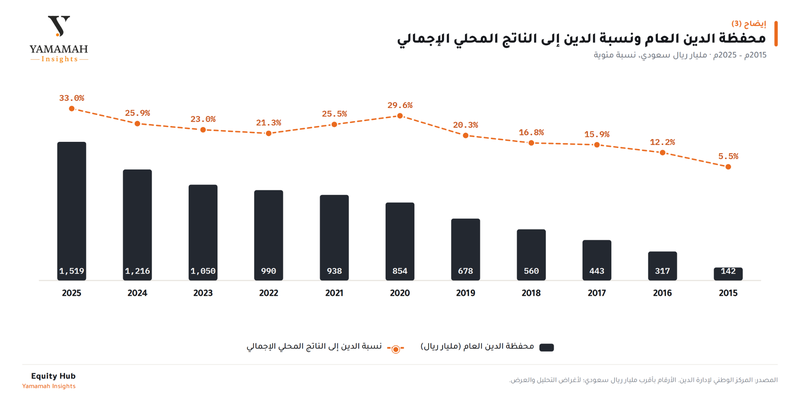
The step aims to manage the public debt portfolio, which stood at SAR 1.667 trillion at the end of the first quarter of 2026, with a debt-to-GDP ratio of approximately 33%, one of the lowest among the G20 countries.
This framework supports maintaining the Kingdom's high credit ratings at (Aa3) from Moody's, with a stable outlook, and (A+) from Fitch, helping protect the pricing of sovereign issuances.
This step helps reduce duration risk in the portfolio's average maturity and secures sustainable financing channels for the substantial capital expenditure requirements of the major Vision 2030 projects (such as NEOM, New Murabba, and the Riyadh Metro).
It also maintains the pricing spread needed to attract foreign investors to international debt issuances and supports the approved annual borrowing plan for 2026, amounting to SAR 217 billion, to cover the deficit and finance the economic transformation without putting pressure on government reserves.
Disclaimer: This material was prepared under the supervision of an editor at “Yamamah Insights” with the assistance of artificial intelligence tools for financial education purposes. It does not constitute a recommendation to buy, sell, or hold any security, and reflects the views of its contributors rather than those of the platform.
 Ask Yamami

Comments (4)
No comments yet. Be the first to comment!