
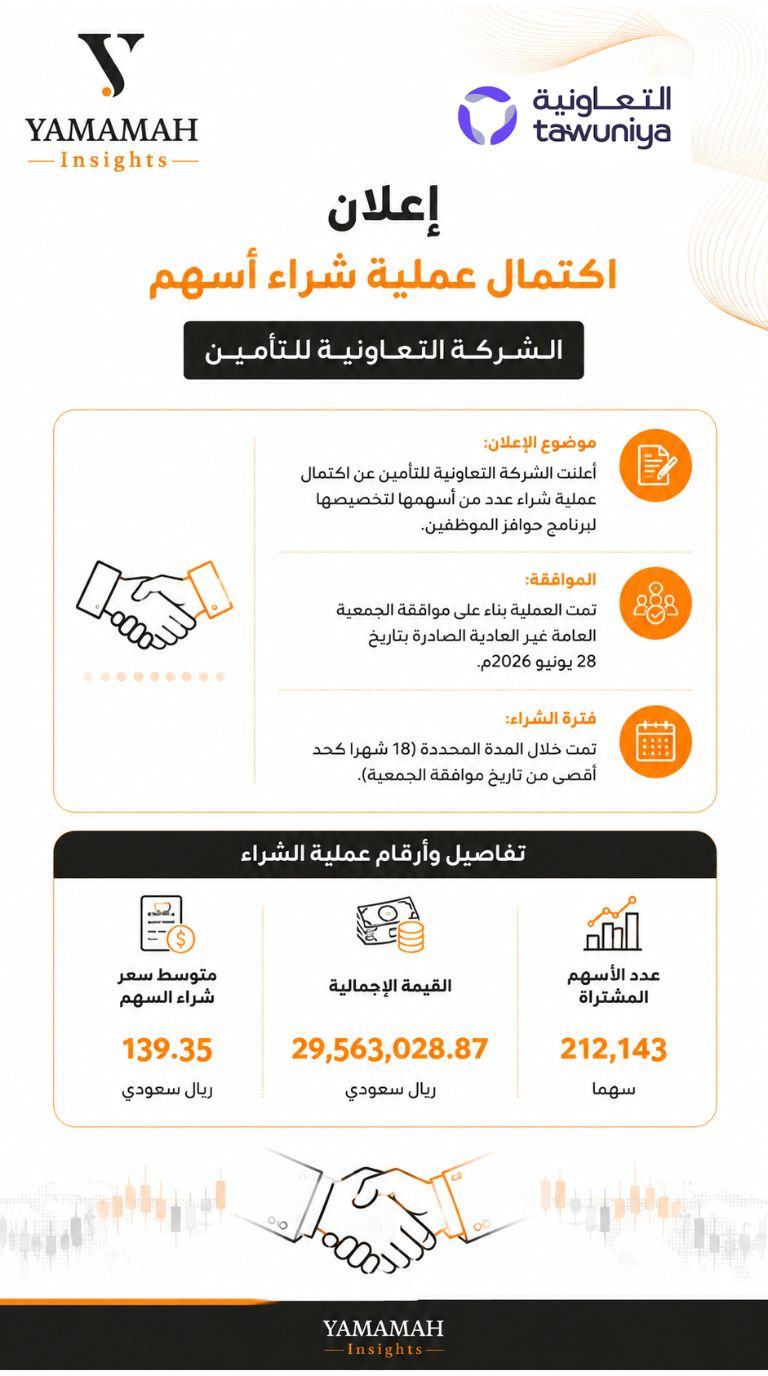
The Cooperative Insurance Company announced the completion of the purchase of a number of its shares allocated to the Employee Incentive Share Program, based on the approval of the Extraordinary General Assembly held on June 28, 2026.
This strategic step comes as part of the company’s efforts to strengthen employee loyalty, attract and retain talent, by linking employee objectives to the company’s financial performance, thereby contributing to the creation of added value for shareholders in the financial market.
Students from Al Yamamah University discussed the managerial and financial dimensions of this move and its implications for the work environment and the company’s performance, as follows:
Linking management and employee interests to performance to create sustainable value
Student Mohammad Alghaihab @Mohammad Alghaihab explained his perspective, saying: "In my view, the Cooperative’s share buyback to support the Employee Incentive Share Program reflects an approach aimed at linking management and employee interests to the company’s performance.
When eligible employees are granted shares in the company, part of their compensation becomes linked to share performance and growth in the company’s value, rather than relying solely on cash incentives.
This type of incentive can be more effective over the long term because it gives management a stronger motivation to make decisions that increase profitability and preserve the company’s value, particularly when the shares are linked to a vesting period or specific performance targets.
However, in my view, the key issue here is the share grant mechanism. If it is linked to actual and sustainable performance, it is a good tool for aligning managers’ interests with those of shareholders. But if shares are granted without clear performance conditions, they may become more of a cost to shareholders than an incentive for them."
Aligning employee and shareholder interests to support long-term growth
Student Abeer Altuwaijri @Abeer Altuwaijri shared her view, explaining: "In my view, the Cooperative’s decision to purchase shares under the Employee Incentive Share Program is a positive step in the long term because it strengthens employees’ connection to the company’s performance and makes their interests more closely aligned with those of shareholders, particularly when incentives are tied to the achievement of specific targets.
Although purchasing shares worth approximately SAR 29.5 million leads to a decrease in liquidity and shareholders’ equity from an accounting perspective, the impact is not necessarily negative if the company has strong liquidity and the ability to meet its obligations.
I also believe that these programs may be more effective than cash incentives in retaining talent because they encourage employees to focus on the company’s growth and value over the long term, rather than only on a short-term reward."
The accounting impact as an investment to enhance future performance
Student Sultan bin Saidan noted: "In my view, the impact of the buyback will appear in the financial statements primarily through a decrease in cash or available investments and the recognition of the purchased shares as treasury shares within equity. Consequently, total shareholders’ equity may decline. However, if these shares are later used under the Employee Incentive Share Program, the positive impact may be reflected in aligning employee interests with the company’s long-term performance."
The quality of vesting conditions as a measure of incentive program success
Student Rana Alshamrani @Rana Alshamrani added: "I believe the most important point here is distinguishing between the cash impact of the purchase and the accounting cost of the incentive program.
The SAR 29.5 million was actually paid from the company’s liquidity when the shares were purchased, while being recorded as treasury shares within equity; it was not an immediate expense on the income statement.
The impact on profitability appears through share-based compensation expense under IFRS 2 during the vesting period. Therefore, the more important question is not only the size of the program’s cost, but also the quality of the vesting conditions themselves: Do they link employees’ receipt of shares to performance and the creation of long-term value for shareholders, or do they rely primarily on mere continued employment?
Here, the program can be assessed in practice as a tool for achieving greater alignment between employee and shareholder interests, rather than merely as an incentive to retain talent."
Balancing financial liquidity with the benefits of attracting talent
Student Rimas Almashali @Rimas Almashali affirmed: "I think the buyback is generally positive here because it is tied to the Employee Incentive Share Program, which may help the company attract and retain talent.
From a financial perspective, the direct impact on liquidity and shareholders’ equity needs to be considered against the long-term benefit of motivating employees."
Productivity and employee loyalty versus the cost of purchasing shares
Student Ghadah Alwallan @Ghadah Alwallan concluded the analysis by saying: "I believe linking the share buyback to the Employee Incentive Share Program is a good step because it strengthens employees’ connection to the company’s performance and long-term success.
The important thing is for the impact of these incentives on talent retention and productivity to outweigh the cost of purchasing the shares."
Limited financial impact and a strategic step to motivate talent
In an analytical review of the company’s performance, financial and economic analyst "Hamad Alsaeed" @Hamad Alsaeed explains: The Cooperative’s completion of the purchase of employee incentive shares at a cost of SAR 29.56 million for 212.14 thousand shares represents a management commitment to the authorization granted by the General Assembly, rather than an intervention in the share price.
What merits attention is that the capital impact is limited given the size of the transaction. The amount does not exceed approximately 4.8% of the first-half net profit of SAR 609.8 million, and the purchased shares represent only about 0.14% of the weighted average number of outstanding shares, which stands at 149.6 million shares. This makes their effect on earnings per share positive but marginal through a reduction in the denominator.
In this context, it should be noted that treasury shares are deducted from equity and are not treated as an asset. Accordingly, the difference between the average purchase price and the current market price "as of the date this article was prepared," which was approximately SAR 145.60, does not pass through the income statement, while the program cost is recognized gradually over the vesting period in accordance with the International Financial Reporting Standard.
The value of the event is expected to remain primarily in its motivational dimension, linked to the Cooperative’s 2030 strategy, particularly after first-half profits declined by 16.2% despite written premiums growing by 21.5% to SAR 14.5 billion.
Disclaimer: This article was prepared under the supervision of a Yamamah Insights editor and with the assistance of artificial intelligence tools for financial education purposes. It does not constitute a recommendation to buy, sell, or hold any security, and it expresses the views of its authors, not those of the platform.


Comments (0)
No comments yet. Be the first to comment!