

Dr. Sulaiman Al Habib Medical Group announced its preliminary financial results for the period ended June 30, 2026 (the first half), recording notable revenue growth accompanied by moderate net profit growth as a result of operating costs associated with new expansions.
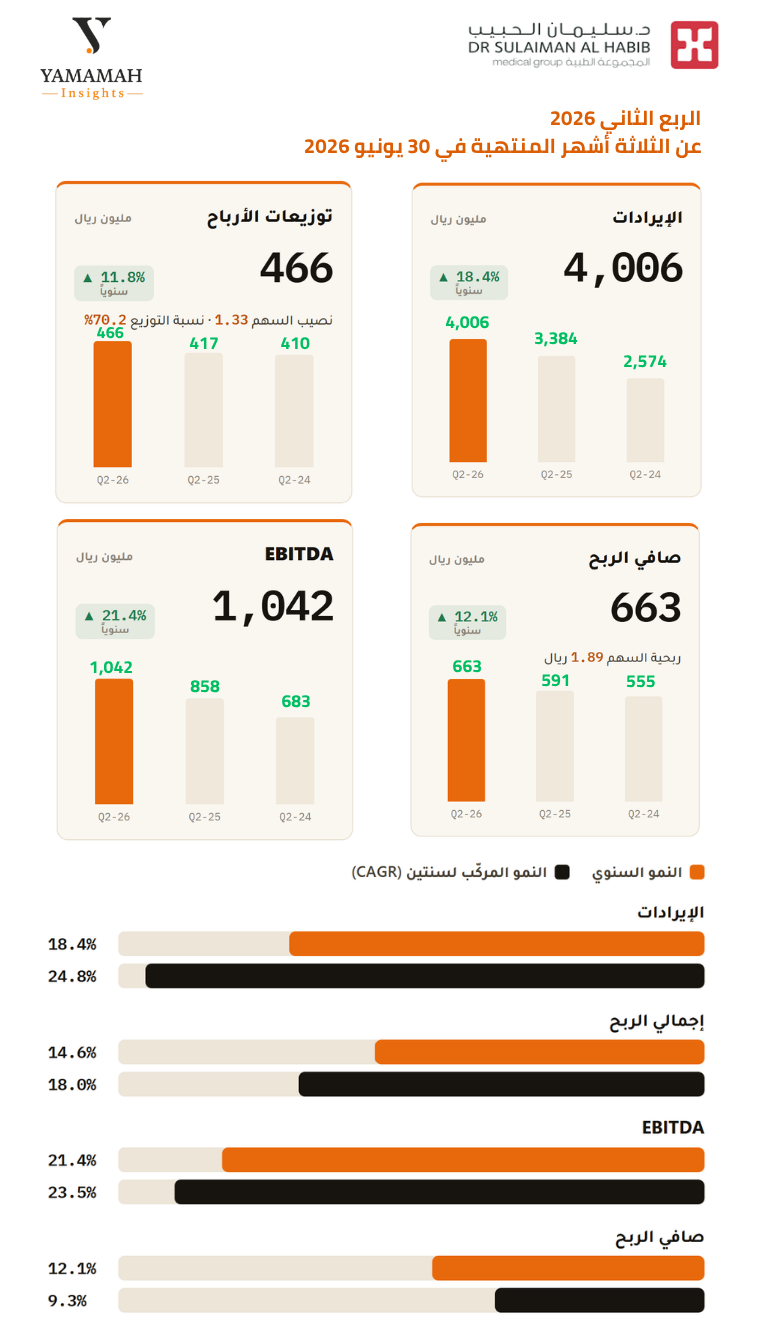
In terms of financial performance, the group’s revenue jumped in the second quarter by 18.38% to exceed SAR 4 billion (SAR 4,006.45 million), contributing to an increase in total first-half revenue to SAR 7.44 billion, a growth of 13.76%.
This performance was reflected in second-quarter net profit, which grew by 12.12% to reach SAR 662.66 million. In contrast, six-month net profit growth was moderate at 1.56%, reaching SAR 1.16 billion compared with the same period of the previous year.
The group attributed the increase in revenue primarily to higher patient numbers and occupancy rates in the hospitals sector, and its positive impact on pharmacy-sector sales growth, in addition to higher revenue from the solutions segment.
The company explained that the continued moderate pace of net profit growth during the first half was due to the impact of fixed operating costs at hospitals that recently entered service as part of the group’s strategic expansion network. These projects remain in the operational ramp-up phase (accelerating operational growth), while their contribution to revenue continues to increase gradually toward optimal utilization of the added operating capacity.
Students from Al Yamamah University discussed the implications of these results and their financial and operational impact on the company’s trajectory, as follows:
Healthcare Expansion and Cost-Coverage Efficiency
Student "Rimas Al-Mashali" @Rimas Almashali began the analysis by saying: "I believe that revenue growth compared with the limited increase in net profit reflects the fact that the company is still bearing the operating costs of new hospitals before they reach optimal operating capacity, which is a natural phase in healthcare expansion.
The increase in second-quarter profit also indicates improved patient numbers and more efficient coverage of fixed costs after the seasonal factors affecting the first quarter had ended.
Looking ahead, the positive impact of the expansion is expected to become clearer in profits and margins as occupancy rates rise and new branches contribute more to revenue."
Investment and Expansion Phase
Student @شهد المحيسن added: "The results indicate that the company remains in an investment and expansion phase rather than a profit-maximization phase.
The increase in revenue confirms the strength of demand, while operating expenses at new branches weighed on net profit. This is normal in the early stages.
If these branches reach their operating capacity in the coming periods, margins are expected to improve and the expansion should have a clearer impact on earnings per share."
Investing in Long-Term Growth
Student @فهد الطيب shared his view, saying: "What stands out in these results is the continued revenue growth despite higher operating expenses, indicating that the company is investing in a long-term growth trajectory.
The key point in the next phase will be to monitor the extent to which profit margins improve as new branches reach operational maturity."
Return on Investment and Long-Term Value
For her part, student "Ghadah Alwallan" @Ghadah Alwallan highlighted returns, saying: "It is important not to focus only on revenue growth, but also on the return generated by the expansion.
If the company continues opening new hospitals, the more important question is whether these branches, once they achieve operational stability, can generate a return exceeding the cost of investment in them. The success of expansion is measured by its ability to create long-term shareholder value, not merely by the number of branches."
Revenue Growth and the Temporary Impact of Expansion
Student "Fay Al-Dosari" @Fay Aldossari contributed a detailed analysis, saying: "Revenue growth of 13.8% reflects good demand, but operating expenses at new branches, such as salaries, maintenance, and depreciation costs, affected part of first-half profit.
I believe this phase is temporary and natural in the hospital sector, where fixed expenses begin at a high level from day one, while building a patient base takes time before a branch reaches its full capacity.
As for the difference in performance between the two quarters, the weaker first-quarter performance was due to seasonal factors such as Ramadan and holidays, while the increase in the second quarter represents the return of patient flows to complete postponed appointments.
The integration between the group’s segments is also evident here. A patient’s visit to a hospital leads directly to referrals to the pharmacy and solutions segments, increasing sales without the need for additional marketing expenses and accelerating cost coverage.
New branches typically need one to two years to reach full operations. Once a branch covers its fixed expenses and reaches break-even, any additional revenue will flow directly through to net earnings per share in future periods."
Core Business Strength and Cost Absorption
Student "Mohammad Alghaihab" @Mohammad Alghaihab commented: "What is notable about the results is that the company achieved profit growth despite higher operating expenses at new hospitals, demonstrating the strength of its core business and its ability to absorb costs.
If the expansion reaches full operating capacity, this is expected to have a greater impact on net profit."
Operating Margin Indicators and Financing Costs
In a detailed analysis of the financial statements, student "Rana Alshamrani" @Rana Alshamrani said: "It is notable that second-quarter growth in earnings before interest, taxes, depreciation, and amortization (EBITDA) was very close to the pace of revenue growth, which means that the operating margin is actually improving.
Accordingly, the real pressure on net profit is not necessarily due to the operating costs of new branches, as is generally assumed. If that were the case, its impact would have appeared directly in EBITDA.
This gap points to pressures below that line, represented by depreciation and amortization (D&A) and financing costs associated with capital expansion.
More importantly, the two-year compound annual growth rate (CAGR) clearly shows that net profit is growing at a much slower pace than revenue, reflecting an ongoing erosion in profit margins that has persisted for a longer period, rather than being merely a passing seasonal effect."
Asset Utilization Efficiency and Operating Costs
Student @تينا عزي added: "The expansion through opening new hospitals initially raises operating costs because of building preparation, operation of medical systems, and recruitment of personnel before full operating capacity is reached. Therefore, it is natural to see revenue grow faster than net profit at this stage.
As occupancy rates rise in the coming periods, asset utilization efficiency is expected to improve and operating costs per patient to decline, which will have a positive impact on profit margins in the future."
Segment Integration and Growing Demand
Student "Jumana Al-Shehri" @Jumana Alshehri commented on the analysis: "The company’s results reflect good growth. The 13.8% increase in revenue indicates rising demand for its services, while profit growth was limited by the operating costs of new branches, which is normal during an expansion phase.
The increase in second-quarter profit compared with the first quarter was also likely due to the end of seasonal factors such as Ramadan and holidays.
In addition, the integration of the company’s segments—hospitals, pharmacies, and healthcare solutions—contributes to higher revenue and enables the same customer to use multiple services, improving operational efficiency.
As new branches reach operating capacity and their expenses stabilize, the results of the expansion will have a clearer impact on earnings per share in the future."
A Look at the Stock Valuation and P/E Ratio
Student "Mohammad Alabdullah" @محمد العبدالله added another dimension to the discussion, saying: "With the major expansion plans and ambitions, an important question remains for investors: Does the current share price reflect all these positive expectations? Looking at the P/E ratio, we can see that the stock is trading at levels above 30 times, a figure that reflects very high expectations for future growth. This does not mean that the stock is overvalued, but it does mean that any slight slowdown in executing the expansion or delay in raising occupancy rates could put pressure on the stock. Therefore, I believe the opportunity exists, but its success depends on management’s ability to achieve its stated objectives within a reasonable timeframe."
Phase-by-Phase Variation and Operational Ramp-Up
Student "Khalid Waleed " @khalid waleed concluded the students’ views by saying: "I believe the difference in growth rates between revenue and profit is the most important aspect of these results. Revenue growth of approximately 13.8% compared with limited profit growth is normal and expected given the new openings. The healthcare sector, particularly new hospitals, requires an operational ramp-up period. They bear fixed expenses and full salaries from day one, while patient demand and traffic build gradually. This variation is temporary, and once the new branches begin operating at full capacity, this revenue growth will translate directly and strongly into net profit."
Record Profits Supported by Operational Growth... Stock Moves Sideways
The financial expert "Abdulaziz Khrais" commented on the financial results, saying: "Dr. Sulaiman Al Habib Medical Group continued to dominate the healthcare sector and recorded its highest profit since the company was founded, amounting to SAR 662.6 million in the second quarter of 2026.
Profit also exceeded analysts’ average expectation of SAR 612 million, supported by growth in the hospitals and pharmacies segments as a result of increased patient numbers and higher occupancy rates, which contributed to the growth of the company’s sales and profits.
It is worth noting that the new hospitals recently opened by the company contributed to higher sales, although the resulting increase in costs put pressure on the profit margin.
As for the stock’s recent movement, it has not been favorable. It is trading near its price lows and has been moving sideways for two months between SAR 210 and SAR 220. Any trading below these levels could lead to the stock revisiting its lowest levels since 2022."
An Analytical Reading of Margins and Profits
In an analytical review of the company’s performance, financial and economic analyst "Hamad Al-Saeed"@Hamad Alsaeed explains: The first-half results demonstrate the strength of the company’s operating performance, but they also clearly reflect the cost of its current expansion. Despite revenue growth of 13.8% and growth in earnings before interest and depreciation of 13.2%, with its margin remaining stable at approximately 25.5%—confirming the sustainability of the core business’s efficiency—net profit declined markedly, barely growing by 1.6%, accompanied by a margin decrease of approximately 190 basis points.
This pressure is mainly attributable to the group being at the peak of an expansion wave involving the opening of new hospitals that have not yet reached mature occupancy levels. These facilities place temporary pressure on margins until their revenue builds and they reach full operating capacity, as they bear fixed costs such as salaries and depreciation from day one.
This explains the first-quarter decline, higher depreciation, and bank financing costs. In reality, the pressure also affected operating profit itself, which declined by 6.1% despite revenue growth of 8.8%. First-quarter profit settled at SAR 503 million, its lowest level since the second quarter of 2023 and below the average forecast.
What we are seeing is merely a timing gap between capital expenditure and the realization of related revenue, not a demand crisis. The key indicator remains the net profit margin in the second half. If the new hospitals approach their target occupancy levels, depreciation burdens will be absorbed and profitability will return to growth. However, if pricing competition and pressure on occupancy rates in the private sector intensify, the pressures will persist. Naturally, the stock’s high valuation makes it highly sensitive to either of these scenarios.


Disclaimer: This material was prepared under the supervision of a Yamamah Insights editor with the assistance of artificial intelligence tools for financial education purposes. It is not a recommendation to buy, sell, or hold any security, and expresses the views of its contributors, not those of the platform.
 Ask Yamami

Comments (7)
No comments yet. Be the first to comment!