

The global financial and academic circles have witnessed a radical shift in the philosophy of responsible investing, following Princeton University’s official reversal of its 2022 commitment to fully divest from publicly traded oil and gas companies.
This shift represents not just a change in one investment portfolio, but reveals the depth of the structural crisis facing environmental, social, and governance (ESG) investment strategies in the face of market volatility and profitability targets.
The Economic Dilemma: The University’s Budget Under the Guillotine of Returns
Princeton University is classified as one of the wealthiest academic institutions globally, with its endowment fund valued at approximately $36.4 billion. However, the uniqueness of this fund lies in its role as the lifeblood of the university, covering 65% of its annual operating budget, a dependency ratio that far exceeds most Ivy League universities.
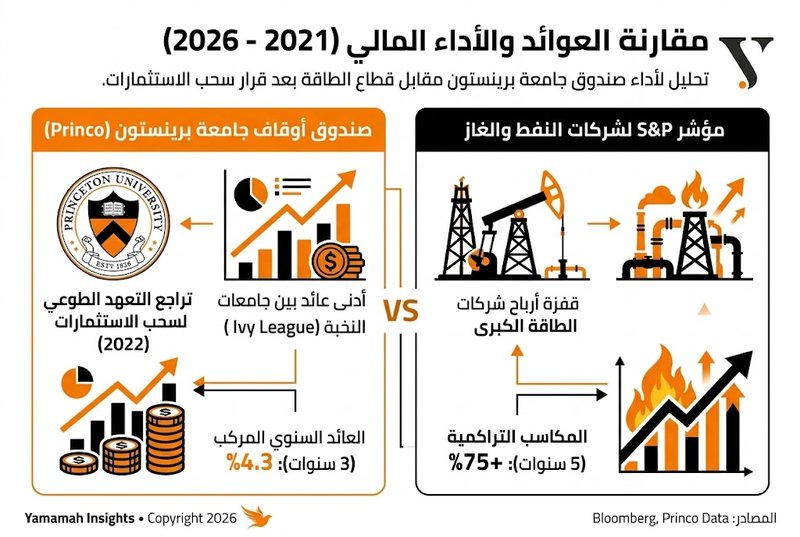
In recent years, the fund's management, known as "Princo", has faced severe financial pressures. According to Bloomberg, the fund's annualized return over three years has slowed to just 4.3%, the lowest among elite universities. This decline has been exacerbated by the university president's warnings of economic challenges and rising political pressures threatening the institution's financial stability.
The Concept of "Opportunity Cost" and the Boom in the Energy Sector
In economics, opportunity cost is defined as the value and lost gains resulting from choosing one investment alternative over another. This concept is key to understanding Princeton's decision.
While the university adhered to its voluntary decision to boycott the traditional energy sector for climate reasons, the oil and gas sector was experiencing an exceptional "profit boom". The S&P index for oil and gas production companies - which includes energy giants like Exxon Mobil and Chevron - achieved strong gains of 75% over the past five years.
This stark contrast placed the fund's management in front of a bitter numerical reality: the commitment to ethical boycott cost the fund billions in lost profits, at a time when the university needed every dollar to secure scholarships and fund scientific research.
Summary in Axios Style (The Big Picture)
Event: Princeton reverses its voluntary 2022 commitment to divest from oil and gas, while maintaining a ban on thermal coal and oilsands.
Immediate Reason: The fund's returns dropped to 4.3%, coinciding with a 75% profit surge in energy companies, threatening to fund 65% of the university's expenses.
Future Implications: A shift in the literature of ethical investment; the new administration sees oil and gas companies as key players in financing the transition to clean energy, rather than obstacles to it.
Redefining Climate Transition: Investment Flexibility
Recent statements from the new investment fund president, Vincent Tuohey, show a shift in the institution's pragmatic philosophy. Major energy companies are no longer viewed as "enemies of the climate", but as "partners in the transition".
The university confirmed that it remains committed to achieving a net-zero emissions investment portfolio by 2046, but it has changed its strategy to achieve this goal based on two pillars:
- Flexibility vs. Self-Imposed Constraints: Imposing prior constraints on the quality of stocks limits the fund manager's ability to seize profitable opportunities in tough times.
- Self-Funding Climate Research: Profiting from the traditional energy sector provides the university with the liquidity needed to fund climate change research and environmental innovation within its laboratories.
Despite this reversal, the university has maintained certain red lines; it continues to boycott thermal coal and oilsands, sectors internationally classified as the highest in carbon emissions and the most costly to extract, indicating that the university's reversal is carefully considered from both environmental and investment perspectives.
Beyond the News: Has the Era of ESG Ended?
Princeton University's decision marks a turning point that may be followed by other universities and endowment institutions. It reflects the end of the era of "comprehensive boycotts" and the beginning of the era of "conditional pragmatism". The global economy is rediscovering the reality that the transition to renewable energy requires trillions of dollars, and that this money cannot be generated by undermining current economic sectors, but rather by leveraging their strong returns to finance the energy of the future.

Comments (8)
No comments yet. Be the first to comment!