

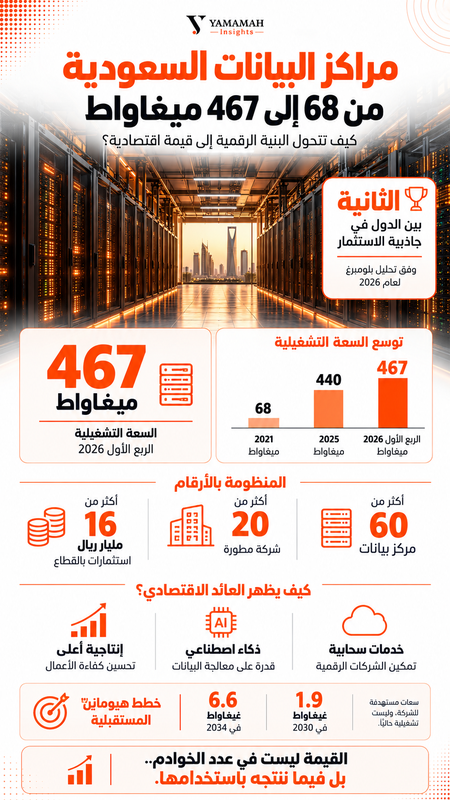
Saudi Arabia’s operational data center capacity rose from 68 megawatts in 2021 to 467 megawatts in the first quarter of 2026, alongside expanding investment in artificial intelligence and cloud computing. But the economic value of these centers is determined not by their size alone, but by their ability to empower businesses, boost productivity, and develop new digital services and products.
From server rooms to economic infrastructure
When we use a banking app, buy a product online, or turn to an artificial intelligence tool, part of the process takes place in a data center that may be hundreds of kilometers away.
These centers are more than places to store files. They are facilities housing servers, communications equipment, power systems, and cooling systems, enabling applications to run and information to be processed around the clock.
As the use of artificial intelligence expands, the ability to operate these centers efficiently has become an important factor in economic competitiveness, affecting the cost and speed of digital services and the scope for developing them locally.
What do the Saudi figures tell us?
The Kingdom’s operational data center capacity rose from 68 megawatts in 2021 to 440 megawatts in 2025, then reached 467 megawatts in the first quarter of 2026.
That means announced capacity is now around 6.9 times its 2021 level.
The Kingdom is also home to more than 60 data centers developed by over 20 companies, while announced sector investment has exceeded 16 billion riyals since the launch of Saudi Vision 2030.
These figures reflect the expansion of digital infrastructure, but do not necessarily imply a comparable increase in revenue or productivity: available capacity is not the same as the amount used or the returns it generates.
Why are data centers measured in megawatts?
A megawatt is a unit of electrical power equal to one million watts.
When a data center is said to have a capacity of 100 megawatts, this refers to the amount of power it can support, according to the definition used for the measurement.
The figure may refer to the power allocated to IT equipment or to the facility’s broader power capacity. That is why it is important to understand how capacity is calculated when comparing projects.
But electrical capacity is not directly equivalent to computing capacity.
Two centers with the same electrical capacity may differ in the number of operations they can perform, depending on their processors, equipment efficiency, cooling, and the applications they run.
So, a rise in capacity measured in megawatts indicates infrastructure expansion, but is not enough on its own to show the actual volume of computing output.
Why has Saudi Arabia become an attractive market?
In March 2026, BloombergNEF published an analysis of data center markets highlighting the importance of access to electricity and suitable land for these projects.
Together, these two factors accounted for 58% of the weighting used to assess market attractiveness.
Saudi Arabia ranked among the leading markets in the analysis, supported by the availability of energy and land for expansion.
This ranking does not measure the number of existing data centers or their revenues; it assesses how suitable the market is for developing new projects.
This matters because data centers require substantial investment before they can begin operating, from buildings and power networks to equipment, cooling systems, and connectivity.
The more efficiently and competitively these fundamentals are available, the better the prospects for attracting investors and digital service providers.
How do data centers create economic value?
Their impact can be understood through three channels.
First: enabling the digital economy. Data centers make cloud services possible, allowing businesses to use software, storage, and computing power over the internet instead of buying all the equipment and running it on their own premises.
This can lower the cost of starting a technology business and help small companies access tools that would otherwise require substantial capital investment.
Second: supporting artificial intelligence and industry. Artificial intelligence applications require large volumes of data to be processed. Industrial companies can use these applications to monitor equipment, predict failures, and improve inventory management.
For example, if a factory can detect signs that a machine is about to fail before it breaks down, it may reduce production downtime and maintenance costs.
But this benefit does not come from building a data center alone. It requires suitable applications, reliable data, and skilled people who can use them.
Third: creating new businesses and services. Computing infrastructure can help local developers and companies create digital software and solutions that can be sold in Saudi Arabia and abroad.
The economic value therefore extends beyond spending on building and operating data centers to include revenue from products and services that use their infrastructure.
From 467 megawatts to gigawatts: What are the plans ahead?
One gigawatt equals 1,000 megawatts.
As artificial intelligence applications expand, companies operating in the Kingdom have announced plans to build capacity far beyond current operational levels.
One of the most prominent is HUMAIN, owned by the Public Investment Fund. Its announced plans include developing capacity of around 1.9 gigawatts by 2030, rising to 6.6 gigawatts by 2034.
These are target figures in the company’s plans, not capacity already brought online. They should not be added mechanically to other projects without checking for overlap.
Is funding alone enough to build these data centers?
Data centers require substantial investment in construction and fit-out, as well as access to electricity, cooling systems, and connectivity.
In August 2026, consulting firm Alvarez & Marsal estimated that a scenario involving the operation of nearly half the announced capacity in sector projects by 2030 could require capital expenditure of between $28 billion and $42 billion.
This estimate is conditional on the expansion scenario being realized. It is not money already invested or a total loan amount that must be secured.
Nor does securing funding guarantee a project’s success. Investors need real commercial demand, contracts that secure future revenue, and the ability to operate the center efficiently.
What are the challenges?
As data centers expand, managing electricity consumption and cooling becomes increasingly important, especially as artificial intelligence systems place greater demands on infrastructure.
Other challenges include securing advanced processors, developing specialized talent, protecting data, and attracting customers who can put new capacity to economically viable use.
If operational capacity expands faster than actual demand, companies may bear the cost of facilities and equipment that do not deliver the expected commercial returns.
Conversely, limited capacity may constrain companies’ ability to develop new services or expand their use of artificial intelligence.
The sector’s efficiency is therefore measured not by capacity alone, but by how much of it is used, its cost, and the quality of the services it supports.
When does data become a source of wealth?
Data centers can be compared to ports.
Building a new port increases the capacity to receive ships and cargo, but it does not guarantee more trade or higher profits unless businesses use it and economic activity benefits from it.
Likewise, building new data centers gives the economy advanced technology infrastructure. But value is created when factories, banks, companies, and developers use it to cut costs, improve productivity, and deliver new services and products.
The key question is whether Saudi Arabia can turn the expansion of data centers into growth in local companies, skills, and digital products.
What matters is not the number of servers brought online, but what is produced using them.

Comments (6)
No comments yet. Be the first to comment!