

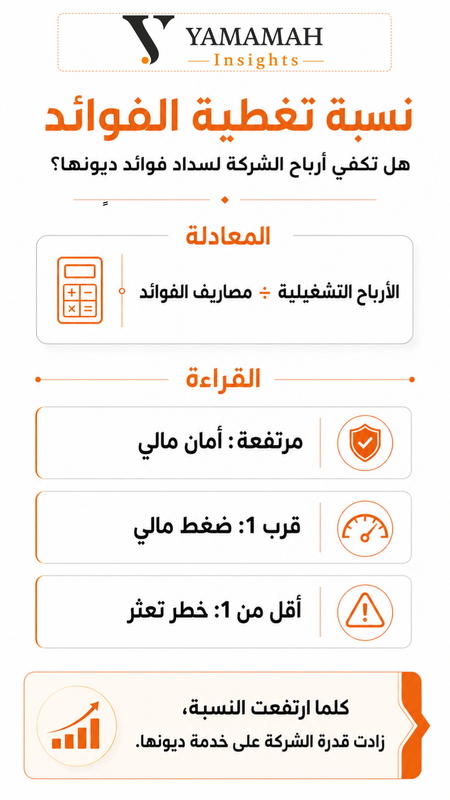
In the world of corporate finance, a company's success is not only measured by the size of its profits but also by the strength of those profits and their ability to shield the company from "debt burdens." Here, the "Interest Coverage Ratio" emerges as a fundamental "financial safety measure" that determines how many times a company's operating profits can cover its bank interest expenses before tax payments.
Illustrative Example: If a company has operating profits of 100 million riyals and bank interest expenses of 20 million riyals, the ratio equals 5 times.
This means that its profits are sufficient to cover its interest 5 times, providing a very comfortable safety margin.
How do banks and investors interpret this indicator?
The financial condition of the company is determined based on the outputs of this ratio across three main levels:
- High Ratio (Financial Safety):
Reflects the strength of the financial position and the company's high ability to meet its obligations to lenders without compromising its operational liquidity. - Approaching the number (1) (Financial Pressure):
Indicates that the company barely covers its debt interest, and any slight decline in profits could lead it into a liquidity crisis. - Less than (1) (Risk of Default):
A red alarm; the company does not generate enough profits to cover the interest, forcing it to spend its own cash or borrow again to pay the interest, which is an unsustainable path that ends in financial default. - Negative Ratio (Operating Deficit):
Occurs when the company incurs operating losses from the outset, meaning that financing burdens exacerbate its losses and push it towards a severe solvency crisis.
Why is this ratio considered the "first filter" for financing?
Banks and financial institutions do not like to lend to companies that consume all their profits to cover previous loan costs. Therefore, the Interest Coverage Ratio represents a "measure of borrowing efficiency" and the primary tool that determines debt capacity; through it, lenders decide whether the company is eligible for additional financing or if it has already reached its maximum limit.
 Ask Yamami

Comments (6)
No comments yet. Be the first to comment!