

Many people wait for a "large amount" to start saving, then they are surprised that large amounts—like bonuses—evaporate quickly if there is no system. The pivotal idea: Saving is a regular behavior that builds security, while money without behavior disappears without a trace. Therefore, the power is not in the number, but in consistency and discipline.
An infographic that explains why the "amount" might deceive you if it comes without a system, and how to make saving happen automatically through simple rules that protect you from financial leakage and build an emergency fund step by step.
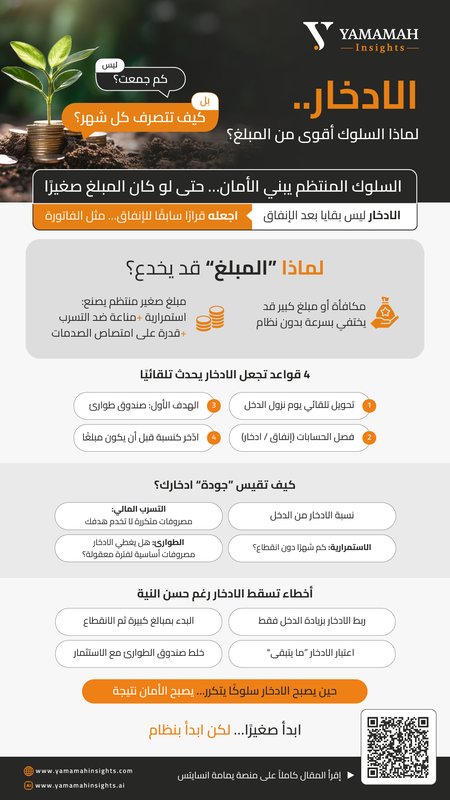
To make saving "automatic" read it through 4 clear rules:
Automatic transfer on payday: Make saving the first operation… not the last.
Separate accounts (spending/saving): So intentions don't get confused with expenses.
First goal: emergency fund: Because it absorbs shocks before they disrupt your budget.
Save as a percentage before it becomes an amount: The percentage teaches you to continue no matter how your income changes.
Then assess your "saving quality" with realistic questions: Do you have a fixed percentage? How many months have you continued without interruption? Is financial leakage preventing you? And does your savings cover basic expenses for a reasonable period?
When saving becomes a behavior that repeats… security becomes the result.
 Ask Yamami
Comments (10)
No comments yet. Be the first to comment!