

Gold prices are on track to record a significant weekly decline as investors assess renewed tensions in the Middle East and the prospects of sustained high inflation, which may force the US Federal Reserve to keep interest rates "higher for longer." The prices of the precious metal have dropped to trade below $4,100 per ounce, affected by technical pressures and outflows from exchange-traded funds, solidifying gold's losses that have exceeded 20% since the peak historical highs witnessed in the first quarter of the year.
The Fed and the Inflation Dilemma: The Era of Kevin Warsh and AI Pressures
The current pressures on gold come at a sensitive time when US monetary policy is undergoing significant shifts; the minutes from the latest Federal Reserve meeting revealed that some policymakers see strong justification for raising interest rates rather than lowering them, despite a temporary hold. Futures traders are now pricing in a sharp upward probability for a rate hike by the September meeting, reaching about 68.8%, and exceeding 81% for December, especially after renewed oil tensions and concerns about the impact of energy prices on core inflation, according to the CME FedWatch tool.
In this context, the new Federal Reserve Chair, Kevin Warsh, announced the formation of five working groups to review areas of monetary policy. Highlighting emerging challenges, the President of the Federal Reserve Bank of New York, John Williams, stated that he is closely monitoring "inflationary demand related to the technological boom and artificial intelligence," warning that sustained demand could push interest rates to higher levels, increasing the opportunity cost of holding gold as a non-yielding asset.
Major Banks Lead the Broadest Wave of Forecast Cuts for 2026
This combination of high interest rates and a strong US dollar (DXY) has forced major global financial institutions to rebuild their economic models and collectively cut their price targets for 2026 sharply:
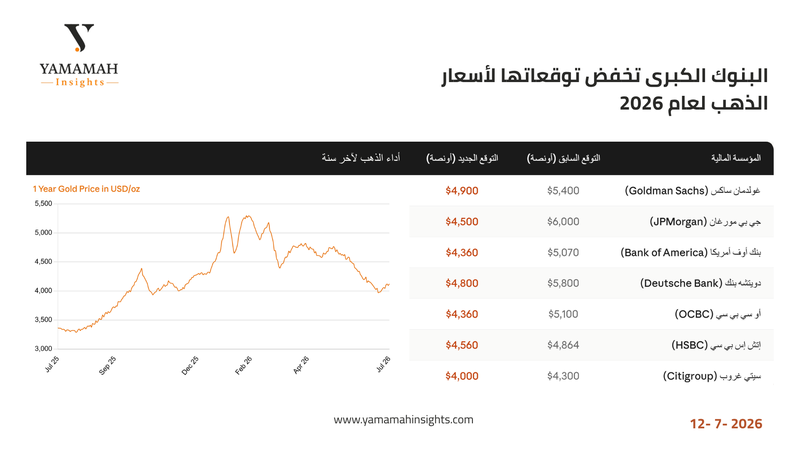
JPMorgan's Forecasts Decline by 25%
JPMorgan is leading these jewel-like transformations on Wall Street. After holding a highly optimistic astronomical view predicting the ounce would reach $6,000 for many months, analysts have officially downgraded their fourth-quarter 2026 forecasts by nearly 25%, settling on a new target of $4,500 per ounce. The bank attributed this downward adjustment to the market's excessive sensitivity to high real interest rates, alongside a slowdown in overall demand from some major sovereign and commercial buyers compared to the frenzied rush at the beginning of the year.
Goldman Sachs and Bank of America Join the Cautious Camp
Goldman Sachs has not been immune to this wave, as the bank's analysts have reduced their year-end 2026 price target from $5,400 to $4,900 per ounce. Although the bank still views gold as an excellent structural hedge in a high sovereign debt environment, it has called for a "cautious" approach in the short term due to the current downside risks surrounding price movements.
Similarly, revised data from other banking institutions showed similar reductions; Bank of America's target has dropped to $4,360 from $5,070 in previous models, while Deutsche Bank has adjusted its forecast down from $5,800 to $4,800.
Outflows from ETFs Pressure Critical Support Levels
The pressures have not been limited to adjustments by investment banks but have extended to the primary driver of investment liquidity, as gold-backed ETFs have experienced the broadest wave of liquidation and outflows in several months. Holdings in major global funds, led by the (SPDR Gold Shares), have declined, driven by intense selling from institutional investors who preferred to shift their liquidity towards cash funds and short-term bond yields to take advantage of the high interest rates offered by the Fed. This ongoing liquidity drain has weakened prices' ability to hold, depriving gold of the necessary momentum to rebound, making current technical support levels face a real test against selling pressures.
Return to Economic Realism
Ultimately, this scene transcends the language of dry numbers and charts to write a new chapter of "economic realism" that awakens markets from the euphoria of astronomical targets. The retreat of Wall Street giants and their acknowledgment of the harshness of high interest rates and the allure of the dollar, alongside the noticeable outflow of liquidity from traded funds, sends a clear message to the prudent investor: the days of emotional rush towards safe havens driven by fear are over—at least for now. We are now in a phase that requires careful and rational reading away from the noise of predictions, where tangible cash returns have become sovereign, and the precious metal will not regain its true luster and lost balance until US monetary policy decides to turn the page on strict tightening to write a new beginning.
 Ask Yamami

Comments (8)
No comments yet. Be the first to comment!