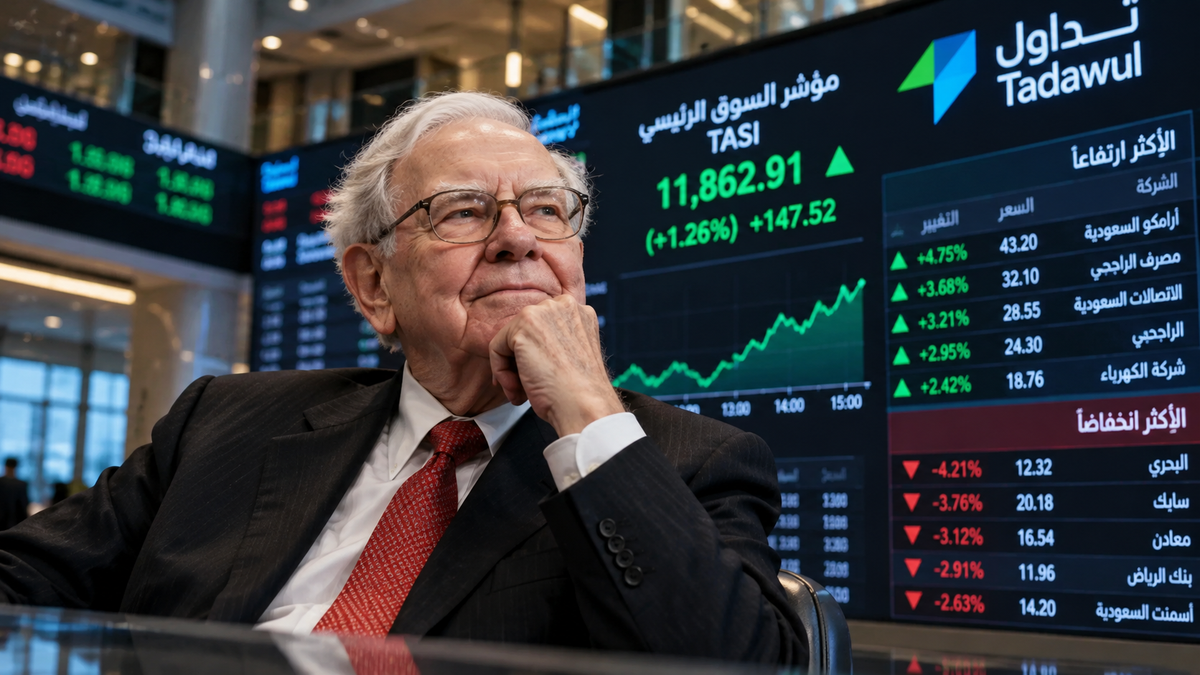

Imagine opening the Saudi stock market screen one morning and seeing the share price of a company you know well plunging.
The news is full of worry, red dominates the screen, and investors are wondering: Should I sell before it falls further?
This is where Warren Buffett might start with a different question:
Has only the share price fallen… or has the company’s value actually declined?
This idea lies at the heart of one of the best-known lessons in investing, known as “Mr. Market.”
Imagine the market as a moody person
American investor Benjamin Graham, Warren Buffett’s mentor, put forward a simple idea:
Imagine you have a business partner who comes to you every morning and offers either to buy your stake or sell you theirs.
But their mood is constantly changing.
One day, they’re extremely optimistic and demand a very high price. The next, they’re gripped by fear and willing to accept a low price.
The company itself may not have changed much.
What has changed is the partner’s mood.
That partner is Mr. Market.
Something similar happens in the stock market. Prices may rise on optimism and fall on fear, while a company’s underlying business does not change at the same pace.
This is where the difference between price and value comes in
On TASI, for example, a company may report good earnings and still see its share price fall.
Another company’s share price may rise even though its results have not improved by as much.
That’s because a share price reflects more than a company’s results. It is also affected by investor expectations, fear and greed, news, and the price level the market had already anticipated.
That’s why investors distinguish between two concepts:
Price: What you pay for a share right now.
Value: What you believe the company is economically worth, based on its business, earnings, and growth potential.
This is where the idea Buffett became famous for begins.
What did Buffett do with Coca-Cola?
After market turmoil in 1987, Buffett began buying shares in Coca-Cola in 1988.
But he didn’t buy simply because prices had fallen.
He looked at the company itself: a global brand, a product sold in many markets, and a business capable of generating earnings over many years.
In other words, he was less concerned with what had happened to the stock the day before and more interested in what the company might become years later.
That’s an important distinction.
Because a falling share price doesn’t automatically mean it’s an opportunity.
It may have fallen because the company is facing a real problem, its earnings are declining, or its debt has become too high.
So the lesson of “Mr. Market” isn’t: Buy every stock that falls.
It’s:
Don’t let price movements alone shape your opinion of a company.
Applying the idea to the Saudi market
The next time you see a TASI stock plunge, don’t start by asking:
How much did the stock lose today?
Ask different questions:
Have the company’s earnings changed?
Have its sales declined?
Has its debt increased?
Has its competitive strength weakened?
Or has the market’s mood been the main thing that changed?
These questions don’t mean the stock is worth buying, but they can help you separate the company from the screen showing its price.
And this may be the most important lesson in the “Mr. Market” idea:
The market offers you a price every day, but it doesn’t force you to buy or sell.
Sometimes, the best trade may be to do nothing.
Because the red on the screen tells you what happened to the price.
But to know what happened to the value, you need to look at the company itself.
 Ask Yamami

Comments (2)
No comments yet. Be the first to comment!