

In the corridors of Wall Street, a saying echoes today as it did in the late nineties: "This time, it's different." With artificial intelligence giants such as (OpenAI), (Anthropic), and (SpaceX/xAI) preparing to test public market appetite, investors and policymakers find themselves facing a real test of knowledge economy concepts. These anticipated IPOs are not merely capital-raising operations; they represent an attempt to price "algorithmic intelligence" as a strategic asset, at a time when valuations of these companies are inflating at rates exceeding their current ability to generate profits.
From Tangible Assets to Intangible Asset Dominance
Historically, valuations in financial markets were based on companies' ability to exploit material assets. However, as The Economist analysis points out, the current revolution represents the peak of the global economy's transition toward "Intangible Assets." Capital today is no longer machines and factories, but a complex mix of massive databases, computing power, and specialized human capital.
Understanding this shift requires viewing these companies not as traditional software producers, but as "data refineries" in the digital age. Yet this transition carries structural risks; public markets find it extremely difficult to value assets that cannot be easily liquidated in case of bankruptcy.
Business Model Dissection: How Do Artificial Intelligence Companies Make Money?
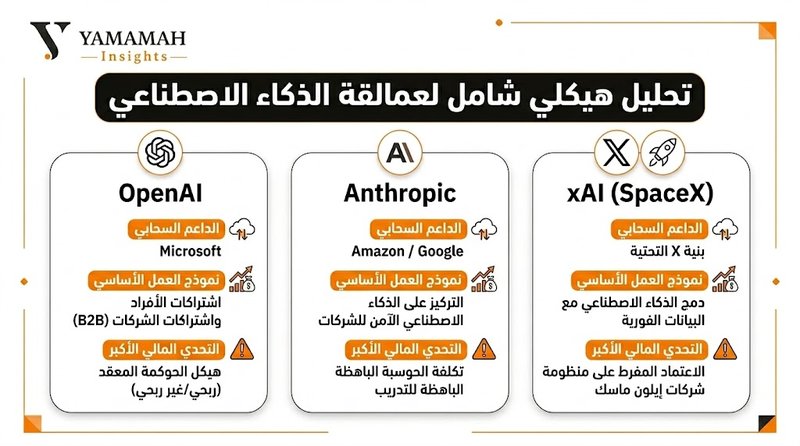
To understand the inflation in these companies' valuations, which Bloomberg and Financial Times reports criticize, we must dismantle their core business model, which relies on selling "Intelligence-as-a-Service." This model rests on three financial pillars:
- Application Programming Interfaces (APIs): Renting the capabilities of Large Language Models (LLMs) to other companies and developers to integrate into their products, with pricing based on usage volume (Tokens).
- Direct Subscriptions (SaaS): A consumer and business-oriented model (like ChatGPT Plus), providing recurring and nearly stable cash flows.
- Strategic Cloud Alliances: Deep partnerships with cloud service providers (such as OpenAI with Microsoft, and Anthropic with Amazon). These partnerships ensure computing power availability at preferential rates in exchange for profit shares.
Despite diverse income sources, these companies face a dilemma of massive "Capital Expenditure" (CapEx). Training an advanced artificial intelligence model requires thousands of Nvidia chips and energy costs equivalent to small city consumption. This gap between current revenues and operational costs drives these companies toward initial public offerings to secure "free money" from the public to sustain cash burn.
The Valuation Dilemma: Are We Facing an Investment Bubble?
From an academic finance perspective, markets value companies based on the "Discounted Cash Flow" model, expressed by the following equation:

Where current value (V) strictly depends on future cash flows (CF) and discount rate (r).
The current problem highlighted by digital economy professors is that current valuations (exceeding $80 billion for some companies) assume quasi-fictional future cash flows and ignore rising interest rates (which raise r and lower valuations). Investors currently rely on "Total Addressable Market" (TAM) measurements instead of financial fundamentals, the same trap that markets fell into during the (Dot-Com) 2000 crisis.
Impact on Macroeconomy and Supply Chains
Successful IPOs in this sector will create a multiplier effect (Multiplier Effect) on other digital economy sectors:
- Semiconductors: Companies like TSMC and Nvidia become the new central banks of the digital economy, controlling the supply of computing power.
- Energy Infrastructure: Massive demand for data centers will force repricing of the energy sector, with massive investments directed toward nuclear and renewable energy to ensure operational sustainability.
 Ask Yamami
Comments (7)
No comments yet. Be the first to comment!