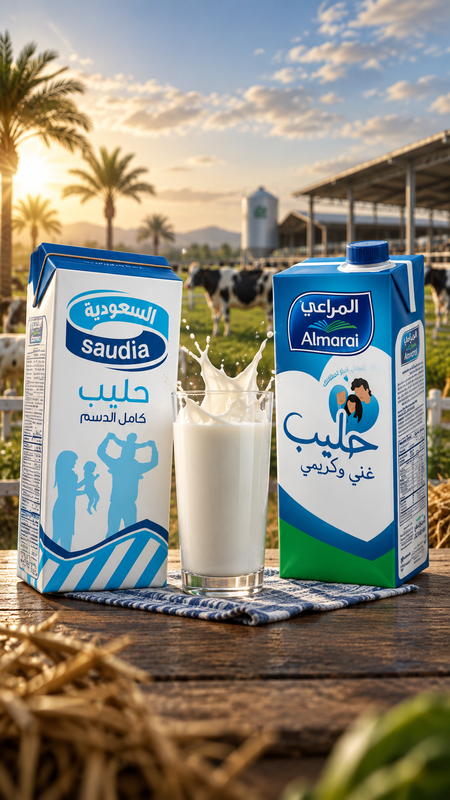

In a supermarket refrigerator, the two packages may look similar: milk for everyday consumption, priced so consumers can compare them within seconds. But behind them are two completely different economic models. Almarai has built a business exceeding SAR 21 billion through scale, integration, and control over broad segments of the food chain. Saudia, owner of the “Saudia” brand, has instead chosen a narrower scope and operational focus that enabled it to achieve a 15% net margin in 2025. The story is not about which milk is better, but about a bigger question: does a food company create its profits by owning more of the chain, or by mastering fewer of its links?
Place a carton of Almarai milk next to a carton of “Saudia” in a Riyadh store, then ignore the colors, logo, and price for a moment.
On the outside, the two products serve essentially the same purpose.
But if you trace the riyal paid by the consumer backward, you will find two companies building profits in different ways.
Almarai wants to be present across broad areas of the dining table: dairy, juices, bakery products, poultry, and baby food, supported by farms, factories, and an extensive distribution network.
Saudaco, by contrast, offers a more focused model: long-life milk, ice cream, tomato paste, and a more limited number of categories.
One built its advantage through breadth.
The other sought to extract greater value from a narrower scope.
The report “The Food Industry in Saudi Arabia” describes this contrast clearly: Almarai’s integration and breadth, and Saudia’s strict focus, represent two different paths to excellence in the food industry.
This makes the comparison between them about more than comparing two companies.
It is a lesson in corporate economics.
Almarai: Own the Chain Before Anyone Else Competes for It
Founded in 1977, Almarai developed from a dairy business into one of the region’s largest food and beverage companies. The report presents it as the region’s most complete example of what is known as Vertical Integration.
The idea is simple.
Instead of relying on a different party at every stage, the company controls many stages itself.
The farm.
Production.
Manufacturing.
Packaging.
Storage.
Refrigerated transport.
Distribution.
Then the brand and the shelf where it reaches the consumer.
This model is costly, but it gives the company something extremely important in the food industry: control.
When a company sells a highly perishable product, relying entirely on an external supplier or distributor becomes a risk. Every hour of delay in the cold chain may mean a shorter product life, greater waste, or an empty shelf in front of the consumer.
For Almarai, the truck is not a side business that comes after the factory.
It is part of the product.
And the warehouse is not merely a place to store packages.
It is part of the ability to deliver on the promise carried by the brand.
Scale Itself Can Become an Asset
Almarai’s net profit in 2025 reached approximately SAR 2.456 billion, up 6% from the previous year, on revenue exceeding SAR 21 billion. Shareholders’ equity stood at approximately SAR 20.5 billion, according to the figures cited in the report.
But the most important figure for understanding the model is not profit alone.
It is scale.
In the food industries, a large company can spread some of its fixed costs across a huge volume of products.
The factory.
The warehouse.
The technology system.
The management teams.
And the distribution network.
The more units that pass through this infrastructure, the more widely its cost can be distributed.
This is known as Economies of Scale.
If the same truck visits a milk retailer every day, it may become economical for it to carry juice, yogurt, or another product as well.
And if the company has strong relationships with retail chains, it can use the same channel for a larger number of products.
Thus, the distribution network turns from a cost into an asset.
It is like building an expensive road and then increasing the number of vehicles traveling on it.
Every additional product using the same road may make the initial investment more valuable.
From Milk to Chicken
This idea explains why Almarai did not remain a milk company.
The report notes that its portfolio expanded into juices and bakery products through brands such as L’Usine and “7DAYS,” and into poultry through “Alyoum,” in addition to baby food. It also considers the poultry segment’s expansion one of the company’s next growth drivers.
Almarai’s logic here is not necessarily that every food category is better than dairy.
Rather, the infrastructure built around a large food company can be used to seize opportunities in other categories.
But this breadth comes at a price.
Each new segment adds a factory, inventory, supply chain, or new operational risks.
That is why scale is not automatically an advantage.
It becomes an advantage only when management can keep complexity under control.
Saudaco: What If You Don’t Need to Own Everything?
On the other side stands Saudi Dairy and Food Products Company, “Saudaco.”
Its best-known brand on milk shelves is “Saudia.”
But the economic model behind the package is different.
According to the report, in 2025 Saudaco achieved a gross profit margin of 34.6%, a net margin of 15%, and net profit of SAR 477.4 million, in addition to cash balances exceeding SAR 670 million.
To understand what the figure means, net profit margin answers a simple question:
Out of every SAR 100 in sales, how many riyals remain for the company as net profit at the end?
A 15% margin means that every SAR 100 in revenue left approximately SAR 15 in net profit, mathematically speaking.
This is different from total profit.
Almarai generates much higher absolute profits because it is a much larger company.
But the margin answers a different question: How much does the company retain from each riyal of sales?
This is where the strength of Saudaco’s model becomes apparent.
Long-Life Milk Is More Than Just Milk
The report links part of Saudaco’s model to its focus on long-life milk.
The difference between it and fresh milk may seem technical to the consumer, but it is economic for the company.
Fresh products require a strict cold chain, faster delivery to stores, and careful management of waste and expiration.
Long-life milk, by contrast, has a longer storage period and does not require the same cold infrastructure throughout its entire journey.
In other words, the product choice changes the company’s economics itself.
The warehouse becomes simpler in some respects.
The selling window is longer.
The risk of spoilage is lower.
And the ability to distribute the product over longer distances becomes relatively easier.
This does not mean that long-life milk is cost-free, or that Saudaco’s margins result from it alone.
But the example illustrates an important idea in the food industry:
Sometimes the design of the product itself is a logistical and financial decision.
Focus Can Be an Advantage Just Like Scale
There is a common belief in business that the larger company is necessarily stronger.
Not always.
Scale provides purchasing, distribution, and investment power, but it also brings complexity.
Focus, on the other hand, allows a company to concentrate its capital, management, and expertise on fewer activities.
This is where the concept of operational focus emerges.
The company does not try to be present in every category; instead, it chooses a limited group of products and seeks to operate them with high efficiency.
The report links Saudaco’s model to three core categories: long-life milk, ice cream, and tomato paste. It sees the company’s financial results as evidence that scale is not the only path to excellence in the food industry.
This is an important lesson.
A smaller company can achieve solid economics if it has a suitable product, disciplined operations, and a strong brand, without burdening its balance sheet with unnecessary complexity.
A Billion Riyals or a 15% Margin?
This is where one of the most common mistakes in comparing companies occurs.
A reader may see that Almarai generated SAR 2.456 billion in profit versus Saudaco’s SAR 477.4 million and conclude that the former is “more efficient.”
That cannot be determined from the two figures alone.
Absolute profit tells us how much the company earns.
The margin tells us what percentage of its revenue it retains.
Return on capital raises a third question: how much profit did the company generate compared with the money it needed to invest?
These are different measures.
Therefore, there is no contradiction in one company being far larger than another while the smaller company achieves a higher net margin.
According to the report’s map, Almarai’s net margin is close to 11.7% on revenue exceeding SAR 21 billion, compared with 15% for Saudaco.
This does not make either model “better.”
It reveals that each model uses a different way to convert sales into profits.
What Does Almarai Buy in Exchange for a Lower Margin?
If Saudaco achieves a higher margin, why doesn’t every food company choose its model?
Because margin is not everything.
In exchange for its more asset-intensive model, Almarai gains other advantages.
Greater scale.
Broader diversification.
A presence in multiple categories.
An extensive distribution network.
And greater ability to launch new products through an existing infrastructure.
This diversification can also reduce reliance on a single category.
If dairy growth slows, an opportunity may come from poultry, bakery products, or juices.
The trade-off is that the company must manage a larger system, make greater investments, and bear more types of costs.
In 2025, for example, the report notes that Almarai disclosed an impact of approximately SAR 200 million from higher diesel prices. In a company that relies extensively on transportation and refrigeration, energy costs become an influential factor throughout the chain.
Scale creates protection in one area and sensitivity in another.
And What Does Saudaco Give Up in Exchange for Focus?
Focus is not cost-free either.
A company that relies more heavily on a limited number of categories is more exposed to any long-term change in them.
If consumer tastes change, competition intensifies, or retailers’ private labels put pressure on prices, the smaller portfolio has fewer drivers to offset weakness.
The report itself identifies competition, private labels, and shifts in consumer behavior among the risks facing Saudi food companies in general.
The two models can therefore be viewed as a trade-off between two types of risk.
Almarai accepts greater complexity to gain greater scale and diversification.
Saudaco accepts greater concentration to achieve simpler, more disciplined operations.
Which One Requires More Capital?
This is a central point in understanding the food industry.
An integrated company that owns farms, factories, fleets, and warehouses naturally needs a broad asset base and continuous financing for investment, maintenance, and expansion.
The report notes that Almarai was among the early Saudi nonbanking companies to use sukuk on a large scale, which fits the nature of an industry requiring long-term assets and relatively stable cash flows.
This is where the concept of capital intensity appears.
It is the amount of money that must be invested in factories, equipment, and assets before revenue can be generated.
The higher the capital intensity, the more the question becomes not only how much the company earns, but how much it must invest to achieve that profit.
This is important when comparing a broad model like Almarai’s with a more focused model like Saudaco’s.
Looking only at the income statement is not enough.
We must consider how much capital each model needs in order to operate.
One Builds a Moat Through Distribution, the Other Through Discipline
Investors use the term competitive moat to describe the advantage that makes a company difficult to compete with.
It does not mean a literal moat, but a set of barriers that prevent others from easily copying it.
Almarai’s moat is relatively clear.
Scale.
The brand.
The fleet.
Distribution.
The factories.
The ability to place a large group of products on extensive shelf space.
A competitor may be able to produce excellent yogurt.
But building a network comparable to that of a large company is far more difficult than copying a recipe.
Saudaco’s moat is different.
It rests more heavily on the brand, focus, operational discipline, and selecting categories that the company can manage efficiently.
One model says: Own more parts of the chain.
The other says: Own only what you can operate well.
Why Does an Investor Need to Know the Difference?
Because two companies in the same sector may respond to shocks differently.
Higher transportation and refrigeration costs may matter more to a company that relies heavily on an extensive cold network.
Changes in raw-material prices have different effects depending on the product mix and contracts.
Higher interest rates have different effects depending on the scale of financing and investment.
And changes in consumer tastes may benefit a diversified company or hurt one concentrated in a few categories.
That is why the phrase “food company” tells an investor very little.
Just as the phrase “technology company” can encompass radically different models, two companies selling milk may be economically completely different.
What matters is not only what the company sells.
It is how it creates the riyal it retains after the sale.
Does a Higher Margin Mean a Better Company?
Not necessarily.
A high margin may be excellent, but a company earning a lower margin on a huge sales base can generate greater profits and cash flows.
The company may also use its profits for new investments that drive future growth.
Conversely, a more focused company may generate a good return on less capital and return a larger share of its cash to shareholders.
A sound economic comparison therefore requires a range of indicators: revenue growth, margin, cash flows, invested capital, debt, return on capital, and the sustainability of the competitive advantage.
This is where the article meets an important investment principle:
The best operational company is not necessarily the best stock, and the highest margin is not necessarily the best model for every stage.
The price an investor pays for all of this remains a separate part of the equation.
The Paradox Revealed by Saudi Arabia’s Food Industry
The report presents a map positioning food companies according to portfolio diversification and margin, placing Almarai and Saudaco in clearly different positions: the former toward breadth and integration, and the latter toward focus and higher margins. It concludes that both paths can lead to excellence, while the “danger zone” lies in breadth without sufficient scale, or focus without differentiation.
This may be the most important idea in the entire comparison.
The problem is not being large or small.
The problem is being stuck in the middle without a clear advantage.
If you want breadth, you need scale that makes breadth economical.
And if you want focus, you need something that makes that focus valuable: a brand, product, cost advantage, or efficiency that competitors find difficult to imitate.
The Packages Look Similar… the Balance Sheets Do Not
A consumer can stand in front of a store refrigerator and choose between Almarai and “Saudia” within seconds.
For the consumer, the decision is about price, taste, habit, or the brand.
Behind the shelf, however, there are two different schools of profit creation.
Almarai has built a company that can begin with inputs and the farm, pass through the factory and fleet, and end with multiple products on shelves across the region.
Saudaco proves that the path does not necessarily require such breadth; a more focused portfolio can produce strong margins and a solid cash position when managed with discipline.
Therefore, the right question is not:
Almarai or Saudia milk… which is better?
It is:
What kind of company do you want to build: one that profits because it controls a larger share of the chain, or one that profits because it does fewer things more efficiently?
In the food industry, both paths can lead to profit.
Almarai bets that scale makes the chain stronger. Saudaco bets that focus makes each riyal more profitable. Between these two bets emerges one of the most important lessons in business: you do not need to sell the most things to create the best economics; you need to know exactly where your value is created, and then build the company around it.

Comments (0)
No comments yet. Be the first to comment!