

Introduction
Saudi Arabia's capital market has undergone one of the most significant transformations in the Gulf region over the past two decades — evolving from a largely closed, domestically focused exchange into the largest stock market in the Middle East by market capitalization. Behind the headlines of record-breaking IPOs, MSCI and FTSE emerging-market inclusions, and multi-billion-dollar privatizations sits a carefully constructed regulatory architecture that makes all of it possible.
For any investor considering entry, any issuer contemplating a listing, or any advisor structuring a transaction, understanding this architecture isn't optional — it's foundational. It determines who can participate, what they can do, how they must behave, and what happens when things go wrong.
Five interconnected pillars hold the system together:
| Pillar | Role | |
|---|---|---|
| Capital Market Law (CML) | The statutory foundation | |
| Capital Market Authority (CMA) | The regulatory overseer | |
| Tadawul | The exchange operator | |
| Edaa | The securities depository (ownership register) | |
| Muqassa | The central counterparty (clearing) |
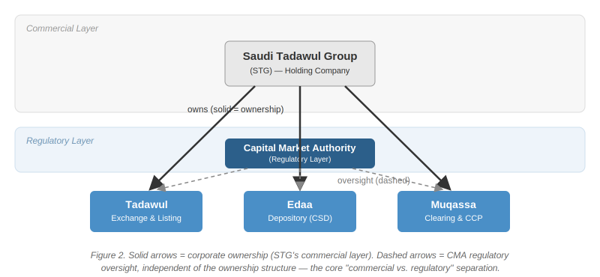
A sixth element — the CRSD/ACRSD dispute resolution system — gives the architecture teeth, and a corporate development in 2021 binds the operational entities together: Saudi Tadawul Group (STG) was established as a holding company, bringing Tadawul, Edaa, and Muqassa under one corporate umbrella while preserving each entity's distinct regulatory function. This structure — unusual in the region — separates commercial strategy from regulatory oversight, letting the exchange and post-trade entities compete internationally while remaining accountable to the CMA.
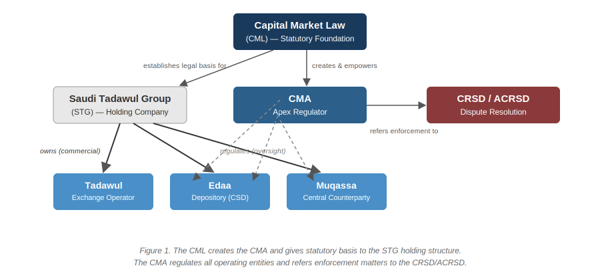
This article examines each pillar in turn — its mandate, evolution, and role in the broader ecosystem — before showing how they interact across a transaction's full lifecycle.
- The Capital Market Law (CML): The Constitutional Foundation
Every regulatory architecture needs a constitutional document — a statute that creates institutions, defines their powers, and sets the boundaries of permissible market activity. In Saudi Arabia, that document is the Capital Market Law, issued by Royal Decree No. M/30 of 31/7/1424H (2003).
Scope and Purpose
The CML was enacted with several interlocking objectives that remain relevant today: regulating and developing the capital market consistent with Islamic Sharia principles; protecting investors from unfair, unsound, and fraudulent practices; reducing systemic risk to ensure market stability; and creating the institutional framework — principally the CMA — to enforce all of the above.
The Law governs the full range of market activity: securities offerings, licensing and conduct of market participants, exchange operations, clearing and settlement, disclosure obligations, and the prohibition of market abuse. In effect, it is the enabling statute for virtually everything that happens in Saudi capital markets.
The 2015 Amendments: Liberalization and Foreign Access
The original 2003 Law provided a robust but relatively basic framework. The 2015 amendments modernized it substantially, reflecting the market's growth and the Kingdom's ambition to attract foreign capital:
- Enhanced CMA powers — broader investigative and enforcement authority, including the power to impose sanctions and refer matters to the CRSD.
- Foreign investment framework — the statutory basis for the Qualified Foreign Investor (QFI) regime, enabling direct foreign participation.
- Derivatives and new instruments — expanded coverage that later enabled futures and options markets.
- Corporate governance — reinforced statutory requirements for board responsibility and shareholder protection.
The 2019/2020 Amendments: Demutualization and Post-Trade Modernization
Royal Decree No. M/116 (2019, effective 2020) was every bit as consequential. It formally recognized Tadawul's demutualization and transition to a holding company structure, providing the statutory basis for the Saudi Tadawul Group. Critically, it also established the legal foundation for Muqassa as an independent central counterparty, separating clearing from depository functions for the first time — and strengthened the CRSD framework along with protections against insider trading and market manipulation.
By codifying these developments in primary legislation, the 2019/2020 amendments ensured the market's institutional evolution rested on statutory authority rather than regulatory discretion alone.
- The Capital Market Authority (CMA): The Apex Regulator
If the CML is the constitution, the CMA is the government established under it. Created by the CML, the CMA is an independent public authority governed by a board of five full-time commissioners, including a Chairman. Its independence — structural and operational — is a deliberate design feature meant to insulate regulatory decisions from short-term political or commercial pressure.
Mandate and Functions
- Regulating and developing the market — from drafting implementing regulations to approving Tadawul's rule changes.
- Protecting investors — overseeing disclosure, investigating market abuse, and ensuring fair treatment.
- Reducing systemic risk — through prudential regulation, capital adequacy rules, and oversight of clearing and settlement systems.
- Ensuring fairness and efficiency — monitoring trading activity, reviewing prospectuses, and enforcing listing obligations.
Regulatory Instruments
The CMA exercises its mandate through a hierarchy of tools: binding rules and regulations (e.g., the Rules for Offerings of Securities and Continuing Obligations, Corporate Governance Regulations, Investment Funds Regulations); interpretive notifications and guidelines; and licensing and supervision of "Authorized Persons" — broker-dealers, investment advisers, fund managers, custodians, and arrangers.
Independence and Accountability
The CMA's independence isn't absolute — board members are appointed by Royal Order — but its day-to-day regulatory decisions (approving a prospectus, granting a license, imposing a fine) are taken independently. This balance between governmental oversight and operational independence mirrors securities regulators globally and has been essential to building international confidence in the Saudi market.
- Saudi Tadawul Group and Tadawul: The Market Operator
While the CMA regulates, Tadawul operates. Established in 2007 under the CML, Tadawul is the Kingdom's sole authorized securities exchange. Its job isn't merely providing a venue for buyers and sellers — it's ensuring that price discovery happens in an orderly, transparent, and efficient manner.
From Mutual Organization to Holding Company
Originally a mutual organization owned by its member brokers, Tadawul demutualized and transitioned to a holding company structure in 2021. Saudi Tadawul Group (STG) became the parent entity, with Tadawul, Edaa, and Muqassa operating as wholly owned subsidiaries (see Figure 2). This restructuring mattered for several reasons:
- Separation of ownership and access — reducing conflicts of interest between exchange ownership and trading rights.
- Commercial flexibility — STG can diversify revenue, invest in technology, and expand into data services and post-trade infrastructure.
- Governance enhancement — independent board members and clearer accountability.
- Regulatory clarity — the 2019 CML amendments gave this structure explicit statutory grounding, keeping CMA oversight distinct from STG's commercial management.
Tadawul's Regulatory Role
Tadawul isn't merely a commercial venue — it's a front-line regulator, operating under a delegation of authority from the CMA:
- Listing rules — which securities may list, ongoing disclosure duties, suspension/delisting conditions.
- Trading rules — market-making obligations, short-selling constraints, circuit breakers.
- Market surveillance — real-time monitoring for manipulative or abusive activity, with referrals to the CMA.
The CMA retains ultimate supervisory power, but Tadawul handles day-to-day operational regulation — an efficient division of labor that requires close coordination to avoid gaps or overlaps.
Market Segments
- Main Market — established companies meeting stringent listing criteria.
- Nomu (Parallel Market) — lighter-touch platform for SMEs and growth companies.
- Sukuk and Bonds Market — debt instruments, growing rapidly as funding sources diversify.
- Derivatives Market — index and single-stock futures, cleared through Muqassa.
- Post-Trade Infrastructure: Edaa and Muqassa
Markets can't function without reliable post-trade infrastructure. Saudi Arabia separates depository functions from clearing functions — a two-entity model aligned with international best practice that reduces the concentration of systemic risk.
Securities Depository Center (Edaa): The Record of Ownership
Edaa is the Kingdom's Central Securities Depository (CSD). It operates behind the scenes, but its functions are indispensable:
- Securities registration — maintaining the electronic register of ownership, eliminating physical certificate risk and enabling T+2 settlement.
- Custody and corporate actions — dividends, rights issues, stock splits, and mergers. Foreign institutional investors access the market through global custodians (e.g., HSBC, BNY Mellon, State Street) acting as licensed local custody members linked directly to Edaa.
- Systemic stability — as the sole CSD, Edaa faces intensive CMA oversight of business continuity, cybersecurity, and operational risk, consistent with standards set by CPMI and IOSCO.
Muqassa: The Central Counterparty
Established in 2020 as a separate legal entity under STG, Muqassa acts as the Central Counterparty (CCP) — interposing itself between buyers and sellers in every trade. Its functions are distinct from Edaa's:
- Trade clearing — netting thousands of daily trades into manageable settlement obligations.
- Risk management — margin requirements and default funds that absorb losses if a clearing member fails, particularly critical in the leveraged derivatives market.
- Settlement coordination — managing the clearing process that precedes Edaa's delivery-versus-payment settlement.
This Edaa/Muqassa separation prevents risk concentration in a single entity, aligns Saudi post-trade infrastructure with international peers (EuroCCP, LCH), and lets each entity specialize in its core competency.
- Dispute Resolution: The Two-Tier Quasi-Judicial Framework
Rules without accessible enforcement are merely suggestions. Saudi Arabia addresses this with a two-tier quasi-judicial system: the Committee for the Resolution of Securities Disputes (CRSD) and the Appeal Committee (ACRSD).
CRSD: First Instance
- Enforcement actions — confirming CMA-imposed fines, trading bans, or license revocations.
- Investor claims — damages arising from CML or CMA regulation violations, including misleading prospectuses, insider trading, or market manipulation.
- Inter-participant disputes — between Authorized Persons, or between market participants and Tadawul.
ACRSD: Appeal and Final Review
Parties dissatisfied with CRSD rulings may appeal to the ACRSD, which reviews both law and fact. Its decisions are generally final and binding, providing legal certainty and discouraging frivolous litigation.
This two-tier structure builds institutional jurisprudence, gives investors accessible, specialized justice outside the general court system, and disciplines the CMA itself — since enforcement decisions may be scrutinized by an independent tribunal. The 2019/2020 amendments further clarified CRSD/ACRSD procedures, timelines, and evidentiary standards.
- The Interplay: How the Architecture Functions
Understanding each pillar individually is necessary but not sufficient — the system's strength lies in how the pieces interact across a transaction's lifecycle.
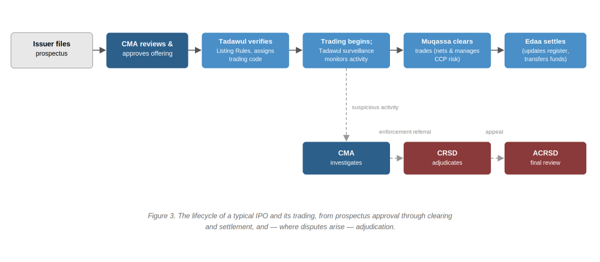
The chain shows a clear division of labor: the CMA sets standards and approves disclosures; Tadawul operates the market and enforces trading rules; Muqassa manages clearing risk; Edaa ensures the back office functions flawlessly; and the CRSD/ACRSD provide judicial oversight. No single institution performs all these functions, and the separation itself creates checks and balances that reinforce market integrity.
The CMA–Tadawul relationship deserves particular note: Tadawul proposes its own Listing Rules and trading procedures, but these require CMA approval before taking effect, and the CMA conducts regular inspections and can direct the exchange to act if it identifies threats to market integrity. It isn't a purely hierarchical relationship — Tadawul holds operational expertise the CMA relies on, and the two maintain continuous dialogue. Edaa and Muqassa similarly operate under CMA oversight while retaining technical autonomy in system design, with the CMA ensuring that autonomy never compromises systemic stability or investor protection.
- Looking Ahead: Emerging Regulatory Frontiers
The architecture above isn't static. The CMA and market infrastructure entities are actively expanding the regulatory perimeter:
- FinTech and the regulatory sandbox — the CMA allows FinTech firms to test robo-advisory services, digital onboarding, and blockchain-based settlement under relaxed conditions for a defined period, in line with a global trend toward regulatory sandboxes.
- Debt Capital Markets (DCM) deepening — streamlined disclosure for frequent issuers and new frameworks for green bonds and sukuk, requiring ongoing coordination between Tadawul (listing), Muqassa (clearing), and the CMA (disclosure regulation).
- ESG disclosure and sustainable finance — CMA-issued ESG Disclosure Guidelines, currently principles-based but expected to move toward more prescriptive standards for large-cap issuers and government-related entities, intersecting increasingly with existing Offering Rules and Corporate Governance obligations.
Conclusion: Why the Architecture Matters
Saudi Arabia's capital market regulatory architecture is not an administrative footnote — it's a strategic asset. The statutory clarity of the CML (as refined in 2015 and 2019/2020), the operational independence of the CMA, the commercial and regulatory sophistication of Tadawul within STG, the systemic reliability of Edaa, the risk-management discipline of Muqassa, and the judicial oversight of the CRSD/ACRSD together create an environment where capital can be raised, deployed, and protected with confidence.
- Foreign investors get assurance that investments are governed by rules enforced by a capable regulator, traded transparently, cleared through a robust CCP, and settled securely — with recourse to specialized tribunals if disputes arise.
- Domestic issuers get access to deep capital pools within a framework balancing efficiency and investor protection.
- Advisors and intermediaries get a predictable environment for structuring transactions and managing compliance risk.
As Saudi Arabia continues deepening its capital markets — through new privatizations, derivatives expansion, FinTech innovation, or ESG integration — this architecture will be tested and inevitably refined. Its foundational design, established by the CML and operationalized through the CMA, Tadawul, Edaa, Muqassa, and the two-tier dispute resolution system, has proven robust enough to support one of the most dynamic capital markets in the emerging world. Understanding it remains the essential first step for anyone seeking to participate in the Saudi market.


Comments (8)
No comments yet. Be the first to comment!