

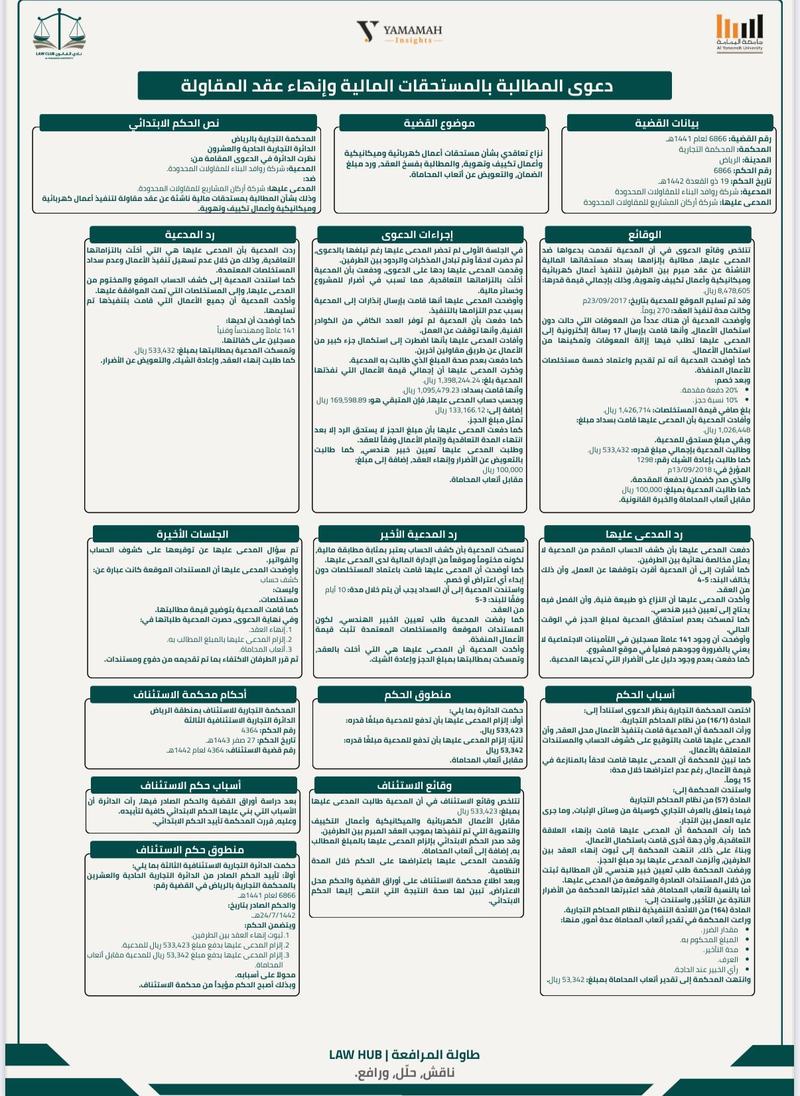
Legal Characterization of Accounting Documents and the Burden of Proof
In a legal analysis of the issues in the case, student "رسيل النفيعي" @Rasil Alnefaie explores the technical and analytical dimensions of the burden of proof, saying:
"I believe the issue here is not limited to a discrepancy in the figures; it raises a deeper question: who bears the burden of proving the correct value of the work performed?
The plaintiff relied on the payment certificates and the statement of account signed and stamped by the defendant, while the defendant submitted a different calculation of the value of the work and the amounts paid.
This leads me to ask: Are signed accounting documents enough to determine the value of the work, or does the nature of a construction contract require technical evidence of the percentage of completion and the work actually performed?
If these documents represent actual approval of the value of the work, they may be sufficient to support the plaintiff’s claim, particularly since the defendant did not object to them within the period referred to by the court. But if the objection concerns the quantity of work, the quality of its execution, or the percentage of completion, the issue becomes technical and may require a different form of evidence.
The question that remains is: Does signing an accounting document legally determine the value of the work, or does its evidentiary weight still depend on proving that the work it represents was actually performed?
Distinguishing Accounting Evidence from the Technical Assessment of Execution
In the same vein, student "وعد العتيبي" @Waad Alotaibi agrees with this view and elaborates on the limits of the documents’ legal evidentiary weight, saying:
"I agree with Rasil, and I believe it is important here to distinguish between the evidentiary weight of signed documents and proof that the work was actually performed.
An accounting document signed and stamped by the defendant is evidence of the amounts approved, especially when no objection was made within the specified period. However, it does not necessarily settle every issue relating to the percentage of completion or the work actually carried out on site.
Accordingly, if the disagreement is limited to the amount recorded in the documents, they may be sufficient to determine which claim is better supported. But if it extends to the quantity of work, the percentage of completion, or the quality of execution, the issue becomes technical, and an engineering expert may be the most appropriate means of verifying it.
That is why I believe the most important question is: Was the dispute in this case about the value of the work originally approved, or about the work actually performed? The answer makes a significant difference in determining the burden of proof and the evidentiary weight of the documents".
The discussion is still open...
Between those who believe a signed statement of account settles the amount and those who believe a construction contract can only be resolved through technical proof of the work performed, where do you stand?
Do you agree with the court’s decision to reject the request for an engineering expert and rely solely on the documents?
Share your views and comments on the topic, and we also welcome your contributions to the other issues in the case.

Comments (8)
No comments yet. Be the first to comment!