

ACWA Power announced a significant jump in its net profit for the third quarter of 2026, up 71.1% to SAR 635.07 million, compared with approximately SAR 371.1 million in the same quarter a year earlier.
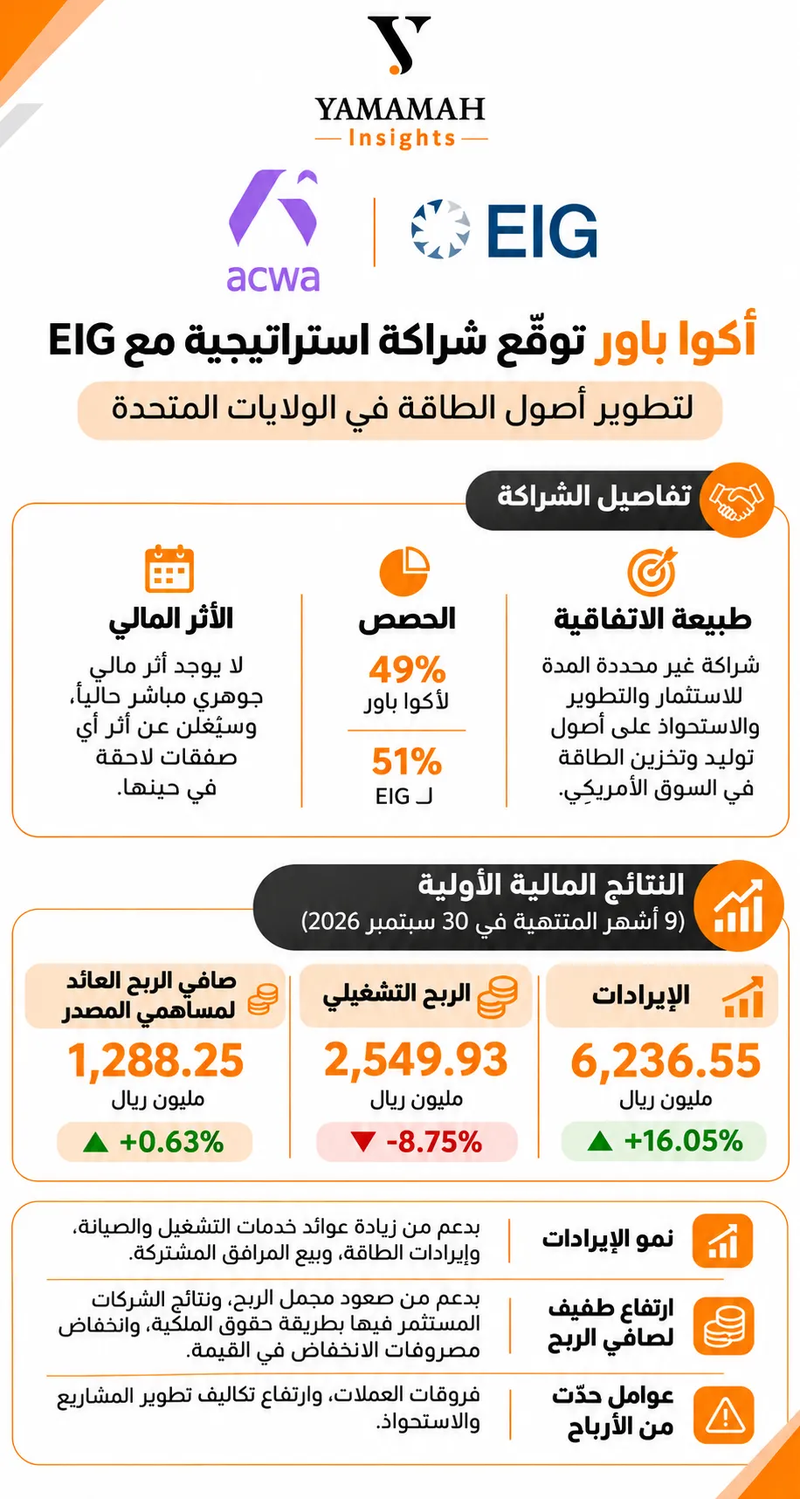
The company’s revenue rose 32.69% to SAR 2.2 billion, driven by growth in its operations and maintenance, power, and development and procurement segments. Net profit for the nine-month period reached approximately SAR 1.28 billion, with revenue exceeding SAR 6.2 billion.
As part of its global expansion, ACWA Power, through its subsidiary, signed a strategic partnership agreement with EIG Management Company—which manages $27.1 billion in assets—to develop and acquire power generation and storage assets in the United States.
Under the agreement, ACWA Power will hold a 49% stake, with EIG holding 51%. The partnership aims to combine development and operational capabilities with investment, financing, and business platform-building expertise.
Students from Al Yamamah University discussed the financial implications of the company’s impressive results and the impact of its U.S. partnership on revenue diversification and future growth, as follows:
Long-term opportunities and a careful balance between growth and financing risk management
Student Zikra Abdul Kareem @Zikra Abdulkareem shared her perspective: “I believe ACWA Power’s entry into the U.S. market represents a strategic opportunity that goes beyond geographic expansion, particularly given the rapid growth of artificial intelligence and rising energy demand. Investing in power generation and storage gives the company opportunities to secure long-term contracts and new revenue streams.
Transferring expertise and technology also strengthens its global competitiveness and supports the Saudi economy by diversifying sources of income.
Profit fluctuations require a closer look at the timing of revenue recognition and financing and development costs. One quarter of higher profits is not enough to determine whether growth is sustainable.
In my view, the success of this expansion depends on balancing growth with financing risk management to ensure sustainable returns over the long term.”
Diversifying financing sources and hedging currency and interest rate risks
Student Nouf Al-Olayan @Nouf Alojayan also shared her views, explaining: “Rising interest rates and financing costs are a challenge for companies like ACWA Power, because energy and infrastructure projects require substantial capital investment and take a long time to generate returns.
It is therefore important to diversify funding sources across loans, equity, and strategic partnerships, while making use of long-term financing and fixing interest rates as much as possible to reduce risk.
Expanding into international markets also requires managing currency risk through financial hedging and, where possible, matching revenues with liabilities in the same currency.
The goal is to preserve profit margins and cash flows without allowing financing and expansion costs to undermine the economic viability of projects.”
Sustaining growth and monitoring cash flows amid rising costs
Student Rabiah Almugait @Rabiah Almugait noted: “The 71% increase in third-quarter profits is a positive indicator, but the relatively flat nine-month profit means it is best not to judge performance based on a single quarter.
It is important to assess how sustainable this growth is and monitor operating cash flows, particularly given the expansion into the U.S. market and rising financing costs.
I believe the partnership’s success depends on ACWA Power’s ability to generate attractive returns from new projects without creating financing burdens that could weigh on future profitability.”
Diversifying profits and capitalizing on rising demand to power data centers
Student Rahaf Al-Anazi @Rahaf Alanazi added: “I believe the partnership in the U.S. market is a strong opportunity for ACWA Power, especially as the need for energy to power data centers and artificial intelligence technologies continues to grow.
The expansion will also help the company increase its investments and diversify its profits rather than relying on a single market.
As for the financial results, the difference between third-quarter and nine-month profits warrants further monitoring to determine whether the improvement will continue.
I believe the company’s success depends on its ability to manage project and financing costs while sustaining growth and generating good returns over the long term.”
Revenue recognition timing and balancing expansion with future profitability
Student Raneem Asiri @Raneem Asiri emphasized: “In my opinion, ACWA Power’s entry into the U.S. market is an important opportunity to benefit from rising energy demand driven by the expansion of data centers and artificial intelligence, particularly in renewable energy and storage projects.
International expansion also helps the company gain new expertise, diversify its income sources, and support the Saudi economy.
The rise in third-quarter profits alongside relatively flat nine-month profits may be linked to the timing of revenue recognition, so we need to monitor upcoming results to confirm that growth is continuing.
I believe the company’s future success depends on managing financing costs and currency risks while balancing expansion with profitability.”
Long-term contracts as a way to stabilize revenue and cover debt costs
Student Ahmed Al-Jadaan @AHMED ALJADAAN observed: “Investing in major projects such as power plants requires financing in the billions. Looking at ACWA Power’s nine-month results, despite revenue growth, operating profit fell by 8.75%.
The main reason for this pressure is the increase in project development and acquisition costs, as well as the impact of currency differences as the company expands globally.
Infrastructure companies often manage these risks through long-term contracts that stabilize revenue and cover high debt costs. This is the biggest challenge in ensuring that revenue growth translates into sustainable net profit.”
Declining operating profits highlight the challenge of turning opportunities into cash flows
Student Yazan Mohammed @Yazan Hamoud shared his view, noting: “From my perspective, what stood out most was that ACWA Power’s revenue rose by 16%, while its operating profit for the nine-month period fell by 8.75%. This shows that higher revenue does not necessarily translate into a proportionate increase in profits.
I see its partnership with EIG as a strong opportunity, particularly given the rise in energy demand driven by artificial intelligence. But its real success depends on its ability to turn these opportunities into sustainable profits and cash flows, while controlling financing and expansion costs.”
Enabling the digital economy is a deeper opportunity than simply meeting rising electricity demand
Student Thanaa Alshayib @Thanaa Alshayib explained: “I believe ACWA Power’s expansion into the U.S. market is an important strategic move, particularly given the rapid growth of artificial intelligence and rising energy demand to power data centers.
What makes this move distinctive is that the company is not simply entering a new market; it is investing in a fundamental need that will continue to grow in the coming years.
Financially, I was struck by the wide gap between the 71% increase in third-quarter profits and the modest 0.6% growth in nine-month profits. This underscores the importance of assessing financial performance over a longer period rather than relying on the results of a single quarter, especially since the timing of revenue recognition and financing costs can have a clear impact on results.
In my view, ACWA Power’s biggest challenge is not the number of projects it takes on, but its ability to generate attractive returns from them while managing financing costs and international expansion risks in a balanced way.
Most importantly, artificial intelligence may drive demand, but energy is what enables that growth in the first place. That is where ACWA Power’s real opportunity lies: to become part of the digital economy’s infrastructure, not merely a company benefiting from higher electricity demand.”
Sharing investment costs and risks to ensure the sustainability of international projects
Student Jumana Al-Shehri @Jumana Alshehri added: “I believe ACWA Power’s expansion into the U.S. market is an important move, particularly given rising energy demand from artificial intelligence and data centers. The partnership with EIG helps share investment costs and risks while leveraging the partner’s expertise.
Global expansion also helps diversify revenue, exchange expertise, and support the Saudi economy.
As for the financial results, the 71% increase in third-quarter profits compared with 0.6% growth in nine-month profits may be due to the timing of revenue recognition or differences in project performance and expenses. We therefore need to monitor upcoming results to confirm that growth is sustainable.
Interest rate pressures and development costs can be addressed by diversifying funding sources, managing currency risks, and assessing project viability before investing.”
A proactive move and smart allocation of stakes to ensure stable financial flows
Student Dana Al-Sadoun @Dana Al-Sadoun emphasized: “I believe the partnership between ACWA Power and EIG is a smart, proactive move to meet the enormous demand for energy and data centers resulting from the artificial intelligence boom.
Its strength lies in the allocation of stakes (49% for ACWA Power and 51% for EIG), which shares risks and capital while drawing on ACWA Power’s expertise in generation and storage to ensure sustainable returns and stable financial flows.”
Cost management is key to sustainable growth that does not rely on a single quarter
Student Rand Al-Khalaf @Rand Alkhalaf said: “From my perspective, ACWA Power’s entry into the U.S. market is a strong opportunity to benefit from rising energy demand driven by artificial intelligence. It will also help diversify the company’s investments and strengthen its global presence.
However, the success of this expansion depends on its ability to manage financing and project costs and achieve sustainable profit growth rather than relying on higher profits in just one quarter.”
Strengthening its global position and controlling development costs are essential to success
Student Meshail Al-Anazi @Meshail ALANazi shared her view, explaining: “I believe the U.S. partnership is a positive step for ACWA Power, as it opens up new opportunities to benefit from substantial growth in energy demand, especially with the spread of artificial intelligence.
International expansion also strengthens the company’s global position, but the most important thing is its ability to achieve sustainable growth while controlling financing and development costs.”
Performance fluctuations and monitoring improved cash flows through the new partnership
Student Jana Al-Shahrani @Jana Alshahrani explained: “From my perspective, ACWA Power’s expansion into the U.S. market is an important strategic move, especially given rising energy demand driven by the growth of data centers and artificial intelligence.
However, I believe the success of this expansion depends not only on increasing revenue, but also on the company’s ability to generate sustainable profits and control financing and operating costs.
Despite the 71% increase in third-quarter profits, the 0.6% growth in nine-month profits shows that performance remains uneven.
I therefore believe it is important to monitor the results of the partnership with EIG and its contribution to improving cash flows and long-term returns.”
Risk management efficiency and revenue timing as factors in sustaining strong expansion
Student Noof Al-Anazi @Noof Alanazi added: “I believe ACWA Power’s entry into the U.S. market represents a strong strategic opportunity, particularly given rising energy demand from data centers and artificial intelligence.
However, the success of the expansion depends on managing financing costs and risks efficiently.
The increase in third-quarter profits compared with relatively flat nine-month profits may be related to the timing of revenue recognition. It is therefore important to monitor upcoming results to confirm that growth is sustainable.”
Future project returns as a measure of the success of strategic agreements and partnerships
Student Mohammad Alghaihab @Mohammad Alghaihab offered a comprehensive analysis: “I believe ACWA Power’s partnership with EIG is an important step in the company’s global expansion, particularly because entering the U.S. market opens up significant opportunities in the energy sector, as electricity demand rises with the expansion of data centers and artificial intelligence.
What caught my attention most, however, was the company’s results: despite a 71% increase in third-quarter profits, nine-month profits grew by only 0.6%.
This shows that the company’s performance is affected by the timing of project execution and revenue recognition. I therefore believe that judging its growth based on a single quarter could be misleading.
In my opinion, ACWA Power’s real challenge is not simply securing new projects, but financing this expansion and turning it into sustainable cash flows, particularly amid rising financing and development costs.
To me, the partnership is a promising strategic opportunity, but its true success will be reflected in the returns generated by the projects in the future—not in the scale of expansion or the number of announced agreements.”
Sharing capital and risk as an advantage that goes beyond entering the U.S. market
Student Mohammed Al-Mudbil @Mohammed Almudbil concluded the analyses by saying: “I believe the partnership’s advantage is not limited to entering the U.S. market; it also includes sharing capital and risks with EIG, rather than having ACWA Power bear the entire cost of expansion. Especially given the rising cost of projects, the success of the expansion ultimately depends on generating a good return without putting significant pressure on cash flows.”
Taking the investee-company model to the U.S. market amid debt and interest rate pressures
In an analytical assessment, financial and economic analyst “Hamad Alsaeed” @Hamad Alsaeed adds: ACWA’s third-quarter results came at a time that broadens their significance, coinciding with the announcement of its partnership with EIG. Net profit rose 71% to SAR 635 million, while operating profit increased 88%, supported by results from companies accounted for under the equity method—a model ACWA is taking to the United States through a 49% stake in a platform targeting initial capital of approximately $4 billion.
High debt remains a risk, with net leverage at the parent-company level reaching SAR 21.6 billion, or 6.59 times its operating cash flow at the end of June. Meanwhile, the 87-basis-point rise in the U.S. 10-year yield during the quarter increases the financing cost of new projects and puts pressure on future profits.
With the International Energy Agency projecting that global data-center electricity consumption will double to approximately 945 terawatt-hours by 2030, the partnership is expected to help diversify ACWA’s income geographically and open a growth path in a market where demand is expanding.


 Ask Yamami
Comments (6)
No comments yet. Be the first to comment!