
On July 7, 2026, ACWA Power announced the issuance of a strategic government approval granting the company exclusive rights to export green hydrogen produced in the Kingdom of Saudi Arabia and its various derivatives, which include green ammonia, green methanol, and green methane, in addition to synthesized fuel using green hydrogen to global markets, in line with achieving national clean energy targets.
The government approval also included a direct mandate for the company to develop projects for the production, transmission, and export of electricity from renewable energy sources, aiming to connect and export it to European markets and Arab countries, thereby enhancing the company's position as a key regional and international player in the energy transition system.
The company clarified that it is difficult to determine the exact financial impact of these approvals and exclusive mandates at this early stage, affirming its commitment to disclose to all shareholders any material developments or subsequent financial impacts as they materialize, in accordance with relevant regulations and instructions.
Students from Al Yamamah University discussed the implications of these results and the structural cost implications as follows:
Management of Financing and Long-term Future Returns
Student "Rimas Almashali" @Rimas Almashali opened the analysis by evaluating the strategic financial impact, stating: "This announcement is positive as it opens new growth opportunities for ACWA Power in the clean energy sector, but its financial impact will not be immediately visible; projects related to hydrogen export and electrical interconnection require significant investments and a long time for implementation, so it is natural for the market to monitor the company's ability to manage financing and maintain profitability.
Additionally, the decline in return on equity and return on assets in 2025 makes it important for these projects to generate substantial returns to compensate for the level of spending.
If the company succeeds in execution and signing long-term contracts, it is expected to enhance its global position and support its long-term growth".
Infrastructure Challenges and Competitive Advantage of Exclusivity
Student @Shahad Al-Muhaysin commented from an operational and logistical perspective, saying: "The biggest challenge is not in producing green hydrogen itself, but in the infrastructure required for its transport and export; this project requires massive investments in electrical interconnection networks, transmission lines, ports, and integrated supply chains, and any delay in implementing any of these elements could affect the timeline and costs.
However, if ACWA Power successfully manages these projects efficiently, it will achieve a strong competitive advantage in the long term, as having exclusive export rights gives it a significant edge and places it in a leading position in the clean energy market, especially with the increasing global demand for green hydrogen".
Pricing Mechanisms and Quality of Export Contracts
Student "Ghadah Alwallan" @Ghadah Alwallan continued the discussion by focusing on commercial and pricing aspects, stating: "One of the most important things to monitor after this announcement is not just the size of investments, but the pricing mechanism for hydrogen and electricity exports; exclusivity gives ACWA Power an advantage in entering the market, but it does not necessarily guarantee high returns if contracts are signed at low prices or with limited margins.
Therefore, I believe that investors will be more interested in monitoring the contracts that will be signed and how they reflect on cash flows and return on capital, rather than just the announcement itself".
Financial Structuring, Technical Data, and Environmental Governance
For her part, student "Sara Al-Aqeel" provided a structural analysis of financial and technical indicators, explaining: "The debt-to-equity ratio has actually improved to 0.96x compared to 1.67x in 2021, despite a slight decline in profit margin in 2025, noting that large export projects are often financed through separate project financing, not directly through the company's budget.
On the other hand, exclusivity gives the company a strong negotiating advantage in energy sale contracts, although the announcement did not specify its duration or legal limits.
This is accompanied by technical challenges represented by the scarcity of electrolyzer equipment globally, the complexity of high-voltage direct current (HVDC) interconnection, and efficiency loss when converting hydrogen to ammonia for transport.
In the context of Environmental, Social, and Governance (ESG) standards, sovereign exclusivity supports the company's image as a leading player, which may attract sustainability funds, but this depends on the clarity of future disclosures, especially since the company itself has not issued any specific financial figures yet".
Opportunities for International Expansion and Revenue Growth
Student @Tina Azy concluded the analysis by pointing out the dimensions of international expansion, stating: "Granting ACWA Power exclusive export rights gives it a strong advantage, as it opens up greater opportunities for expansion outside the Kingdom.
It is true that new projects require significant investments and may increase spending, but if the company succeeds in implementing them efficiently, it could reflect on revenue growth and strengthen the company's global position in the clean energy sector".
Analytical Vision of the Company's Path and Profit Stability
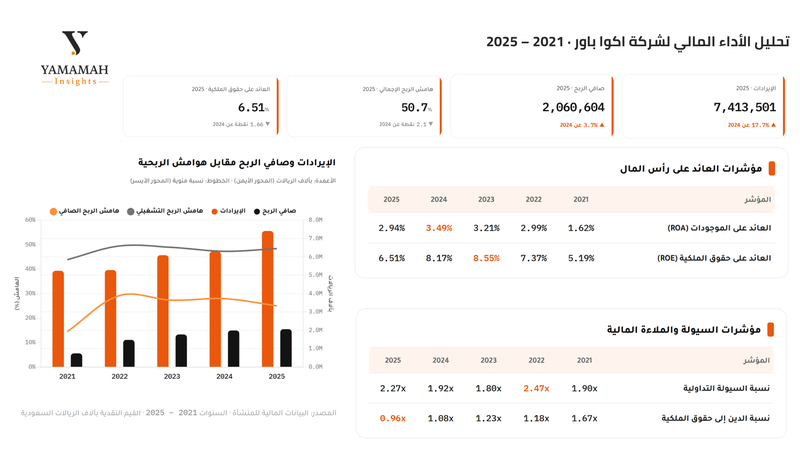
In an analytical reading of the company's performance, financial analyst and economist "Hamad Alsaeed" @Hamad Alsaeed stated: ACWA Power has recorded good financial performance over the past five years, achieving record revenues of 7.41 billion riyals, a growth of 17.7% compared to 2024. The approval of its monopoly on exporting green hydrogen will be a positive point for the company's future growth. Revenues are expected to jump significantly when operations begin, supported by extended contracts free from competition. Moreover, the exclusive approval will enhance the company's pricing power in Europe, which will help protect and stabilize the gross profit margin at 50.7%.
The temporary decline in return on assets to 2.94% (from 3.49%) and return on equity to 6.51% (from 8.17%) is attributed to the commencement of massive capital expenditures on projects under construction. With the new mandates, the currently managed assets of 455 billion riyals will double, turning into cash liquidity sources once commercial export begins, raising the return indicators to good levels.
Liquidity indicators and the financial position show significant strength, with the current ratio rising to 2.27 times, and the debt-to-equity ratio declining to 0.96 times. Therefore, this healthy and sovereign-backed financial structure gives the company high borrowing capacity, facilitating financing for interconnection networks and hydrogen plants through preferential debt at a financial leverage ratio (80:20), which in turn supports the company's continuity and expansion without any pressure on shareholder cash.
The company's financial performance over the last five years:

Comments (8)
No comments yet. Be the first to comment!