

ADES Holding Company announced a 44% jump in revenue for the first nine months of 2026, reaching SAR 6.77 billion.
Alongside this growth, the company announced it had been awarded new contracts to operate two offshore rigs in India for Oil and Natural Gas Corporation Limited (ONGC), worth SAR 439.6 million.
Despite exceptional growth in revenue, supported by recent acquisitions such as Shelf Drilling, net profit for the period fell 23% to SAR 459.8 million.
The decline was mainly due to the temporary suspension of some operations, higher depreciation and interest expenses, and the lower profit margins of newly acquired operations.

Students at Al Yamamah University discussed the financial and operational implications of these results, and how new international contracts could support revenue sustainability and ease cost pressures, as follows:
Easing cost pressures by improving rig operating efficiency
Yazan Hamoud @Yazan Hamoud explained his view: “What caught my attention was that ADES revenue rose by 34.8%, while net profit fell by 55.8%, showing how costs are pressuring profitability.
I see the India contracts as a positive step toward diversifying revenue, but the priority is improving rig operating efficiency and reducing financing costs, because expansion alone does not guarantee profit growth.”
Strategic importance beyond financial scale to ensure continuity of operations
Student Ahmed Al-Jadaan @AHMED ALJADAAN shared his view: “As for ADES’ new contracts in India to operate two offshore rigs, worth SAR 439.6 million, their importance is more ‘strategic’ than ‘financial.’
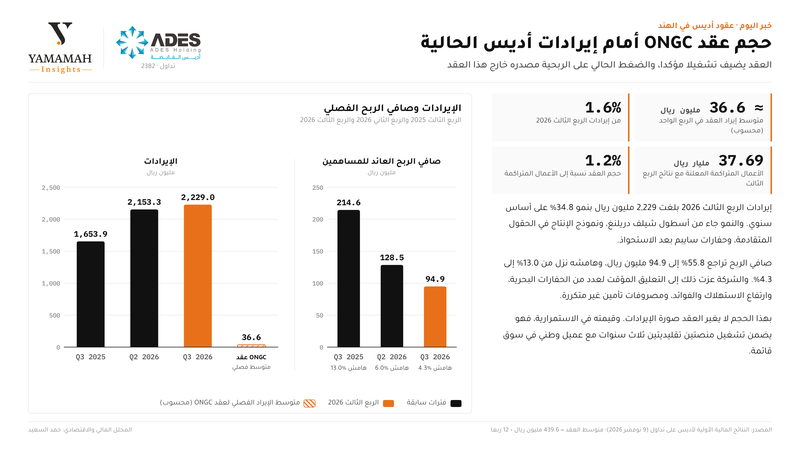
The figures indicate that the contract will add an average of about SAR 36.6 million in quarterly revenue. That is just 1.6% of third-quarter revenue and 1.2% of the company’s total backlog, which reached SAR 37.69 billion.
But its real value lies not in its financial size, but in securing three years of operations with a national client in a new market. It also helps the company diversify its markets and offset the impact of rig suspensions elsewhere.”
Balancing financing asset-intensive growth with shareholder profitability
Student Albatool Bedairi @Albatool Bedairi noted: “I believe the biggest challenge for asset-intensive companies like ADES is balancing expansion financing with maintaining shareholder profitability.
Buying and financing rigs requires substantial investment, while the company also incurs depreciation and financing expenses that can affect net profit even as revenue rises.
From an accounting perspective, depreciation reduces profit but does not represent a cash outflow when recorded, unlike debt interest payments and new investments.
In my view, expansion should be assessed through operating cash flow, return on invested capital and debt levels. A company’s success is measured not just by the size of its assets, but by its ability to turn them into sustainable profits and cash flows.”
Reducing equipment downtime is essential to turning expansion into profits
Student Dina Alarjani @Dina Alarjani added: “In my view, ADES Holding’s expansion into global markets is a positive step, especially its India contracts, which help diversify revenue sources and reduce reliance on a single market.
At the same time, higher revenue does not necessarily mean higher profits, because of operating costs, debt and equipment depreciation.
The company’s priority should be balancing expansion with profitability while ensuring rigs operate efficiently and reducing their downtime.”
Operating efficiency and lower financing costs to support sustainable growth
Student Rabiah Almugait @Rabiah Almugait affirmed: “I believe ADES’ expansion and entry into new markets is a positive step toward increasing market share and diversifying revenue sources. But revenue growth alone is not enough to judge the success of expansion, particularly when net profit has fallen by more than 50%.
Higher financing and operating costs, as well as the suspension of some rigs, could significantly affect margins.
So the key in the coming period will be the company’s ability to improve operating efficiency, lower financing costs and turn revenue growth into actual profits that support sustainable growth and protect shareholder interests.”
Backlog and international expansion as a bet on gradually restoring margins
Student Haifa Almutairi @Haifa Almutairi remarked: “I believe ADES Holding is in a period of clear divergence, with strong revenue growth alongside significant pressure on profit margins.
Revenue for the first nine months rose 44% to SAR 6.77 billion, while net profit fell 23% to SAR 459.8 million. Third-quarter profit dropped 55.8% to SAR 94.9 million, despite quarterly revenue growth of 34.8% to SAR 2.22 billion.
The decline is mainly due to operating losses resulting from geopolitical tensions, higher financing costs and expansion.
Meanwhile, the company is bolstering future cash flows with a new ONGC contract in India worth SAR 439.6 million, starting in 2027. The bet is on a substantial backlog and international reach to improve operating efficiency and gradually restore margins.”
Assessing international expansion by earnings quality and utilization rates
Student @عمر الشيخ shared his view: “ADES’ results reveal a noteworthy gap between revenue growth and profitability. Revenue for the first nine months rose about 44% to SAR 6.77 billion, while net profit fell about 23% to SAR 459.8 million.
I don’t believe this necessarily means the expansion strategy has failed, but it does raise questions about earnings quality, especially given the contribution of acquired assets with lower profit margins and the impact of temporary rig suspensions.
Operationally, rig downtime is a major challenge for energy services companies because equipment represents significant capital investment, and any downtime can mean lost revenue while some costs continue. Raising equipment utilization and improving contract and maintenance scheduling are therefore essential to protecting profit margins.
Expansion in India, through two contracts worth a total of SAR 439.6 million for three years per rig, diversifies markets and revenue sources and reduces reliance on a single geographic market. It also gives the company greater visibility into future work, with operations expected to begin by the end of the first quarter of 2027.
As for debt and equipment depreciation, the challenge is balancing expansion with maintaining cash flow. Acquisitions can boost revenue and backlog, but may also increase financing and depreciation burdens; each investment should therefore be assessed against its expected return and cost.
In my view, ADES has promising opportunities thanks to its international presence and long-term contracts, but the figures show that its current challenge is less about increasing revenue than turning growth into higher profits. From an industrial engineering perspective, maximizing rig utilization, reducing downtime, improving maintenance efficiency and raising the profitability of each contract will determine the long-term success of its expansion strategy.”
Maximizing value from current contracts before making new expansion investments
Student Jumana Al-Shehri @Jumana Alshehri noted: “I believe ADES’ expansion and acquisitions have helped increase revenue and market share, but they have also raised financing costs and pressured net profit.
Rig suspensions also directly affect profitability because operating costs continue during downtime.
The India contracts are a positive step toward diversifying markets and reducing reliance on one region.
Regarding debt, the company should focus on improving operating efficiency, raising profit margins and making the most of its current contracts before pursuing further expansion, so that revenue growth translates into actual profits.”
Absorbing short-term costs as a prelude to future profit recovery
Student Dana Al-Sadoun @Dana Alsadoun added: “ADES Holding reported an excellent 44% jump in revenue to SAR 6.77 billion, driven by fleet expansion, while net profit fell 23% to SAR 459.8 million.
In my view, this decline is natural and understandable given higher financing and asset depreciation costs associated with expansion and servicing SAR 19 billion in debt, along with the temporary suspension of some rigs.
However, new contracts—such as the India contract worth SAR 439.6 million—and a backlog of SAR 37 billion confirm that this is a temporary squeeze as expansion costs are absorbed, paving the way for a strong recovery in profitability.”
Long-term returns as the measure of success for strategic expansion deals
Student Jana Alshahrani @Jana Alshahrani affirmed: “In my view, ADES’ results show that revenue growth does not necessarily mean profit growth, especially when operating and financing costs are rising.
I see the India contracts as a positive step because they help the company diversify its income and reduce reliance on certain markets. But the key is its ability to turn this revenue into actual profits.
In the coming period, the company should focus on improving rig operating efficiency and reducing downtime, while managing debt and costs more effectively. The success of expansion depends not just on the size of contracts, but on the returns they generate over the long term.”
Managing asset intensity to overcome operational challenges and depreciation pressures
Student Rand Alkhalaf @Rand Alkhalaf remarked: “I believe ADES’ expansion and entry into new markets such as India is a positive step, as it helps diversify revenue sources and reduce reliance on one market.
But higher revenue does not necessarily mean higher profits, particularly given operating costs, debt, equipment depreciation and the risk of rigs being taken out of service.
So I believe the company’s success depends not only on increasing contracts and expanding, but also on its ability to manage costs and achieve sustainable profits that protect shareholder interests.”
Assessing individual contract profitability to protect returns and reduce maintenance costs
Student Thanaa Alshayib @Thanaa Alshayib shared her view: “I see ADES Holding’s expansion as a positive step, especially its entry into new markets such as India, because this helps diversify its income and reduce reliance on one market.
At the same time, higher revenue does not necessarily mean higher profits, particularly given debt costs, rig maintenance and depreciation, as well as potential losses from equipment being out of service.
What matters here is that the company should not focus solely on increasing contracts and expanding, but also pay attention to each contract’s profitability and rig operating efficiency. Ultimately, the success of expansion depends not on its size, but on the actual returns it generates for the company and its shareholders.”
Sustainable profitability as a safeguard for market diversification
Student Meshail Alanazi @Meshail ALANazi noted: “I believe ADES’ expansion into international markets is a positive step toward stronger growth and diversified revenue sources, particularly its entry into the Indian market through new contracts that reduce reliance on existing markets.
At the same time, the risks of rig suspensions, rising operating costs and debt must be considered, as they could affect net profit.
So I believe the company’s success depends not only on increased revenue and acquisitions, but also on its ability to improve operating efficiency and achieve sustainable profits that protect shareholder interests.”
Turning contractual backlog into free cash flow and attractive returns
Student Mohammed Almudbil @Mohammed Almudbil concluded the comprehensive analyses by saying: “For me, the point about ADES that deserves the closest attention is not just the size of its contracts or its revenue growth, but the quality of those contracts and their ability to generate actual cash flow.
The company has a substantial backlog and long-term contracts, giving it visibility into future revenue. But with rising debt, financing costs and acquisitions, the key question is whether these contracts will generate returns higher than their financing costs, and whether they will produce enough cash to service debt and fund expansion.
So I believe the success of expansion in India and elsewhere should be measured not just by revenue growth, but by improvements in free cash flow and return on invested capital. If these indicators improve alongside rig utilization, then expansion will be creating real value for shareholders.”
ADES posts below-expectation results amid geopolitical tensions
Expert “Abdulaziz Khrais” believes ADES posted results below expectations, with actual net profit of SAR 94.87 million, compared with an average forecast of SAR 126.43 million from research firms.
Khrais explained that this was the company’s lowest profit in three years, dating back to Q3 2023. He noted that the company had been affected by geopolitical conditions in the region, particularly as some of its rigs had been suspended in Saudi Arabia and Qatar.
Regarding its financial position, Khrais noted that the company remains financially strong despite its high debt, particularly since it increased its share capital through a 100% bonus share issue.
Between debt pressures and the quality of future growth
In an analytical assessment, financial and economic analyst “Hamad Al-Saeed” @Hamad Alsaeed added: ADES reported third-quarter net profit of SAR 94.9 million, down 55.8% year over year, though above some analysts’ estimates. More important than the rate of decline is its source. The pressure did not come from demand: backlog rose to SAR 37.69 billion, with an average remaining term of about 4.4 years. Rather, it came from the cost structure associated with the acquisitions, particularly depreciation and interest. Net debt stood at SAR 19.66 billion, or about 4.7 times earnings before interest, taxes, depreciation and amortization.
Notably, the one-off gain from the Saipem deal offset exceptional insurance expenses, leaving reported profit close to its underlying level. With debt of this scale sensitive to financing costs, the profit outlook depends on how quickly suspended rigs return to service and backlog is converted into cash to reduce leverage. That makes 2027 a test of growth quality, not size.


 Ask Yamami
Comments (5)
No comments yet. Be the first to comment!