

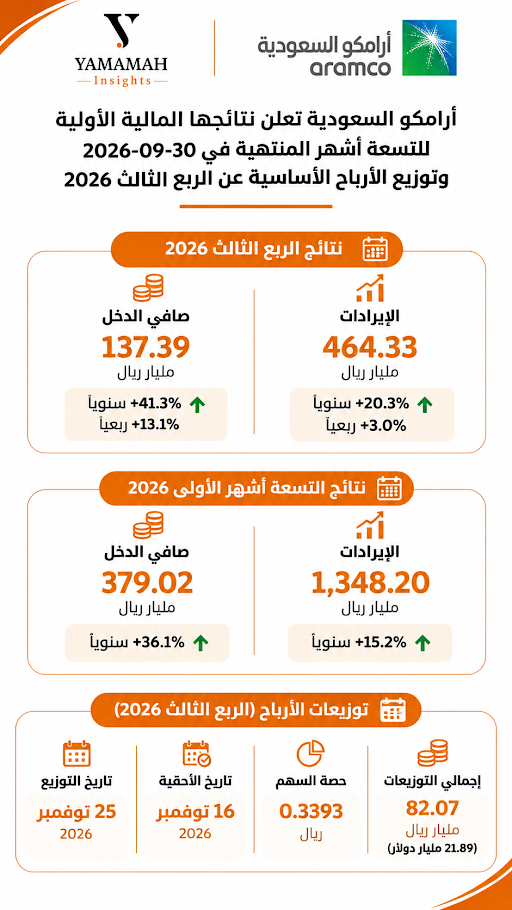
Saudi Arabian Oil Company (Saudi Aramco) announced its preliminary financial results for the third quarter and the nine-month period ended September 30, 2026. It reported a sharp 41.3% rise in net income attributable to shareholders, reaching SAR 137.39 billion (US$36.64 billion), compared with SAR 97.26 billion in the same quarter last year. The increase was supported by higher total revenues and sales-related income of SAR 526.84 billion, higher prices for refined products, chemicals and crude oil, and a gain recognized on the sale of an equity stake in an affiliate. Net income for the nine-month period rose 36.1% to SAR 379.02 billion, with revenue of SAR 1,348.20 billion.
Alongside these record results, and reaffirming its commitment to sustainable returns, the company’s Board approved a base cash dividend to shareholders for the third quarter of 2026, totaling SAR 82.07 billion (US$21.89 billion), or SAR 0.3393 per share. Shareholders eligible for the dividend must own shares on the eligibility date of November 16, 2026, and be registered in the company’s shareholder register at the Securities Depository Center Company (Edaa) at the close of the second trading day after that date—that is, November 18. Distribution will begin on November 25, 2026.
Against the backdrop of revenue growth and investment gains, and the balance between capital investment and a commitment to sustainable cash dividends, Al Yamamah University students discussed the significance of these results and their implications for the future of the Saudi energy giant:
Technology investment diversification and production efficiency
Student "Albatool Bedairi" @Albatool Bedairi began with an investment perspective: "I believe Aramco’s acquisition of a 49% stake in HUMAIN is a strategic move to diversify its investments beyond the energy sector.
Artificial intelligence could help reduce operating and maintenance costs and improve production efficiency, as well as create future revenue opportunities from technology services and data centers.
But the investment’s success depends on its actual return relative to its cost."
Strategic integration and investor confidence
Student "Meshail Alanazi" @Meshail ALANazi highlighted the strength of the company’s financial position: "I believe Aramco’s results reflect its strong financial position and ability to generate profits despite volatility in energy markets.
Its move into artificial intelligence, along with integration with companies such as SABIC and Bahri, enhances efficiency and opens up new sources of income.
Cash dividends also make the stock more attractive and strengthen long-term investor confidence."
Predictive maintenance and shorter downtime
Student "Jana Alshahrani" @Jana Alshahrani analyzed the company’s digital readiness: "I believe Aramco’s 49% investment in HUMAIN is an important step in strengthening its position in technology, especially as artificial intelligence expands globally.
The company could use data analysis to predict equipment failures before they occur, improve production processes and reduce downtime, helping to lower operating costs.
But realizing these benefits depends on successfully implementing the technologies and turning the investment into actual long-term profits."
Sustainable free cash flow and financing expansion
Student "Halah Alalsheikh" @Halah Alalsheikh commented on the balance behind cash dividends: "Regular cash dividends make Aramco shares more attractive to investors seeking steady income, and reflect the company’s ability to generate strong cash flow.
But dividend sustainability depends on continued free cash flow and balancing profit distributions with funding future projects and maintaining the company’s financial position."
What adjusted income reveals when one-off gains are excluded
Student "Rabiah Almugait" @Rabiah Almugait shared her accounting analysis: "Aramco recorded a notable increase in third-quarter earnings, but a closer look shows that part of the growth came from a gain on the sale of a stake in an affiliate, which is non-recurring.
So I think adjusted net income of SAR 117 billion gives us a clearer picture of the company’s performance, apart from exceptional effects."
Portfolio diversity and risk reduction
Student "Noof Alanazi" @Noof Alanazi highlighted the company’s investment competitiveness: "I believe Aramco has a strong competitive advantage thanks to its diverse businesses and investments, helping it reduce risk and avoid relying solely on oil revenue.
Its new investments and cash dividends also reflect a focus on future growth and maintaining shareholder confidence."
Supply chain integration and liquidity constraints
Student "Jumana Alshehri" @Jumana Alshehri broke down the financial statements: "Aramco’s results show strong growth, with revenue up 20% and profits up 41%, taking into account the impact of the stake sale.
Its investment in HUMAIN supports its push into artificial intelligence, while its stakes in SABIC and Bahri strengthen integration and supply chain stability.
The SAR 82.07 billion dividend makes the stock more attractive, but its continuation depends on strong cash flow and the ability to meet obligations."
Tracking operating earnings and energy market volatility
Student "Nouf Alojayan" @Nouf Alojayan emphasized the importance of monitoring revenue quality: "Revenue growth of 20.3% and net profit growth of 41.3% strengthen the company’s ability to meet dividend and other obligations, but adjusted net income of about SAR 117 billion shows the impact of divestment gains.
So we cannot rely on earnings growth alone to assess operating efficiency. We also need to monitor cash flow and operating profits to understand whether this performance is sustainable amid volatility in energy markets."
Free cash flow coverage of cash dividends
Student "Yazan Hamoud" @Yazan Hamoud explained the cash coverage metrics: "What stood out to me was that part of the net profit growth came from non-recurring gains, while adjusted net income rose by just 9.2%.
In my view, dividend sustainability matters most, especially since free cash flow covered third-quarter dividends 1.29 times, but covered only 90% of dividends for the nine-month period. That makes cash flow strength more important than reported earnings growth alone."
Refining and chemicals surge as a buffer against market volatility
Student "Ahmed Jadaan" @AHMED ALJADAAN shared his perspective on the resilience of the operating model: "Aramco’s results offer a practical lesson in the importance of operational integration. Despite a drop in liquids production of about 2.1 million barrels per day, adjusted net income rose 9.2%.
The reason is that profits in the refining and chemicals segment surged to 3.3 times their year-earlier level, offsetting the decline in crude oil sales.
An integrated system spanning drilling, refining and petrochemicals is the real shock absorber that protects Aramco’s profits from market volatility."
Technology vision and integration across transport and manufacturing
Student "Zikra Abdulkareem" @Zikra Abdulkareem commented on structural stability: "The results reflect a strong financial position and the ability to face global challenges.
The move into artificial intelligence reflects a strategic vision to keep pace with technological progress, improve operational efficiency and diversify income sources. In addition, integrating its investments in energy, petrochemicals and transport strengthens business stability and competitiveness, while dividends remain a cornerstone of investor confidence."
Protecting margins and the limits of shipping market volatility
Student @أناغي عطرجي discussed logistics links: "Aramco’s stakes in SABIC and Bahri strengthen integration across production, refining, petrochemicals and transport, reducing operating costs and improving supply chain efficiency.
But volatile shipping and petrochemical prices remain a challenge. Integration helps protect profit margins, but cannot completely eliminate the effects of market volatility."
Adjusted income accuracy and cash flow sustainability
Student "Dina Alarjani" @Dina Alarjani explained the right measure of financial performance: "Aramco’s results are strong, but net profit growth was affected by a gain from selling a stake in an affiliate; adjusted net income therefore gives a clearer picture of the company’s actual operating performance.
The substantial cash dividends remain very attractive, but their sustainability depends directly on continued cash flow and the company’s ability to cover them."
Investing earnings growth and reducing reliance on external parties
Student "Rahaf Alanazi" @Rahaf Alanazi described the foundations of sustainable growth: "Aramco’s strength lies in its ability to use earnings growth to build diverse and sustainable sources of income. Investment in artificial intelligence can improve operations and boost productivity in the future.
Its stakes in SABIC and Bahri also reduce reliance on external parties. Most importantly, it must balance cash dividends with new investments to keep the stock attractive and grow the company."
Operational flexibility and the cost of future investment
Student @ثناء الشايب concluded with questions about efficiency: "A 41% rise in profits compared with 20% revenue growth is a positive sign, but it is important to understand how much of this improvement reflects internal efficiency versus market prices and conditions.
Aramco’s investment in HUMAIN and its stakes in SABIC and Bahri give it greater flexibility to link production with manufacturing and transport, and reduce costs. The key test, however, is whether it can continue generous dividends while also meeting the funding needs of new investment and expansion."
The integrated model and the shift in earnings drivers from prices to volumes
In an analytical assessment, financial and economic analyst "Hamad Alsaeed" @Hamad Alsaeed added: Amid disruption to energy supplies in the region, Aramco’s results put its integrated model to a practical test. The company directs about half of its crude oil to its own refineries and benefited from fuel prices rising faster than oil prices. Refining profits reached 3.3 times their year-earlier level, beating analyst expectations, according to Reuters, and lifted adjusted net income by 9.2% despite production falling by about a fifth.
Notably, free cash flow covered the quarter’s dividends in full, while the base dividend was increased by 3.5%, reassuring income-seeking investors.
Looking ahead, the U.S. Energy Information Administration expects Brent to fall to $74 by the end of 2027, making volumes, rather than prices, the driver of growth. As exports recover and the East-West pipeline expands, a production recovery is expected to be the most important factor in coming quarters.
Over the longer term, Aramco’s acquisition of a 49% stake in HUMAIN takes it into the energy-intensive data center market, linking AI growth to demand for its gas.
 Ask Yamami
Comments (4)
No comments yet. Be the first to comment!