

Estimated financial results for United Electronics Company (Extra) and its subsidiary, United International Holding Company (Tasheel), for the period ended September 30, 2026, showed that total revenue continued to trend upward. Extra recorded 5.3% growth in revenue for the first nine months, reaching SAR 5.96 billion, supported by its retail segment. At the same time, Tasheel’s financing portfolio expanded by 7.3% to SAR 3.2 billion.

By contrast, combined net profit was affected by a SAR 70.1 million increase in net impairment losses on financial assets during the third quarter. This resulted from adopting a conservative credit policy and updating the expected credit loss (ECL) model, putting pressure on consumer finance profitability while the retail segment continued to grow. In this context, Al Yamamah University students analyzed and reviewed the two companies’ results as follows:
Profitability Shift and Pressure from Credit Provisions
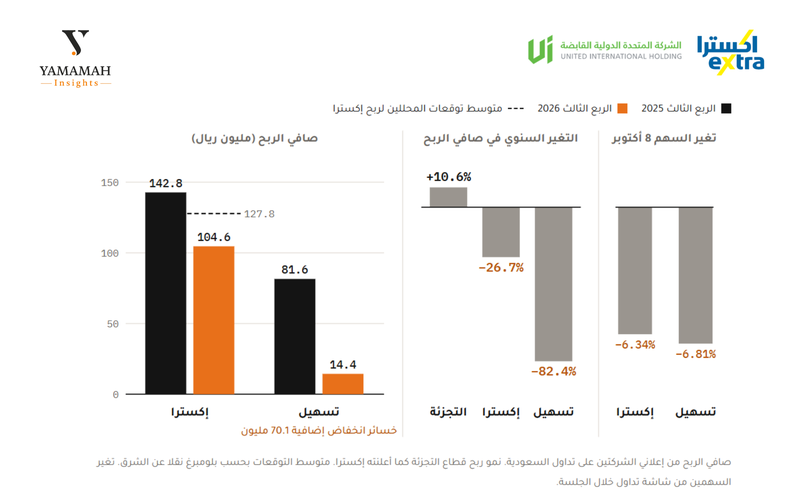
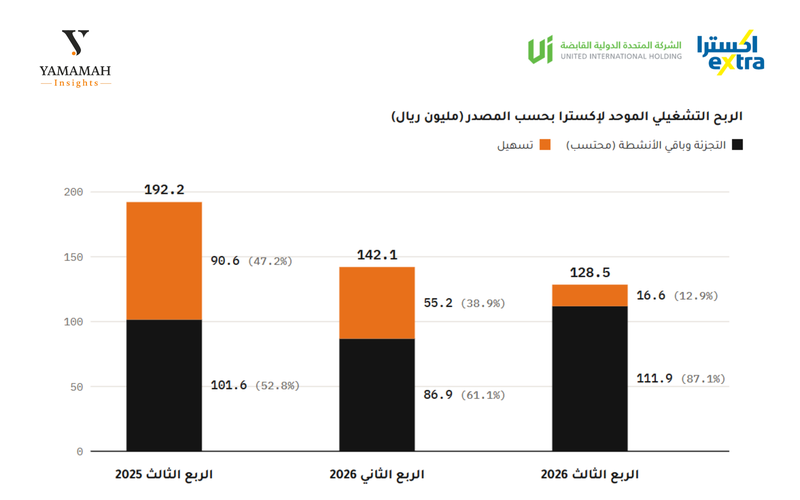
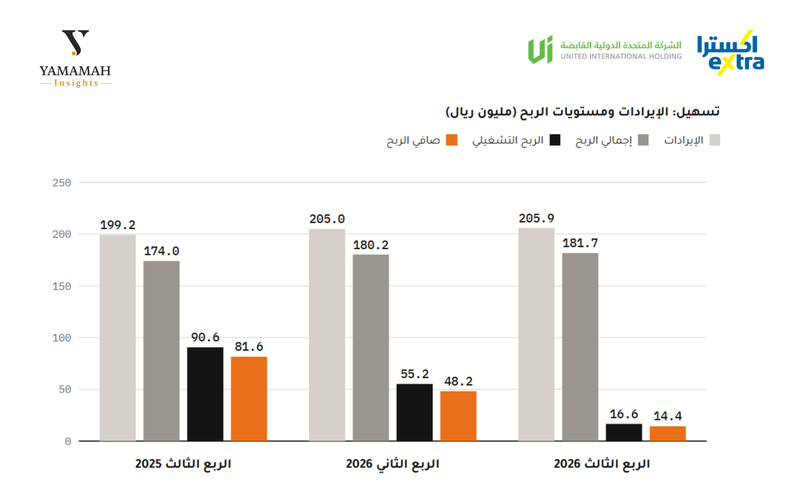
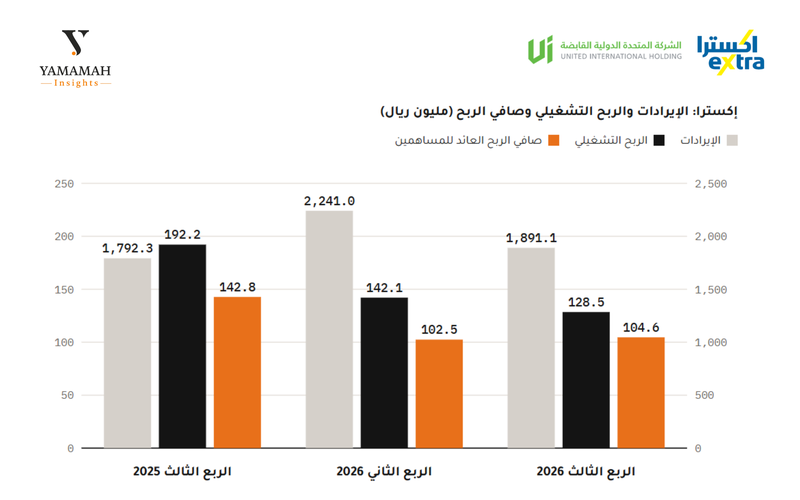
Student Jana Aljebali @Jana Aljebali explained that business growth had not translated directly into growth in net profit, noting where the greatest pressure was concentrated: “Extra reported net profit of SAR 104.6 million, below the analysts’ average forecast of SAR 127.8 million by approximately 18%. This was reflected in declines of 6.34% in Extra’s share price and 6.81% in Tasheel’s share price after the results were announced. Tasheel’s operating profit also fell from SAR 90.6 million to SAR 16.6 million, a difference of nearly SAR 74 million—close to the additional impairment losses of SAR 70.1 million. In contrast, operating profit from retail and other activities rose to SAR 111.9 million from SAR 101.6 million, increasing its share of total operating profit to 87%, up from 53%. This reflects growth in the core business, although the sources of profit have become less diversified.”
Retail Resilience and a Conservative Financing Approach
Student Shahad Alkhamis@Shahad Alkhamis believes that Extra’s 5.8% growth in retail sales and the segment’s 10.6% profit growth reflect strong consumer demand and the segment’s ability to support the company’s earnings. She added: “Tasheel’s additional provisions of SAR 70.1 million are a positive, precautionary step in the long term because they clean up the portfolio and reduce future risks, even if they weigh on current profit. JPMorgan’s target price cut also reflects caution about the consumer finance sector more than an assessment of weak operating performance. In addition, future interest rate declines will help lower borrowing costs and support the growth of Tasheel’s portfolio, boosting consumers’ purchasing power in favor of Extra.”
Credit Management Quality and the Outlook for the Share Valuation
Student Albatool Bedairi @Albatool Bedairi noted that JPMorgan’s cut in Extra’s target share price from SAR 108.5 to SAR 80 reflects a more cautious outlook for earnings, particularly following the increase in credit loss provisions in the consumer finance segment. She added: “This cut does not necessarily mean that operating performance is weak overall, especially since the retail segment continues to deliver good growth. Future interest rate declines could also benefit both companies’ results by easing financing costs and encouraging consumption. The most important factor, however, is the company’s ability to manage credit risk, reduce default rates, and improve portfolio quality, since restoring investor confidence and improving the valuation depend on delivering sustainable profits, not simply revenue growth.”
Debt Resolution Efficiency and Underlying Performance Resilience
Student Rabiah Almugait @Rabiah Almugait affirmed that the retail segment can support overall earnings, saying: “The retail segment can support Extra’s profits and offset the impact of declining Tasheel profits, given the growth in its sales and earnings. The additional provisions, meanwhile, are a positive step if they lead to the resolution of non-performing debts and reduce future risks, even if they affect current earnings. The key challenge remains Tasheel’s ability to improve the quality of its financing portfolio while retail activity continues to grow, in order to deliver more stable profits.”
Retail Strength and the Bold Move to Build Provisions
Student Fay Aldossari @Fay Aldossari believes the companies’ current situation reflects a bold restructuring step and strong operational resilience, explaining this across four areas: “First, the retail segment is the company’s true stronghold and shield, protecting it and ensuring stable cash flows. Second, setting aside SAR 70 million in provisions for Tasheel and writing off non-performing loans is a cleansing decision that improves the portfolio and ensures higher-quality profits in the future. Third, JPMorgan’s report appears excessively cautious and reflects a temporary reading of the credit cycle amid an exaggerated market reaction. Fourth, any future decline in interest rates will provide a dual stimulus, lowering Tasheel’s lending costs and boosting consumers’ purchasing power at Extra.”
Sustaining Credit Quality and Key Indicators to Monitor
Student Yazan Hamoud @Yazan Hamoud stressed that the key issue is the nature of the provisions, saying: “The main indicator to track at present is whether the SAR 70.1 million in provisions is a temporary measure to clean up the portfolio or reflects an ongoing challenge to credit quality. If defaults decline over the coming quarters, we will see a clear recovery in Tasheel and Extra’s profits. But if provisions remain elevated, net profit will continue to face pressure even as retail grows. That is why the quality of the financing portfolio remains the most important indicator to monitor.”
Balancing Prudent Remediation with Improving Consumption
Student Rahaf Alanazi @Rahaf Alanazi explained that Extra’s future depends on the two segments working together, saying: “The company’s future depends on continued retail growth and improved performance in the finance segment alike. The precautionary provisions signal a move toward addressing risks rather than postponing them, which is positive for portfolio quality. While interest rate cuts may support consumption, it is essential to monitor actual financial results to verify their direct impact on profitability.”
Curbing Financing Risks and Restoring Balance
Student Dina Alarjani @Dina Alarjani noted that the results show the strength of the retail segment compared with the impact of non-performing debts and provisions on Tasheel’s profits, saying: “Building provisions is a sound move if it cleans up the portfolio and improves its quality, even if it temporarily takes a portion out of the period’s earnings. Sustainable growth requires a balance between strong retail sales and Tasheel’s ability to control financing risks and avoid defaults.”
Diversifying Revenue Sources and the Quality of Growth
Student Zikra Abdulkareem @Zikra Abdulkareem highlighted the importance of diversifying financial income streams, explaining: “The results underscore the importance of diversifying revenue sources, with the retail segment supporting earnings and stabilizing the company amid challenges in consumer finance. Additional provisions for Tasheel weigh on short-term earnings, but are a positive measure to clean up the portfolio and reduce risks. The target price cut reflects caution about the sector without negating the company’s actual operating efficiency, while future interest rate declines present an opportunity to reduce financing costs and support demand. The bottom line is that sustainable earnings depend not simply on growth, but on its quality and on balancing expansion with risk management.”
Future Catalysts and Absorbing Pressures
Student Ryouf Alsewailim @Ryouf Alsewailim affirmed the company’s success in managing its earnings, saying: “The figures show Extra’s success in using its retail segment as a shield to protect profits, alongside Tasheel’s financial boldness in setting aside precautionary provisions to clean up its financing portfolio—the solid foundation for sustainable earnings. JPMorgan’s target price cut is no more than a cautious reading of temporary conditions, while expectations of lower interest rates remain the biggest catalyst for reducing lending costs and reviving demand in retail markets.”
Controlling Default Rates and the Impact of Reliance on Financing
Student Mohammad Alghaihab @Mohammad Alghaihab believes Extra’s results include both positives and areas that require monitoring, saying: “The retail segment achieved good growth in revenue and profits, but higher credit loss provisions at Tasheel cast a shadow over overall earnings. Increasing provisions is a good step if it is followed by resolution of non-performing debts and a reduction in provisions over the coming quarters. Despite the strength of retail activity, the reliance of part of the earnings on financing makes results more sensitive to credit risk. Controlling defaults will put earnings back on an upward trajectory.”
Lower Interest Rates and Easing the Consumer Burden
Student Ahmed Aljadaan @ahmed aljadaan highlighted the potential impact of upcoming monetary policy, saying: “Any downward path for interest rates in the future would be like killing two birds with one stone for Extra. On one hand, Tasheel’s financing and lending costs would fall, improving its currently compressed margins. On the other, consumers would face a lighter burden, boosting purchasing power and increasing demand for Extra’s retail products.”
Long-Term Outlook Versus Temporary Caution
Student Zaid Darweesh @Zaid Darweesh believes the company’s operating performance has solid indicators, outlining four points: “First, retail performance is excellent and shows that it is a safety valve during financing market volatility. Second, Tasheel’s provisions are a proactive step to clean up the portfolio and ensure higher-quality, more stable profits in the future, despite their current impact. Third, JPMorgan’s valuation is excessively cautious, focusing on temporary pressures and overlooking operational strength, which creates an opportunity for long-term investors. Fourth, the coming interest rate cuts will deliver a dual benefit: cheaper loans for Tasheel and greater liquidity that boosts Extra’s sales.”
Cost Management Efficiency and Interest Rate Challenges
Student Noof Alanazi @Noof Alanazi explained that retail growth reduces reliance on financing, noting: “Sustained retail growth depends on continued consumer demand, while Tasheel’s additional provisions help reduce future default risks despite their current impact. The target price cut reflects a cautious assessment of the challenges, not operational weakness. Interest rates remain a double-edged sword: lower rates reduce financing costs and support lending, while higher rates may increase the burden on customers and put pressure on demand.”
Operational Efficiency and Cleaning Up the Financing Portfolio
Student Raneem Asiri @Raneem Asiri affirmed that the future depends on retail growth as a protective shield and on improving financing efficiency, adding: “The increase in Tasheel’s provisions is an excellent proactive step to clean up the portfolio and write off non-performing debts, ensuring stronger results in the future. JPMorgan’s target price cut also reflects temporary pressures that do not undermine operational strength, while the expected decline in interest rates will boost purchasing power and make borrowing easier, benefiting both companies’ sales and profits.”
Financing Quality and Lending Costs
Student Nada Asiri @nada Asiri highlighted the impact of interest rate movements, saying: “Higher interest rates increase Tasheel’s financing costs and reduce demand for installment plans, while lower rates encourage borrowing and purchases, supporting Extra’s sales and Tasheel’s growth—provided financing quality is maintained and default risks are reduced.”
Operational Efficiency and Earnings Quality
Student Thanaa Alshayib @Thanaa Alshayib asked whether the results are sustainable, explaining: “Retail profits growing faster than sales reflects improved operational efficiency, not merely increased sales. Tasheel’s additional provisions of SAR 70.1 million are a positive step toward cleaning up the portfolio and reducing risks if accompanied by an actual improvement in financing quality. JPMorgan’s target price cut signals caution about the sector and does not reflect weakness at Extra. The most important question is not how much the company earned today, but whether it can maintain and grow those earnings. True growth is reflected in sustainable results.”
Retail as a Safety Net and Strategic Debt Cleanup
Student Dana Alsadoun @Dana Alsadoun explained that the retail segment serves as the company’s safety net through its continued growth, adding: “Tasheel’s increase in provisions by SAR 70.1 million to address debts is an excellent long-term strategic decision, even though it has weighed on current earnings. JPMorgan’s target price cut is a cautious assessment focused only on the current period. As interest rates decline in the future, financing costs will fall and consumers’ purchasing power will increase.”
Results Below Expectations and Disappointing Share Price Moves for Extra and Tasheel
Expert Abdulaziz Khrais believes that the shares of Extra and Tasheel reacted very negatively to their financial results, indicating that investors were dissatisfied with the results.
Khrais explained that Extra’s results were not as disappointing as might have been expected, but it became clear that the pressure was coming from its subsidiary, Tasheel. Retail sales grew, while Tasheel’s profits declined. Extra’s share reacted negatively to the results, falling 8%- and reaching its lowest level in 6 years, specifically since October 2020, touching SAR 53.40.
Regarding Tasheel, Khrais noted that its results were very disappointing, falling by more than 82% compared with the same quarter, due to provisions of approximately SAR 70.1 million. As for the share price, Tasheel hit a record low since its listing of SAR 23.76 in Sunday’s session, extending its decline to 48%- since the start of the year alone. He also noted that Extra owns a 65% stake in Tasheel.
How High Interest Rates and Inflation Affect the Retail and Financing Equation
In an analytical assessment, financial and economic analyst “Hamad Alsaeed” @Hamad Alsaeed adds: Extra and Tasheel’s third-quarter results come at a time when Saudi consumers continue to spend even as borrowing costs rise, explaining the different performance of the two segments within the same group. Consumer spending is growing and domestic inflation is stable at 1.8%, which is why retail profits grew by 10.6%.
By contrast, the central bank raised interest rates in September for the first time since 2023, following the riyal’s peg to the US dollar and a global upswing driven by energy prices and regional tensions. As a result, local borrowers are paying higher interest despite stable prices in their market. This affects the finance company in two ways: its funding costs rise while its customers’ installments remain fixed, and accounting standards require it to record expected losses before they occur. This is the context in which we should view Tasheel’s provisions.
Accordingly, the group’s 26.7% profit decline is due to higher risks, not weak demand. We believe that building provisions early, while the portfolio is still growing, is a decision that protects profitability in coming quarters and keeps retail as the actual growth engine for Extra.
 Ask Yamami
Comments (7)
No comments yet. Be the first to comment!