

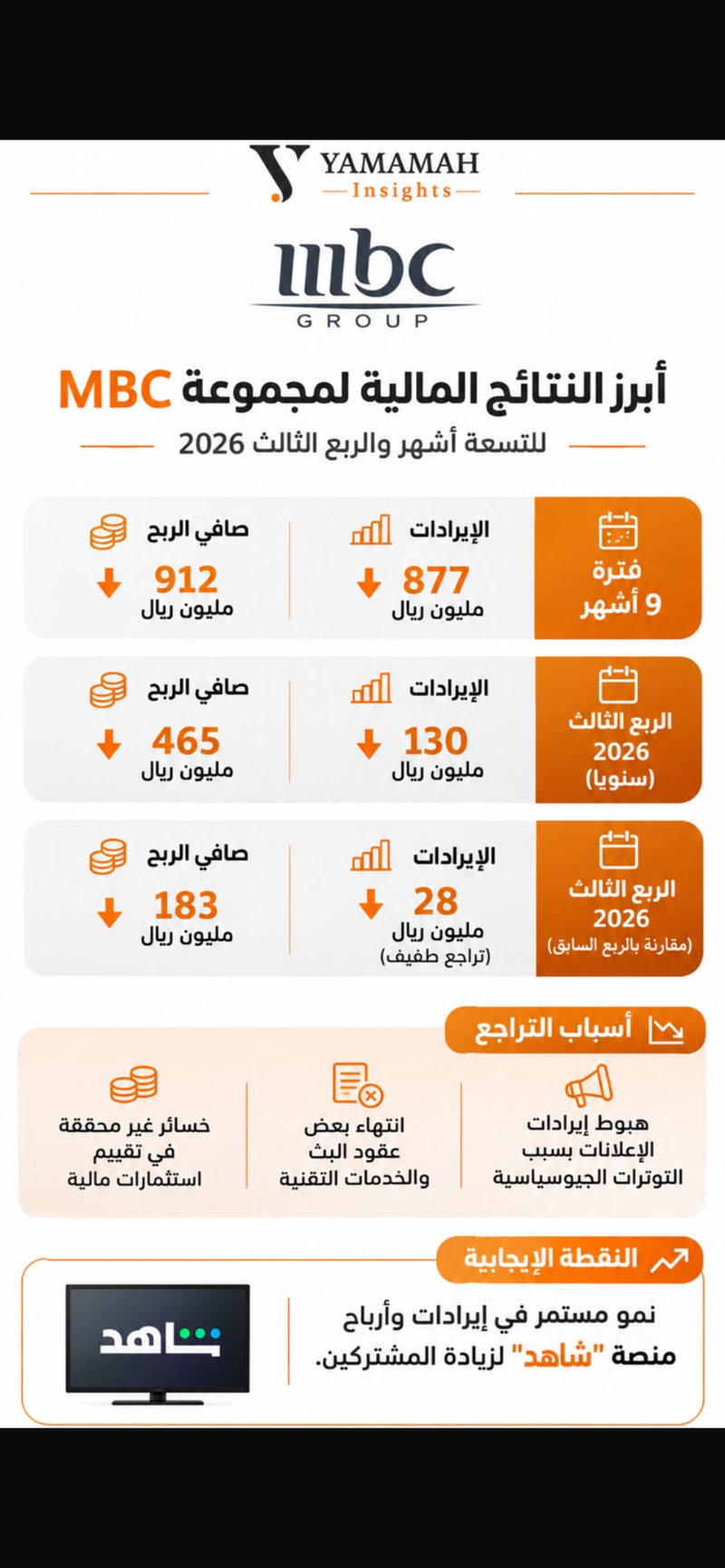
MBC Group's preliminary financial results for the third quarter of 2026 revealed clear pressure in the advertising market and on financial investment valuations, alongside continued resilience in digital streaming. The group's quarterly revenue fell 16.07% (SAR 130 million) to SAR 679.8 million, compared with SAR 810 million in the same quarter last year. Revenue for the first nine months was SAR 2.96 billion, down 22.84%. The decline reflected a SAR 197 million drop in revenue from broadcasting and other commercial activities, as advertising demand slowed amid ongoing geopolitical tensions and the expiration of some broadcasting and technology-services contracts. By contrast, MBC Shahid continued its upward trajectory, with quarterly revenue increasing by SAR 33 million (and by SAR 161 million over the first nine months), driven by subscriber growth. Revenue from media and entertainment initiatives also rose by SAR 34 million due to the timing of project deliveries.
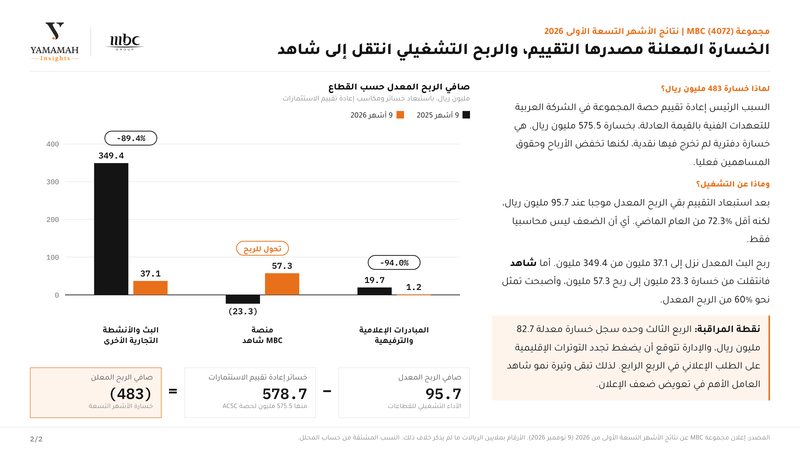
On profitability, the group swung to a quarterly net loss of SAR 445.3 million, compared with a net profit of SAR 19.7 million in the same quarter last year. It recorded a net loss of SAR 509.8 million for the first nine months. The decline was mainly due to unrealized losses of SAR 333 million from a change in the fair value of a financial investment, as well as operating profit turning into a loss of SAR 49.7 million amid weaker broadcasting results, despite a SAR 29 million increase in Shahid's operating profit.
Against challenges in the advertising market and volatility in financial investments, digital streaming and subscriptions are rising as a driver of sustainable growth in media and entertainment.
Al Yamamah University students discussed the implications of these results for the future of MBC Group and the media and entertainment sector:
Digital Transformation and the Quality of Recurring Revenue
Student "Mohammed Almodbil" @Mohammed Almudbil began his investment analysis:
"To me, the most striking part of MBC's results is that the shift toward Shahid is starting to show up financially, not just in subscriber numbers. Shahid's revenue rose about 15.9% in the first nine months to nearly SAR 1.18 billion, and the platform moved from a loss to a net profit of SAR 57.3 million. This matters because a subscription model provides the company with recurring, more predictable revenue than heavy reliance on advertising. As an investor, though, I would look beyond subscriber numbers. What matters most to me is subscriber retention, average revenue per user, content and customer acquisition costs, and whether this growth is actually turning into sustainable cash flow.
As for the quarterly net loss, I think it is important to distinguish between accounting losses and operating performance. A large part of the loss came from revaluing a financial investment. This unrealized loss does not mean the same amount of cash left the company during the quarter. At the same time, it would be wrong to dismiss it and say operating performance is excellent: operational pressures remain, linked to declining advertising and some broadcasting activities. Investors should therefore consider adjusted net profit, operating profit, margins, and cash flow alongside reported net profit to assess earnings quality.
As for competition from social media platforms, I think MBC should use them to reach and acquire audiences, then convert those audiences into users of its own platforms and paid content, rather than trying to compete on the same model. MBC's strengths are its content, intellectual property, audience base, and ability to combine advertising with subscriptions. The group's future, in my view, depends on its success in turning viewing time into recurring revenue, profits, and cash flow, not simply maintaining a large audience."
Subscription Growth and Diversifying Revenue Sources
Student "Rand Alkhalaf"@Rand Alkhalaf shared her perspective on the importance of digital transformation:
"In my view, Shahid's growth is a positive for the group because it creates a recurring source of subscription revenue instead of relying entirely on advertising. Regarding unrealized losses, I think investors should focus on operating performance and cash flows, not net profit alone. To compete with social media platforms, the group needs to develop its digital content and better understand audience interests."
Earnings Quality and the Importance of Operating Performance
Student "Rahaf Alanazi"@Rahaf Alanazi highlighted the importance of assessing financial performance from different angles:
"In my view, digital transformation is a major opportunity for MBC Group because subscriptions provide a recurring, more stable source of revenue than relying solely on advertising. Regarding unrealized losses, investors should not judge the company by net profit alone, but should also consider cash flows, operating performance, and profits from its core business."
Distinguishing Accounting Losses from Actual Performance
Student "Albatool Bedairi"@Albatool Bedairi offered an accounting perspective on the reported losses:
"I believe investors should distinguish between losses from operating activities and unrealized losses resulting from investment revaluations. The SAR 333 million fair-value loss affected accounting net profit, but does not necessarily mean the same amount of cash left the company during the period. Under accounting standards, these changes are recognized in the income statement when an investment is classified at fair value through profit or loss under IFRS 9.
In my view, it is best to analyze operating profit and cash flows alongside net profit. Excluding unrealized losses helps us understand underlying performance, but does not mean ignoring the risk of investment devaluation."
Shahid's Success and Its Impact on Investment Decisions
Student "Jana Alshahrani"@Jana Alshahrani discussed how the platform's growth could shape the group's future:
"In my view, Shahid's growth and move to profitability are positive signs for MBC's future, especially as they reduce its reliance on advertising revenue. As for the losses, it is important to distinguish investment revaluation losses from actual operating performance. Competing with social media platforms will require the company to keep developing its content and attracting subscribers.
From an investment perspective, I would wait for now until we see stable profits and improved cash flows. Shahid's success alone is not enough to judge the performance of the entire group."
Operational Challenges and the Sustainability of Digital Profits
Student "Rabiah Almugait"@Rabiah Almugait stressed the importance of tracking operating performance alongside investment revaluations:
"I believe investors should distinguish between a company's operating performance and losses caused by investment revaluations, since unrealized losses do not necessarily mean the core business has weakened. In MBC's case, however, we can see that operating performance itself faces challenges due to declining advertising and broadcasting revenue, despite Shahid's positive growth. The key is the company's ability to improve operating revenue and grow digital subscriptions, as this will determine whether its profits are sustainable over the long term."
Digital Content and Revenue Diversification
Colleague "Lujain Algorashi"@Lujain Algorashi highlighted the importance of diversifying revenue and adapting to changing audience interests:
"I believe Shahid's growth is an important step for the group because it creates a more stable source of revenue and reduces its reliance on advertising. Unrealized losses alone are not enough to judge the company's performance; what matters more is its operating results and cash flows. The group's ability to compete in the future, I believe, will depend on its success in delivering content that reflects changing audience interests, while making use of its digital presence and diversifying its revenue."
Moving to Digital Platforms and Keeping Up with Audiences
Student "Dina Alarjani"@Dina Alarjani shared her views on digital growth opportunities:
"In my view, MBC's move toward digital platforms such as Shahid is an important step because subscriptions provide more stable revenue than relying solely on advertising.
Regarding the losses, it is important to distinguish unrealized losses from the company's operating performance: a book loss does not necessarily mean the core business is weak.
I believe MBC can remain competitive if it focuses on developing its digital content and keeping pace with viewers' interests, especially as social media use grows."
Digital Transformation and a Flexible Operating Model
Student "Haifa Almutairi"@Haifa Almutairi linked subscription growth to the group's ability to adapt to market challenges:
"In my view, MBC's 2026 results confirm that the future lies in digital subscriptions. While traditional broadcasting and advertising declined, Shahid led growth and generated more sustainable revenue streams.
Book losses from investment revaluations should also be separated from the company's actual operating performance, as they do not represent a cash outflow.
Despite market challenges and pressure from social media platforms, the shift in profitability toward digital shows the group's resilience. Its continued success will depend on investing in exclusive content and diversifying revenue."
Earnings Quality and the Competitive Edge of Digital Platforms
Student "Fahad Alruwaished"@Fahad Alruwaished detailed the financial and strategic factors affecting the group's performance:
"In my view, MBC Shahid's continued revenue and profit growth, driven by subscriber gains, marks a fundamental shift. It gives the group recurring revenue and cash flows that are more predictable, protecting it from seasonal and geopolitical fluctuations currently weighing on the traditional advertising market.
As for the quarterly net loss of SAR 445 million and the SAR 465 million year-on-year decline in net profit, professional investors should separate the unrealized book loss of SAR 333 million, caused by a decline in the value of financial investments, from actual operating performance. These are non-cash accounting items and do not drain operating liquidity or diminish content quality, although there are genuine operating pressures from falling ad revenue and the expiry of some broadcasting and technology-services contracts.
Strategically, the group has a strong opportunity to compete with social media platforms and content creators by leveraging its large-scale original productions and turning Shahid into a comprehensive entertainment platform combining subscriptions and digital advertising, capturing a greater share of advertisers' digital budgets."
Subscription Sustainability and Subscriber Retention
Student @أناغي عطرجي discussed the importance of retaining subscribers and achieving sustainable growth:
"I believe Shahid's subscription model gives MBC recurring, more predictable revenue than advertising, which is affected by market fluctuations. As subscriber numbers grow, profit margins can improve if revenue grows faster than content and operating costs. The real challenge, in my view, is retaining subscribers and reducing churn, because sustainable growth matters more than a temporary increase in numbers."
Developing Digital Content and Strengthening Market Share
Student "Noof Alanazi"@Noof Alanazi pointed to the growth opportunities offered by digital platforms and what competition demands:
"I believe the growth of digital platforms such as Shahid creates new opportunities to increase subscription revenue rather than relying solely on advertising. Regarding unrealized losses, it is important to distinguish them from operating results, as they do not necessarily reflect weakness in the core business. Competition with social media platforms requires the group to keep developing its content and adapting to audience interests to maintain its market share."
Investment Revaluations and the Challenge of Sustaining Growth
Student "Thanaa Alshayib"@Thanaa Alshayib highlighted the difference between accounting losses and the group's digital performance:
"What stands out in MBC's results is that the quarterly loss of SAR 445 million does not tell the whole story, especially since SAR 333 million of it came from revaluing a financial investment rather than direct operating losses. Meanwhile, Shahid's continued growth reflects the group's successful shift toward digital content, with subscriptions helping diversify revenue and reduce reliance on advertising. But the real challenge is sustaining this growth and turning it into lasting profits, amid rising content costs and intense competition for viewers."
From Traditional Broadcasting to Digital Platforms
Student "Yazan Hamoud"@Yazan Hamoud drew attention to the contrast between digital and traditional business performance:
"What caught my attention was that Shahid's revenue rose 15.9%, while traditional broadcasting revenue fell 35.8%, showing how audiences are shifting to digital platforms.
I believe subscriptions can provide more stable income than advertising. However, even after excluding investment valuation losses, the group's adjusted profit fell 72.3%. In my view, the real challenge is whether Shahid can offset the decline in traditional activities and deliver sustainable profits."
Non-Cash Investment Valuations and Shahid's Rising Profitability
Expert "Abdulaziz Khurais" commented on the group's results: "MBC's results were primarily affected by the fall in the fair value of its investment in Arabian Contracting Services Company, in which MBC owns 15.099% of the share capital.
What stands out, however, is the progress in Shahid's revenue and net profit. The company has begun revising its expectations and sharing the targets it set during the past period. Shahid's figures show clear growth: revenue rose 15.9%, and the platform posted a net profit of SAR 57.3 million, compared with a loss in the corresponding period.
The key point for investors is that the company's loss was non-cash, based on the investment's fair value. The company reported adjusted net profit of SAR 95.7 million."
Ad Pressure and Investment Valuations Weigh on Results, While Shahid Closes the Gap
In an analytical assessment, financial and economic analyst Hamad Alsaeed @Hamad Alsaeed added:
"MBC's results came in a year when estimates were betting on an advertising recovery in the second half, but that recovery did not reach television advertising. Most of the SAR 509.8 million loss attributable to shareholders resulted from revaluing the group's stake in Arabian Contracting Services Company; this was a non-cash loss. Still, linking the stake to its market price leaves reported earnings vulnerable to fluctuations with every share-price movement. Operations carry the more important signal: operating profit fell 60.8% and turned into a loss in the third quarter, as broadcasting contracts expired and advertising demand weakened.
By contrast, Shahid now accounts for around 60% of adjusted profit. It leads Gulf subscription services despite lagging in the Saudi market, and its average revenue per subscriber is below that of leading global competitors, leaving room to grow through pricing. The clearest test of an advertising recovery—and of subscriptions' ability to offset its decline—will be the Ramadan season in the first quarter of 2027."

 Ask Yamami
Comments (9)
No comments yet. Be the first to comment!