

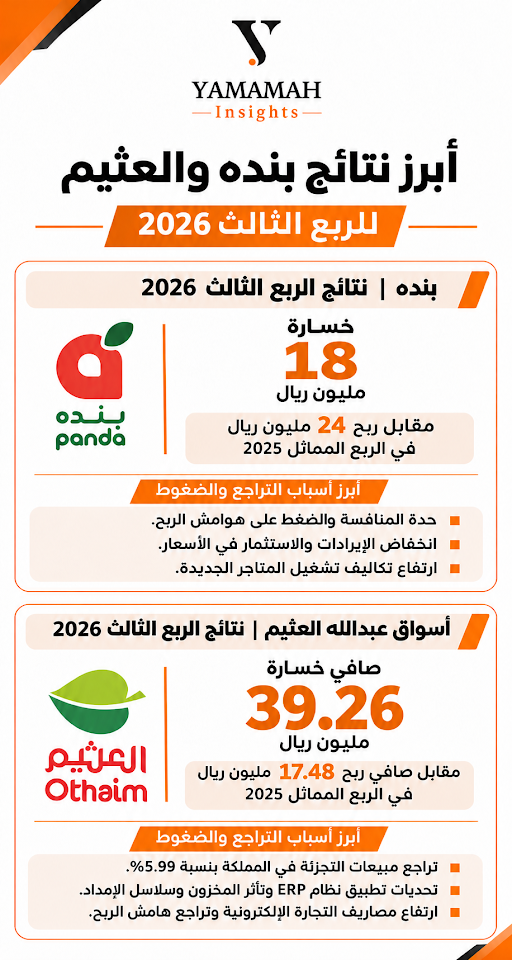
Preliminary financial results for the third quarter of 2026 in Saudi Arabia’s food and consumer goods retail sector revealed clear competitive and operational pressures on leading companies. Savola Group reported revenue growth of 1.5% to SAR 6.5 billion (and SAR 20.1 billion for the first nine months), but quarterly net profit fell 67% to SAR 128 million, compared with SAR 386 million in the same quarter last year. This decline was mainly due to the absence of one-off gains from reversing zakat provisions recorded last year, as well as the retail segment (Panda) posting a net loss of SAR 18 million after investing in prices to protect market share amid intensifying competition. By contrast, the food manufacturing segment performed strongly, with profit rising 31% to SAR 141 million, helping lift the group’s recurring net profit for the first nine months by 26% to SAR 500 million.
Meanwhile, Abdullah Al-Othaim Markets Company faced operational and technological challenges that affected its financial performance. Quarterly sales fell 2.48%, and the company posted a net loss of SAR 39.26 million, compared with a profit of SAR 17.48 million in the same quarter of 2025, weighed down by higher inventory provisions and challenges implementing its enterprise resource planning (ERP) system, which affected supply chains and product availability. Despite these pressures, the company cut its losses by 63.35% compared with the previous quarter, when it recorded a loss of SAR 107.13 million. The improvement was supported by sales growth, lower inventory provisions, a 56% year-on-year jump in e-commerce sales, and capital and exceptional gains from its investments.
Against a backdrop of squeezed retail margins, the rise of the discount-store model, and the costs of digital transformation and supply chains.
Al Yamamah University students discussed the implications of these results and what they mean for the future of Saudi retail:
Cost structure and inventory turnover
Student "Albatool Bedairi" @Albatool Bedairi began her operational analysis: "Discount stores can offer low prices because their operating model is different. They rely on a limited product range, bulk purchases at negotiated prices, and lower costs for decor, services and staff.
They also make up for thinner margins through fast inventory turnover and high sales volumes. The true measure of this model’s success is overall profitability and cash flow, not low prices alone."
Operational efficiency and avoiding a price war
Student "Yazan Hamoud" @Yazan Hamoud highlighted the competitive landscape: "I was struck by how Panda and Othaim went from profits to losses. It shows the scale of price competition in retail.
Discount stores succeed by cutting operating costs and focusing on the most popular products. Panda and Othaim’s real challenge is to improve operating efficiency and retain customers without entering a price war that further squeezes profit margins."
Changing consumer needs and adapting traditional models
Student "Rabiah Almugait" @Rabiah Almugait considered the future of supermarkets: "I expect discount stores to keep growing as consumers focus more on prices, but I don’t think they’ll replace traditional supermarkets, because customers have different needs: some seek the lowest price, while others value product variety and quality.
So traditional retailers may adapt their models and offer more budget-friendly options to protect their market share."
A complete shopping experience and a review of strategies
Student "Noof Alanazi" @Noof Alanazi commented on what attracts customers: "The spread of discount stores reflects changing consumer behavior and greater interest in lower prices. This means traditional retailers must review their strategies and offers to stay competitive.
I believe competition will be about more than price: product quality, variety and the shopping experience will also matter, allowing discount stores to grow without replacing traditional supermarkets."
Cost control and transparent promotions
Colleague "Lujain Algorashi" @Lujain Algorashi shared her view of the competition: "The rise of discount stores shows how competition is shifting toward businesses’ ability to control costs and offer competitive prices by focusing on essential products and improving inventory efficiency.
But lower prices should come from genuine efficiency, not misleading offers that undermine consumer trust and fair competition. The future belongs to businesses that balance affordable prices with sustainable profitability."
Operating savings and bargaining power
Student "Rahaf Alanazi" @Rahaf Alanazi explained the foundations of low pricing: "The secret is cutting operating expenses, such as staffing and decor, and buying in bulk from suppliers to secure lower prices, while accepting a small profit margin and making up for it through higher sales volumes."
Sustaining demand and restructuring business models
Student "Jana Alshahrani" @Jana Alshahrani highlighted the investment equation: "Panda and Othaim’s losses reflect the scale of change as discount stores like Q reduce product variety and expenses to price more flexibly.
But lower prices do not necessarily mean profits; success depends on sales volume and sustained demand. The key investment question is: Can Panda and Othaim adapt their operating models to meet the competition, or will pressure on their profit margins continue?"
Protecting margins and earning consumer trust
Student "Rand Alkhalaf" @Rand Alkhalaf pointed to the challenge of balancing prices: "The spread of discount stores has intensified competition and squeezed Panda and Othaim’s profits by cutting costs and relying on higher sales at lower margins.
But price competition and unclear offers can affect consumer trust, forcing traditional retailers to improve their offers and pricing to protect their market share."
Flexible displays and lower administrative costs
Student "Dana Alsadoun" @Dana Alsadoun described how discount stores cut costs: "Their ability to sell at low prices without losing money comes from a flexible model that reduces administrative costs, displays products in their cartons and uses as few employees as possible, along with fast inventory turnover, strong supplier discounts and low-cost imports."
Why data matters—and why sweeping claims fall short
Student "Faisal Alsaadoun" offered a methodological critique of his classmate’s argument: "Using lots of terminology doesn’t make an argument strong. Claims about operational flexibility, inventory turnover and imports need figures and studies to support them.
Linking major companies’ losses to rising costs, then concluding that discount stores are superior, overlooks differences in business scale, strategies and margins. Sound economic analysis means backing claims with figures and understanding how they relate, not showcasing management jargon."
A divided market and oversight of fake promotions
Student "Zaid Darweesh" @Zaid Darweesh outlined the competitive landscape and the sector’s future: "Discount stores like Q have changed the game by cutting costs, displaying goods in their cartons and relying on private labels.
The Ministry of Commerce is right to intervene, because using loss-leading prices and fake offers as bait undermines fair competition and destroys consumer trust.
The market is heading toward a clear split: discount stores will capture dry groceries and canned goods, while traditional supermarkets focus on fresh products and the shopping experience to stay relevant."
The pricing trap and the search for alternative channels
Student "Ahmed Al Jadaan" @AHMED ALJADAAN described the dilemma facing large chains: "Retail is caught in a brutal pricing trap. For giants like Panda and Othaim, the equation is now: cut prices and sacrifice margins, posting losses of SAR 18 million and SAR 39 million, or hold prices and lose customers.
The traditional supermarket’s challenge today isn’t how to slash prices, but how to build digital channels and smaller stores that can help it stay afloat in this fierce competition."
Structural change and market repositioning
Student "Fay Aldossari" @Fay Aldossari stressed that change is inevitable: "What we’re seeing isn’t a temporary wave but a fundamental structural shift in Saudi retail toward efficiency and value, through narrower product ranges and faster capital turnover.
Traditional supermarkets won’t disappear, but they’re under pressure to reposition: either compete on discounts or become destinations for fresh goods and a premium experience. Undifferentiated mid-sized stores stand to lose the most."
Sustainable profitability versus the lure of low prices
Student @Thanaa Alshaib shared her view on the financial balance: "Competition today isn’t just about who offers the lowest price, but who can maintain low prices and still make a profit.
The real challenge isn’t attracting customers with offers, but keeping them without hurting profit margins. The sector’s future belongs to companies that balance affordable prices, operational efficiency and consumer trust."
Industrial engineering and supply chain efficiency
Student @Omar Al-Sheikh presented a detailed analysis through the lens of figures and industrial engineering: "Competition has become a test of cost and supply chain management without sacrificing margins. Panda posted a loss of SAR 18 million, and Othaim a loss of SAR 39.26 million, also affected by ERP system challenges.
More than 40,000 inspections by the Ministry of Commerce strengthen fair competition. From an industrial engineering perspective, true competitive advantage means delivering the right product, in the right quantity, at the right time, at the lowest possible operating cost—reducing unit costs and improving inventory turnover."
Consumer awareness and protecting market share
Student @Anaghi Atarji described the shift in consumer behavior: "The move toward discount stores like Q reflects a gradual change in consumer behavior and greater price awareness, but they won’t replace traditional supermarkets, which offer a wider range of services.
Panda and Othaim’s real challenge is to protect their market share without entering price competition that squeezes profit margins."
Different profit models and store restructuring
Student "Mohammad Alghaihab" @Mohammad Alghaihab added a long-term perspective: "Panda and Othaim’s shift to losses shows the pressure from discount stores, which offset lower margins with higher sales and lower store costs. But staying in business depends on covering costs and generating positive cash flow.
The rise of discount stores will push large companies to rethink store sizes, operating costs and pricing strategies. In the long run, winners will be those that achieve both competitive prices and sustainable profits."
Intense competition and diverse business models in retail
Expert "Abdulaziz Khrais" commented on market changes: "Competition in retail remains fierce, weighing on sector profits—especially with the arrival of discount stores, which use aggressive pricing to attract as many customers as possible.
As consumer behavior changes, the struggles of large companies have become clear. This was reflected in comments by Savola’s chairman, who said competition for Panda in retail is tough, as well as in remarks by Othaim’s CEO, who fought the discount stores with all his might.
Some companies are trying to change their business models by diversifying revenue. We’ve seen this recently with Panda’s partnerships with Extra, and Danube’s various acquisitions."
Fixed costs versus the flexibility of discount stores
In an analytical review, financial and economic analyst "Hamad Alsaeed" @Hamad Alsaeed adds: The combined profits of Panda, Othaim, Al-Mazra’a and BinDawood shifted from SAR 90 million to a loss of SAR 16.7 million in the third quarter. This signals that competition from discount stores is showing up in financial statements—and that it’s a contest between operating models, not just prices. Discount stores sell at lower margins and turn over inventory in 14 to 28 days, while paying suppliers within 30 to 60 days, financing part of their growth through suppliers.
By contrast, supermarkets carry fixed costs, so a drop in sales has a greater effect on net profit. Notably, consumers haven’t abandoned supermarkets: Panda’s transactions rose from 88 million to more than 95 million while sales remained flat. People visit more often but spend less. Chains have advantages discount stores lack, especially purchasing power and customer data. The next phase belongs to those who turn these assets into lower operating costs per square meter—not those with the largest store network.

 Ask Yamami
Comments (6)
No comments yet. Be the first to comment!