

Saudi Logistics Services Company SAL continued to grow in the third quarter of 2026, with revenue rising 37.53% to SAR 579.3 million, compared with about SAR 421.2 million in the same quarter of the previous year.
Net profit also rose 28.2% to SAR 231.9 million, while operating profit increased 34% to SAR 251.8 million. For the first nine months, revenue reached about SAR 1.54 billion, up 28.2%, and net profit grew 16.9% to SAR 579.9 million.
The growth was mainly driven by a 35.5% increase in third-quarter revenue from the cargo ground-handling segment and 53.1% growth in logistics services revenue, supported by higher cargo volumes, a more diverse customer base and an expanded range of services.
These results invite discussion of several financial aspects, particularly the sustainability of revenue and profit growth, operational efficiency, the debt-to-equity ratio of 148% in the second quarter, and the extent to which the company's expansion contributes to the Saudi economy and enhances the investment appeal of its shares.

Al Yamamah University students discussed the financial aspects of SAL's results, the impact of logistics-sector growth on the company's future, and the challenges of financing and sustaining profits, as follows:
Sustaining growth beyond peak trading seasons
Student Rahaf Alanazi@Rahaf Alanazi shared her perspective: "I believe the company's growth is not tied only to trading seasons; it reflects increased commercial activity and expansion in shipping and logistics. Peak seasons boost demand, but the key is the company's ability to maintain growth throughout the year."
Cash flow and the ability to meet financial obligations
Student Yazan Hamoud @Yazan Hamoud highlighted the importance of monitoring the company's financial position: "What caught my attention is that SAL's revenue grew 13.1% and its profit 21.2% compared with the previous quarter, but its 148% debt-to-equity ratio warrants attention.
I believe higher liabilities are not necessarily a problem if the company generates strong cash flows that cover financing costs. The most important things to monitor are operating cash flow and the company's ability to meet its obligations, because real growth is not just about higher profits; it also means achieving them without significant financial strain."
Operational efficiency and debt management as conditions for sustainable growth
Student Rabiah Almugait @Rabiah Almugait said: "SAL has a significant opportunity to benefit from the growth of the Kingdom's logistics sector, particularly as major projects expand and air freight and trade volumes increase. This can boost revenue and support the sector's contribution to the national economy.
But more important than revenue growth is the company's ability to sustain it and improve operating efficiency, so that increased activity translates into net profit and stronger margins. The debt-to-equity ratio also needs monitoring, as persistently high financing costs could weigh on net profit in the future.
I believe SAL's strength should be measured not only by its current results, but also by its ability to achieve sustainable growth while managing costs and debt efficiently."
Distinguishing seasonal from sustained growth and assessing share appeal
Student Jumana Alshehri @Jumana Alshehri shared her view: "I believe SAL's growth reflects increased commercial activity and the development of the Kingdom's logistics sector, which supports GDP and creates new opportunities. But sustaining growth depends on operating efficiency and maintaining profit margins, especially since a 148% debt ratio could raise financing costs if interest rates remain high.
It is also important to distinguish seasonal growth from sustained growth. As for the stock, its price-to-earnings ratio and dividend yield make the company attractive to investors, but the key is its ability to sustain profit growth and turn expansion into lasting returns."
Logistics expansion and its role in supporting the Saudi economy
Student Dina Alarjani @Dina Alarjani added: "In my view, SAL's results show positive performance and growth in the logistics sector, but its higher debt ratio could put pressure on future profits. The company's expansion supports the Kingdom's economy and Vision 2030 goals, though continued growth depends on commercial activity and the company's ability to control costs."
Improved operating efficiency and the impact of seasonal shipping
Student @أناغي عطرجي said: "I believe SAL's 21% net profit growth, compared with 13% revenue growth, points to improved operating efficiency and profitability, rather than simply increased commercial activity.
In my view, major projects support long-term growth, but seasonal shipping and trade can affect results from quarter to quarter. It is therefore important to compare performance year over year to determine whether growth is sustainable or tied to particular seasons."
Operating profit quality and its role in covering leverage
Student Ahmed Al Jadaan @AHMED ALJADAAN noted: "The 148% debt-to-equity ratio appears high, but it may be normal and justified in the infrastructure and logistics sector, where companies rely on substantial assets and ongoing capital expansion.
What matters most is the quality of operating earnings and their ability to cover this debt. Although the logistics segment recorded an operating loss of nearly SAR 11 million, ground handling delivered an operating profit of SAR 266 million, with a strong margin of 52.9%, helping to offset those losses.
I believe this strong margin provides the company with a buffer against financing pressures."
Managing financing costs and generating sustainable returns
Student Rand Alkhalaf @Rand Alkhalaf said: "I believe SAL's debt ratio is relatively high, but it may be justified if the debt supports expansion and growth. Still, higher interest rates could increase financing costs and affect profits.
The company's growth and expansion also support the Saudi economy by developing logistics services and increasing trade. In my view, continued revenue and profit growth depends not only on seasons, but also on major projects and increased commercial activity.
As for the stock, earnings per share are a positive indicator, but its appeal also depends on the company's ability to sustain growth and generate lasting profits."
Managing financing risks and strengthening the Kingdom's logistics position
Student Meshail Alanazi @Meshail ALANazi shared her view: "I believe SAL is benefiting from growing demand in the logistics sector, but sustainable profits depend on its ability to manage financing costs and expand efficiently.
Its expansion also supports the Kingdom's position as a global logistics hub and boosts the sector's contribution to GDP. A high price-to-earnings ratio may be justified if revenue and profit growth continue, but debt levels and the risk of higher interest rates must be monitored."
Leverage and the nature of investment in logistics
Student Fahad Alruwaished @Fahad Alruwaished offered his perspective: "I believe the 148% leverage level is high in theory, but may be justified by the nature of assets in the logistics sector, which requires major capital investment in infrastructure. Still, the company should be cautious about persistently high interest rates and their future impact on financing costs and net profit.
This logistics expansion is linked to a greater contribution to non-oil GDP and supports the Kingdom's position as a global logistics hub in line with Vision 2030.
Quarterly revenue growth of 13.1% to SAR 579.3 million and net profit growth of 21.2% to SAR 231.9 million reflect a combination of momentum in major projects, a broader customer base and ground handling, alongside busy trading seasons that increase cargo volumes.
With earnings per share of SAR 7.25 for the first nine months and total profits of SAR 579.9 million, a price-to-earnings ratio of about 15 makes the stock reasonably attractive. The sector may merit a valuation premium because of its strong cash flows and competitive position."
Diversified growth drivers, operating efficiency and valuation appeal
Student Fay Aldossari @Fay Aldossari explained in her analysis:
A debt-to-equity ratio of 148% is fully justified by the asset-intensive nature of the logistics sector. This ratio does not pose any structural risk, particularly given the company's strong operating cash flows and excellent interest coverage. This financial stability coincides with the sector's significant economic impact: it is a key driver in transforming the Kingdom into a global logistics hub in line with Vision 2030, while directly supporting non-oil sectors.
Operationally, profit growth of 21%, outpacing revenue growth of 13%, reflects a notable improvement in efficiency, resulting directly from a positive combination of major-project momentum and busy trading seasons.
These factors make the stock's valuation attractive to investors, with a price-to-earnings ratio of about 15 and earnings per share of SAR 7.25. Beyond its current valuation appeal, the company deserves an additional premium reflecting its market leadership and rapid growth.
Free cash flow and the ability to fund expansion
Student Mohammed Almudbil @Mohammed Almudbil added: "I believe SAL's results are positive, but with major expansion plans, the key in the coming periods will be monitoring free cash flow, not just net profit.
The company may generate profits and good operating cash flows, but heavy spending on projects and expansion could leave little cash after investment. The expansion will be successful if SAL can fund its projects and continue distributions without significantly increasing its debt."
Asset efficiency, supply chains and support for the non-oil economy
Student @عمر الشيخ said: "SAL's debt-to-equity ratio is about 148%, which warrants monitoring but does not necessarily indicate structural risk, given the logistics sector's need for major investment in infrastructure, equipment and expansion. The key is the company's ability to generate enough cash flow to service its debt, particularly as persistently high interest rates could raise financing costs and weigh on profits.
SAL's growth and international expansion also strengthen the Kingdom's position as a regional logistics hub by facilitating trade, improving import and export efficiency, and creating jobs. From an industrial engineering perspective, this contribution can be seen in lower supply-chain costs, faster cargo handling, and more efficient use of assets and infrastructure.
Quarter-on-quarter revenue growth of 13.1% and net profit growth of 21.2% are positive indicators, especially as profit growth outpaced revenue growth, which may point to better operating efficiency. However, sustainable growth should be distinguished from the effects of trading seasons and acquisitions, while cargo volumes and profit margins should be monitored to confirm that performance can continue.
For the stock's valuation, earnings per share of SAR 7.25 for nine months and a price-to-earnings ratio of about 15 are noteworthy. Logistics companies may merit a valuation premium due to trade growth and infrastructure investment, provided this is supported by sustainable profit and cash-flow growth and a good return on invested capital.
In my view, SAL has promising growth opportunities thanks to the Kingdom's strategic location and expansion in logistics, but its long-term success depends on balancing growth with financial stability. From an industrial engineering perspective, success is not measured simply by increasing cargo volumes and revenue, but by the company's ability to boost productivity, make better use of assets, reduce operating costs, and convert growth into sustainable cash flows and profits."
Controlling operating costs and turning expansion into profits
Student Noof Alanazi @Noof Alanazi shared her view: "I believe SAL's growth reflects the importance of logistics and its role in supporting the Saudi economy, especially amid expanding commercial activity and major projects. The company's broader range of services and ability to reach new markets also create greater growth opportunities.
However, I believe sustaining this growth depends on controlling operating costs and improving efficiency to ensure profits grow alongside revenue."
Balancing expansion, profitability and financial stability
Student Jana Alshahrani@Jana Alshahrani said: "In my view, SAL's third-quarter 2026 results show positive growth in the company's business, particularly with revenue up 13.1% and net profit up 21.2% compared with the previous quarter.
But what matters more than higher profits is the company's ability to convert this growth into strong cash flows, especially with its debt-to-equity ratio reaching 148%.
The company's expansion in logistics offers an opportunity to increase market share, but it may also raise operating and financing costs. I believe SAL's continued success depends on balancing expansion with profitability while maintaining a stable financial position."
Sustainable profits and debt management as drivers of share appeal
Student Thanaa Alshayib @Thanaa Alshayib added: "I believe SAL is clearly benefiting from the growth of the Kingdom's logistics sector, particularly through major projects and expanding commercial activity.
The 148% debt-to-equity ratio warrants monitoring, but the key is the company's ability to generate cash flows that cover its obligations, especially as financing costs rise.
Revenue and profit growth are positive signs, but it is important to determine whether this growth is sustainable or tied to particular seasons.
A price-to-earnings ratio of about 15 seems reasonable to me if the company continues to deliver solid growth.
In short, SAL has promising growth prospects, but sustainable profits and debt management will determine the stock's long-term appeal."
Balancing expansion and leverage: operating strength versus financing costs
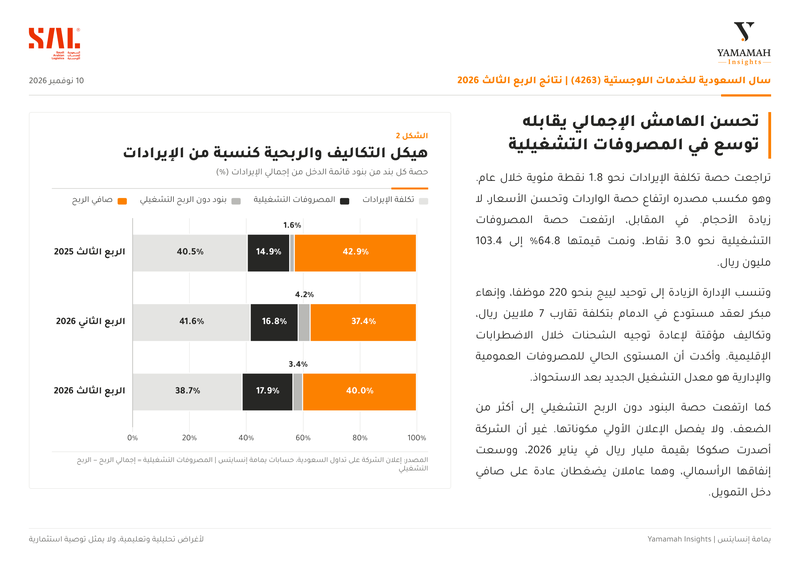
In an analytical assessment, financial and economic analyst "Hamad Alsaeed" @Hamad Alsaeed said: Third-quarter results put SAL at the intersection of clear operating strength and rising expansion costs. On the opportunity side, gross margin increased to 61.3%, supported by pricing power in ground handling and a higher share of imports, while the acquisition of Liege in Belgium opens the door to international expansion and more diversified income sources.
By contrast, operating expenses grew 64.8%, outpacing revenue growth, while non-operating items and zakat doubled as a share of revenue. With leverage at 148% of equity in the second quarter, any rise in interest rates will increase the cost of variable-rate financing and refinancing, pressuring net profit—particularly given distributions of about 75% of profits, a capital expenditure plan of nearly SAR 5.2 billion through 2030, and management's lowered volume outlook for 2026.
The company can still fund growth from the strength of its core business, but sustaining that growth will depend on controlling expenses and using debt efficiently.


 Ask Yamami
Comments (5)
No comments yet. Be the first to comment!