

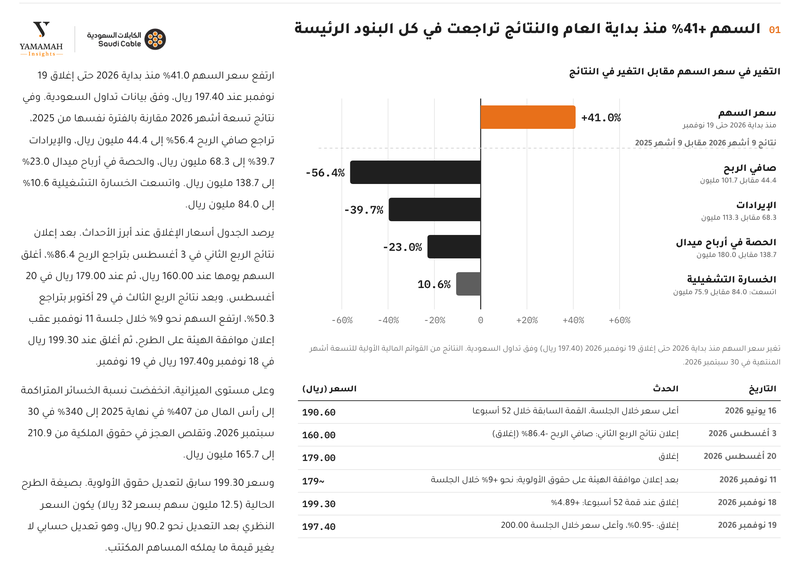
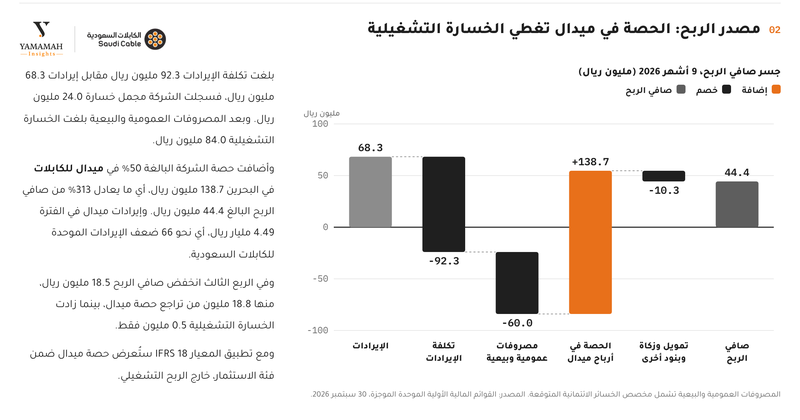
Saudi Cables’ nine-month 2026 results showed a gap between profit and operations. The company posted net profit of SAR 44.35 million, primarily from its share of earnings at associate Midal, which totaled SAR 138.68 million, down 23% from last year.
Its core business remains under pressure: revenue fell 39.72% to SAR 68.28 million, and the operating loss reached SAR 83.99 million. The company attributed the revenue decline to liquidity constraints and lower customer advance payments.
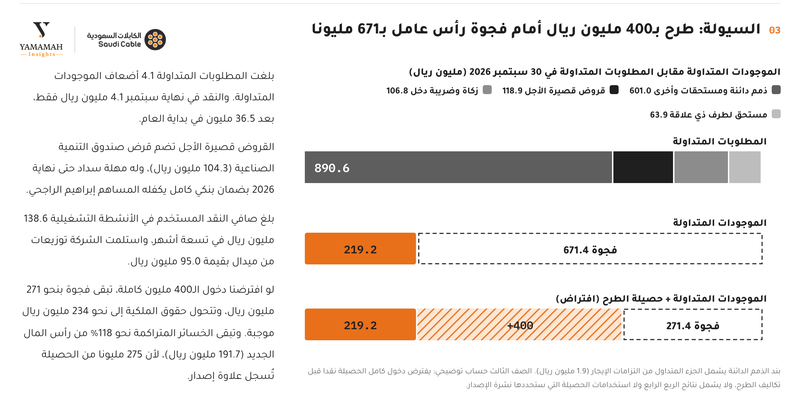
On the balance sheet, accumulated losses reached SAR 227 million, or 340% of capital, while current liabilities exceeded current assets by SAR 671.4 million. The company has also returned to financial reorganization proceedings, and its auditor cited material uncertainty about its ability to continue as a going concern. Management is counting on a SAR 400 million rights issue and revenue growth; the offering is still awaiting approval from the extraordinary general assembly.

In this context, Al Yamamah University students analyzed the company’s performance and challenges to its continued operation as follows:
Limits of the Capital Increase and Expense Management
Student Dina Alarjani @Dina Alarjani believes the share price rise may reflect expectations of an improved outlook for the company. She added: "I don’t expect SAR 400 million to solve all the company’s problems. For Riyadh Cables, the difference lies in how expenses and liquidity are managed."
Market Optimism and Operational Efficiency
Student Jana Alshahrani @Jana Alshahrani explained that Saudi Cables’ share price rise despite lower profits reflects investors’ optimism about the company’s future more than its current financial performance, particularly given its restructuring plan. She added: "A SAR 400 million offering may ease the liquidity crisis, but it won’t solve the problem completely, especially as short-term liabilities exceed SAR 671 million. Compared with Riyadh Cables, the difference is not just sales volume; it also comes down to operational efficiency and managing costs and liquidity."
The Real Test: Generating Cash Flow
Student Mohammed Almodbil @Mohammed Almudbil noted that the share price rise alongside weaker results suggests the market is pricing in a future recovery and better use of the company’s assets. He cautioned: "As an investor, a higher share price isn’t enough unless it translates into cash flow and operating profitability. The SAR 400 million rights issue is a first step, not a complete solution, given a liquidity gap of around SAR 671 million. What matters most is how the funds are used to restore operations and generate sustainable revenue. The comparison with Riyadh Cables shows that strong demand alone is not enough without operational efficiency and working-capital management. The real test for Saudi Cables starts after the capital increase, not when its share price rises."
Financing Capacity and Industrial Contract Execution
Student Albatool Bedairi @Albatool Bedairi explained that the difference between Riyadh Cables and Saudi Cables shows that strong sector demand alone cannot guarantee profits. She said: "Riyadh Cables benefited from a diverse product range and improved performance, earning quarterly profits of SAR 325.1 million. Saudi Cables, meanwhile, faces liquidity pressures that have limited its ability to execute contracts. The key difference lies in operating efficiency, the ability to finance production, and working-capital management. Industrial companies need cash to buy raw materials and run factories so they can meet market demand."
Optimistic Market Valuation and Shareholder Strategies
Student Ghada Alsarheed @Ghada Alsarheed discussed the gap between the optimistic market valuation and the company’s strained financial reality. She said: "The share reaching a five-year high despite a 50% decline in third-quarter profits reflects the market’s bet on a transformation story, driven by infrastructure projects, a limited free float, and brand value. Still, the SAR 400 million rights issue is an operational lifeline and a first step, covering around 60% of the SAR 671 million short-term liabilities gap. Its main purpose is to provide working capital to buy copper and aluminum and restore confidence in the B2B supply chain. Riyadh Cables, by contrast, earned SAR 325.1 million thanks to its financial strength and ability to deliver immediately. To achieve the best outcome, management should focus on quick-turnaround projects with prompt payment and improve transparency. Existing shareholders could also take partial profits before the rights date to protect their capital and use the proceeds to subscribe for remaining shares."
Associate Earnings and a Stalled Industrial Business
Student Ahmed Al Jadaan @AHMED ALJADAAN highlighted the nature of the reported profit: "The apparent profit is an accounting gloss. The company is losing money in its core business and factories, with an operating loss of SAR 84 million. Its net profit comes from its investment in Bahrain’s Midal, which contributed earnings of SAR 138.7 million and offset the deficit. This means the cable manufacturing business is almost at a standstill without the associate."
Restarting Factories and Turning Demand into Cash
Student Yazan Hamoud @Yazan Hamoud affirmed that the share reaching a five-year high despite a 50% decline in profits reflects investors’ optimism about a recovery more than the company’s current performance. He added: "The SAR 400 million capital increase is a positive step, but it alone cannot address the SAR 671 million liquidity gap. The real test is whether the company can restart its factories and turn strong demand for cables into actual profits and cash flow, as Riyadh Cables has done."
Shareholder Decision Criteria and Rights Issue Price
Student Meshail Al Anazi @Meshail ALANazi believes the share price rise reflects investors’ optimism about the company’s future and its restructuring plan, but does not mean the financial crisis is over. She added: "SAR 400 million may help ease the liquidity crisis, but it isn’t enough on its own to solve it. A shareholder’s decision depends on the rights issue price and the company’s ability to recover. The difference between Saudi Cables and Riyadh Cables comes down to operational efficiency, financial position, and the ability to benefit from sector demand."
Cost Control and Subscription Risk Assessment
Student Rand Alkhalaf @Rand Alkhalaf noted that the share price rise despite lower profits reflects investor expectations of future improvement through restructuring and a capital increase. She said: "SAR 400 million may ease the liquidity crisis without solving every problem. Shareholders should review the financial position and risks before selling or subscribing. The difference with Riyadh Cables comes down to management and operational efficiency, and the ability to control costs and turn demand into profits."
Pricing in Restructuring and Collecting Receivables
Student Fahad Alruwaished @Fahad Alruwaished explained that the share reaching SAR 199.30, up 42.36% since the start of the year, despite nine-month net profit falling to SAR 44.3 million from SAR 102 million in 2025 and third-quarter revenue dropping 23% quarter-on-quarter, reflects the market pricing in restructuring and an expected recovery in demand rather than current performance, which is constrained by lower customer advances. He added: "The SAR 400 million rights issue is a necessary first step to restart the factory, but it alone won’t end the liquidity crisis given the SAR 671.4 million working-capital deficit and accumulated losses equal to 340% of capital. Operational efficiency and collecting receivables will therefore be critical to completing the recovery."
Using Liquidity Well and Addressing Debt
Student Noof Al Anazi @Noof Alanazi cautioned that the share price rise may be based on expectations of future business improvement. She added: "Caution is needed: the real challenge is addressing debt and restoring production. A capital increase offers a chance to recover, but success depends on using the funds well. Riyadh Cables’ stronger performance highlights the importance of good management and operational efficiency."
Capturing Sector Opportunities and Managing Resources
Student Rahaf Al Anazi @Rahaf Alanazi believes the share price rise reflects investors’ optimism about growing demand from energy and infrastructure projects, but does not mean the financial challenges are over. She said: "SAR 400 million is an important step toward restarting the factory, but it needs a clear plan to address liabilities and deliver sustainable results. Shareholders should assess the financial position, recovery prospects, and subscription risks rather than relying on the share price. The difference with Riyadh Cables lies in operational efficiency and financial management: turning sector opportunities available to all into profits and cash flow."
Scarce Shares and Restarting Industrial Production
Student Fay Aldossari @Fay Aldossari offered an analysis of trading and the company’s financial position, explaining: "The market is responding to share scarcity after the capital reduction, with shares changing hands ahead of the general assemblies to make the rights issue more attractive. Investors are betting that the company has reached its operational low. For an industrial company, the SAR 400 million does not need to repay all SAR 671 million of debt at once; it needs to ease the bottleneck and buy copper to restart idle production lines, then reschedule debt once confidence returns. It would be a mistake to treat the stock as a long-term investment at a five-year high. Selling to lock in gains can protect investors from rights-related volatility, while staying invested may suit those with additional cash who can wait through the next four quarters. The difference with Riyadh Cables comes down to financing costs, the ability to pay cash for purchases, and the capacity to provide bank guarantees for major projects."
Distinguishing Expectations from Actual Results
Student @ثناء الشايب affirmed that the company is at a pivotal stage. She said: "The share price rise despite financial challenges reflects some traders’ optimism, but it is essential to distinguish expectations from financial and operational reality. A capital increase is a good start, but the funds must be used effectively to achieve real growth in sales and profits. A company’s strength is measured by the sustainability of its financial results, not merely by a rising share price."
Sustainable Profitability Amid Operating Losses
Student Mohammed Alghaihab @Mohammad Alghaihab questioned the sustainability of profitability, explaining: "The share price rise reflects market optimism more than current performance. Net profit of SAR 44.4 million relies heavily on Midal’s earnings, while the operating business continues to post losses. The SAR 400 million rights issue is an important step, but not a fundamental solution given the working-capital gap of more than SAR 671 million. The real challenge is turning this liquidity into sustainable operational improvement that capitalizes on sector growth opportunities."
Improving Industrial Operations and Using Production Capacity
Student @عمر الشيخ reviewed the financial and engineering dimensions of the company’s recovery, saying: "The share price rise reflects expectations that restructuring will succeed, but optimism alone won’t bring recovery. SAR 400 million is an important step, but not enough by itself to address a current-asset shortfall of around SAR 671 million. The funds should be directed to securing raw materials, restarting the factory, and speeding up collections. Shareholders should assess the company after the increase and review the offer price before subscribing. Compared with Riyadh Cables, whose net profit rose 15.5% to SAR 325.1 million, Saudi Cables’ revenue fell by around 48.8%, highlighting the importance of operational efficiency and financing capacity. From an industrial engineering perspective, recovery requires better use of production capacity, inventory management, and cost reductions. Capital restructuring addresses the financial problem, while operational improvements ensure sustainability."
Forward Pricing and the Operational Transformation Story
Student Dana Alsadoun @Dana Alsadoun explained that the market is pricing in the stock’s future prospects, looking beyond third-quarter figures. She noted: "The market is focused less on the 50.3% drop in net profit and more on the company’s survival and confidence in its restructuring plan, following the reversal of the ruling to end financial reorganization and approval of the SAR 400 million capital increase. Investors understand that revenue fell because a cash shortage limited access to raw materials, not because demand was weak. The expected funds are therefore seen as fuel to restart factories and meet the backlog of orders. With a small capital base relative to accumulated losses of 340%, the share price rise is an early bet on a transformation and restart story."
Building a Competitive Edge Through Financial Efficiency
Student Lujain Algorashi @Lujain Algorashi noted that the share price rise despite lower profits reflects market optimism about the restructuring plan. She added: "The SAR 400 million capital increase is a positive first step toward recovery, but may not be enough to end the liquidity crisis. Shareholders should not be swayed by a rising share price without considering financial risks; they should base their subscription decision on the chances of success. The comparison with Riyadh Cables confirms that management, operational efficiency, and financial strength are what make the real difference."
Balancing Subscription Risks and Sector Opportunities
Student Jumana Alshahrani @Jumana Alshehri believes Saudi Cables’ share price rise despite lower profits reflects the market’s view of the company’s future and the sector’s links to energy and infrastructure projects. She cautioned: "The price rise may be linked to restructuring expectations and speculation, and does not necessarily mean the financial position has improved. The SAR 400 million capital increase is an important step toward restarting the factory, but it cannot by itself address liabilities that exceed available liquidity by SAR 671 million without a clear operating plan. Shareholders’ decisions depend on their risk tolerance and confidence in the plan. Those who do not subscribe will see their ownership percentage diluted. The comparison with Riyadh Cables shows that operational efficiency and financial management are essential to turning sector opportunities into profits and cash flow."
Liquidity Challenges and the Capital Increase
Expert "Abdulaziz Khrais" commented on the impact of accumulated losses and the company’s planned rights issue, saying:
"Saudi Cables is still in a difficult position, with accumulated losses reaching nearly 340% of its capital.
The company faces an important event in the coming period: a capital increase through a rights issue at a high premium. The company aims to raise SAR 400 million from shareholders amid a range of financial challenges and liquidity problems, as operating expenses rise.
The company has struggled in recent years. Could a recovery come through a capital increase, which requires shareholder approval?"
Offering Optimism Versus the Liquidity Gap
In an analytical assessment, financial and economic analyst Hamad Alsaeed @Hamad Alsaeed adds: Saudi Cables’ share price rise despite lower profits puts investors in a position that goes beyond quarterly results. Optimism is based on the regulator’s approval of a SAR 400 million offering, financial and ownership support from several major shareholders, and a 50% stake in Midal, which distributed SAR 95 million in cash over nine months. Yet that stake also shows the limits of the picture: its SAR 138.7 million in earnings covered an operating loss of SAR 84 million.
This is where opportunity meets risk. The company linked its revenue decline to liquidity constraints, making the offering a potential route to restoring operations in a growing sector. However, the amount does not cover the SAR 671 million working-capital deficit, which helps explain the company’s move into financial reorganization.
With the number of shares set to nearly triple, earnings per share would fall from SAR 6.65 to SAR 2.31 if profits remained unchanged. Profitable operations will therefore remain the benchmark for determining the share’s value after the offering.
 Ask Yamami
Comments (6)
No comments yet. Be the first to comment!