

Tabuk Agricultural Development Company (Tadco) announced on October 5, 2026, that it had signed a non-binding memorandum of understanding with 386 Vibrant Solar Solutions, an independent solar power producer in the Kingdom, to study and develop a photovoltaic solar power plant and related electrical infrastructure at the company’s site in the Tabuk region. According to the company’s announcement, the project aims to produce around 195,000 megawatt-hours annually for self-consumption, generating sustainable operational savings. The project has received study permits from the Saudi Electricity Regulatory Authority for two plants, each with a licensed capacity of up to 25.5 megawatts. The company confirmed that the memorandum has no financial impact at this stage.
This initiative is part of national companies’ efforts to transition to renewable energy sources and reduce operating costs over the long term, in line with Saudi Vision 2030 targets to improve energy efficiency and develop sustainable agriculture.
In an exclusive statement to Yamama Insights, Mr. Nasser Al-Ruhaili, Chairman of Tabuk Agricultural Development Company, said:
“The memorandum will certainly have a positive impact on the company. However, it is a memorandum of understanding, contingent on both parties completing the necessary studies and assessing the financial impact. The company will then make an appropriate decision.”
Comparing the project’s intended operational impact in reducing costs and promoting sustainability with the company’s current financial position, Yamama University students discussed the implications of this step and what it could mean for the company’s operational future, as follows:
Restructuring Costs and a Financial Lifeline
Student “Ryouf Alsewailim”@Ryouf Alsewailim opened the analysis, saying: “In my view, Tadco’s move toward renewable energy through its partnership with 386 Vibrant Solar is an operational and financial lifeline, especially after accumulated losses reached a level that required an 80.47% capital reduction to write them off.
Reducing the energy bill and activating self-consumption permits are fundamental to addressing the high-cost structure. This would directly help lower operating expenses and improve target profit margins, helping the company emerge from its financial crisis.
There is no doubt that this move would support not only the company’s internal performance but also strongly align with national vision targets to enable the private sector to adopt environmentally sustainable solutions.”
Execution Efficiency and the Limits of Immediate Impact
For her part, student “Rabiah Almugait”@Rabiah Almugait outlined the operational assessment, saying: “Moving toward solar energy is a positive step for Tadco, particularly since lower energy costs could help the company improve profit margins and reduce operating expenses over time.
But given the scale of accumulated losses, the project alone won’t be enough to address them. Its success depends on the actual savings, implementation costs, and operational efficiency.
If the expected impact is realized, it will support the company’s sustainability and align with Saudi Vision 2030 targets for renewable energy.”
Cost Management and Environmental Sustainability
Student “Suad Al-Wali” assessed the company’s financial readiness, saying: “In my view, Tadco’s partnership with 386 Vibrant Solar is a positive step toward supporting Saudi Vision 2030 in renewable energy and environmental sustainability.
I also expect that relying on solar energy will help reduce electricity costs and operating expenses, which will positively affect the company’s profitability over the long term.
I believe this move may help the company limit its accumulated losses, but it also needs to manage costs and increase revenue to achieve sustainable financial improvement.”
Integrating the Financial Plan and Addressing the Drain
Student “Zikra Abdulkareem”@Zikra Abdulkareem commented on the strategic implications, saying: “I believe Tadco’s partnership with 386 Vibrant Solar is a positive step toward strengthening sustainability and improving operational efficiency.
Relying on solar energy is expected to lower electricity costs and operating expenses over the long term, supporting improved profit margins.
Organizing self-consumption also improves energy-use efficiency. Despite the importance of this step, addressing the losses that led to an 80.47% capital reduction to write them off will require a comprehensive financial plan that includes cutting costs, improving production efficiency, and increasing revenue.”
Self-Consumption and the Impact of Upfront Costs
Student “Shahad Al-Khamis”@Shahad Alkhamis shared her analysis of the project’s economic viability, saying: “In my view, Tadco’s partnership with 386 Vibrant Solar is a step in the right direction, but it is not a magic solution.
In terms of financial impact, lowering electricity costs—a major operating expense—could improve profit margins, but the impact won’t be immediate because there will be an upfront investment cost.
On self-consumption, the Electricity Regulatory Authority’s framework allows companies to generate and use their own power, exporting any surplus to the grid, which improves efficiency.
Stopping the losses that led to an 80.47% capital reduction to write them off will require a comprehensive financial plan that includes cutting costs, improving production efficiency, and increasing revenue. .”
An Operational Safety Net and Reduced Strain on the Grid
Student “Fay Aldossari”@Fay Aldossari explained the financial considerations, saying: “Energy bills are a major expense in agriculture, and switching to clean energy will lower direct operating costs and strengthen profit margins over the long term.
The Saudi Electricity Regulatory Authority’s permits improve internal efficiency and ease pressure on the public grid.
As for the accumulated losses, which reached 77% before the capital reduction, lowering energy costs is a crucial step and a lifeline to stem the financial drain and help restructure expenses to address the losses.”
Connecting Sustainability with Competitive Efficiency
Student “Albatool Bedairi”@Albatool Bedairi highlighted the sector’s competitiveness, saying: “I believe Tadco’s partnership with 386 Vibrant Solar reflects the private sector’s growing interest in investing in renewable energy.
Most importantly, using solar energy in agricultural activities connects environmental sustainability with economic efficiency, as companies can reduce their reliance on conventional energy sources and improve their competitiveness.
The success of projects like this could encourage other agricultural and industrial companies to adopt similar solutions.”
Moving from Memorandum to Implementation
Student “Jumana Al-Shehri”@Jumana Alshehri added: “Tadco’s move toward solar energy is a positive step because it helps reduce reliance on conventional electricity and lower operating expenses.
Organizing self-consumption helps companies efficiently generate some of the energy they need.
But since accumulated losses necessitated an 80.47% capital reduction to write them off, the project alone won’t be enough to address the company’s financial situation, especially since it is still only at the non-binding memorandum-of-understanding stage. What matters most, therefore, is actually implementing the project and achieving clear savings, alongside controlling other costs.”
Cash Liquidity and Financing Structure
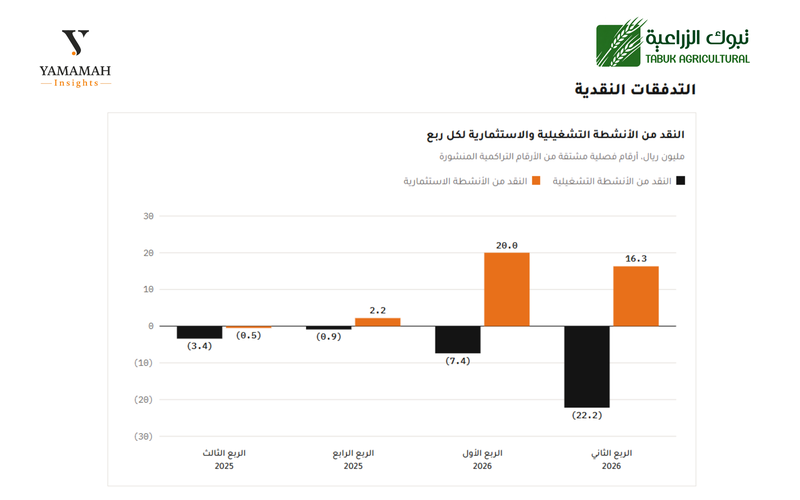
Student “Ghadah Alwallan”@Ghadah Alwallan emphasized the importance of liquidity, saying: “I believe the project’s financing method matters more than the electricity savings, especially since Tadco’s operating cash flow was negative SAR 22.2 million in the second quarter.
Will the company or its partner bear the project cost? The difference could significantly affect its liquidity.”
Integrating Production and Sales to Address Losses
Student “Raneem Asiri”@Raneem Asiri commented on the need for a comprehensive financial solution, saying: “This project is a good opportunity for Tabuk Agricultural Development Company to benefit from solar energy, lower operating costs, and improve its profit margin.
As for the accumulated losses, I don’t think lowering electricity costs alone will be enough. The company should also focus on increasing production and sales and reducing other expenses so that its financial results can improve gradually.”
Strategic Foundations and Preparing for the Future
Student “Dana Al-Sadoun”@Dana Al-Sadoun added a direct assessment of the key issues, saying: “I believe Tadco’s decision to sign the memorandum of understanding is a sound strategic move; it is a fundamental step toward reducing operating expenses and addressing accumulated losses, which reached 77% of capital before the capital reduction. In addition, relying on self-consumption, with a capacity of 195,000 megawatt-hours a year, will lower direct energy costs and improve profit margins.
Although the memorandum is non-binding, it lays the groundwork for a better operational future.”
Improving Consumption Efficiency and Supporting Local Growth
Student “Noof Alanazi”@Noof Alanazi outlined the benefits of energy efficiency, saying: “I believe moving toward solar energy is a strategic step that supports Vision 2030 targets and helps Tadco lower operating costs and improve profit margins over the long term.
Organizing self-consumption also improves energy-use efficiency and supports the local economy. With accumulated losses reaching 77% before the capital reduction, the project may help improve financial performance, but it will require effective cost management and actual savings.”
Improving Negative Operating Cash Flows
Student “Ahmed Al-Jadaan” @AHMED ALJADAAN shared his financial and operational analysis, saying: “Agriculture consumes a lot of energy, and the company’s move to self-consumption—at 195,000 megawatt-hours annually—will kill two birds with one stone: it will significantly lower the electricity bill and improve operating cash flows, which have been negative in recent periods (including the second quarter of 2026, when they reached negative SAR 22.2 million).
This will ease pressure on the company and give it some breathing room to improve its profit margins.”
Financial Stability and More Efficient Operations
Student “Nada Asiri”@nada Asiri highlighted what is needed for stability, saying: “Tadco’s move toward renewable energy is a strategic step that can help reduce operating costs and improve profitability, while aligning with the national vision.
I believe lower energy costs may help limit accumulated losses, but achieving financial stability will also require increased revenue and greater operational efficiency, supporting the company’s sustainability and future growth.”
Operational Productivity and Protecting Savings
Student @ثناء الشايب shared her view on how to assess the financial case, saying: “This is a positive step, especially if Tadco can use solar energy to power its operations and reduce its electricity bill.
But with accumulated losses that necessitated an 80.47% capital reduction to write them off, I don’t expect lower electricity costs alone to be enough. Productivity must also improve and the causes of the losses must be addressed, so the savings aren’t swallowed up by other expenses.
Since the project is still at the non-binding memorandum-of-understanding stage, its value will become clearer after implementation.”
Payback Period and Return on Investment
Student “Yazan Hamoud”@Yazan Hamoud explained how to assess the financial case, saying: “I believe the project’s impact should be measured by comparing the investment cost with expected annual electricity-bill savings, after deducting operating, maintenance, and financing costs.
In other words, we should calculate the payback period and monitor the return on investment and cash flows.
With accumulated losses reaching 77% in the second-quarter 2026 results, the project should deliver clear savings and a reasonable payback period, because any long-term or high-cost investment could add to liquidity pressures.”
Conditions for Transition and Cash Readiness
Student “Dina Alarjani”@Dina Alarjani outlined what is needed for operational success, saying: “Tadco’s move toward solar energy is a good step, particularly because agricultural operations require a continuous energy supply.
But the current agreement is a non-binding memorandum of understanding, with no financial impact at this stage; we therefore need to know the project’s cost and the expected savings before judging its benefits.
Given that accumulated losses reached around 77% before a capital reduction of more than 80% to write them off, the company also needs to improve operational efficiency and diversify its sources of income.”
Shareholder Equity and Financing Pressures
Student “Mohammad Alghaihab”@Mohammad Alghaihab concluded the financial analysis by reviewing shareholders’ equity, saying: “Agriculture relies heavily on electricity for irrigation and cooling, so any reduction in costs will have a sustained effect on expenses.
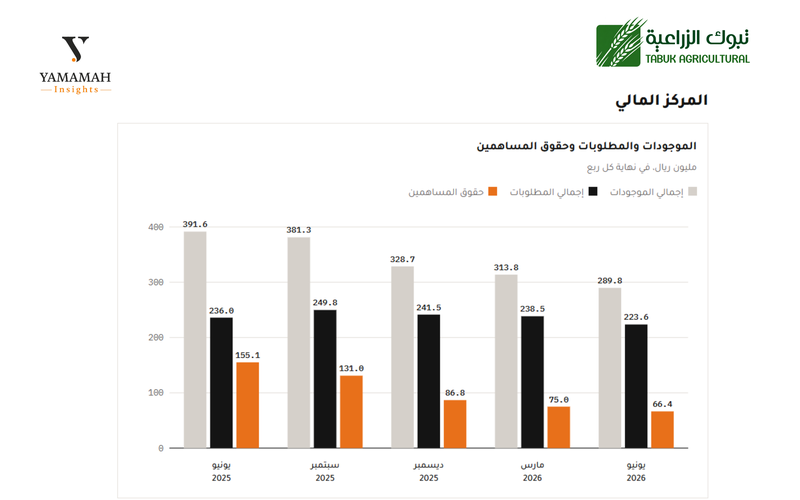
What caught my attention most, though, was the company’s financial position: shareholders’ equity fell from SAR 155 million in June 2025 to SAR 66 million in June 2026, alongside continuing losses and negative operating cash flows. I believe the company needs to balance investment in new projects with preserving liquidity. Its priority now should be improving cash flows, so the solar project serves as a way to improve its financial position rather than becoming a new burden.”
Operational Restructuring and a Potential Financing Model
In an analytical assessment, financial and economic analyst “Hamad Alsaeed” @Hamad Alsaeed added: Tadco’s memorandum with 386 Vibrant Solar should be viewed in a broader context than its headline figures: the role of energy in the costs of an agricultural company restructuring its operations. In desert agriculture, energy is needed to pump water and provide cooling. It is one component of a cost of revenue that was 5.6 times revenue in the second quarter. Accordingly, lowering energy costs improves margins in proportion to their share of costs, with the full effect becoming apparent once production returns to a level that covers fixed costs.
Project implementation is also linked to the company’s current financial position: cash stands at only SAR 7.9 million, compared with liabilities of SAR 223.6 million. This makes it more likely that the developer will finance the plant and sell electricity to the company under a long-term contract, without requiring capital expenditure from Tadco.
At the broader economic level, the move aligns with the Ministry of Energy’s program to displace 95% of liquid fuels in electricity, industry, and agriculture by 2030. The memorandum’s value, however, depends on whether it becomes a binding power purchase agreement.
Second-Quarter 2026 Results

Comments (3)
No comments yet. Be the first to comment!