

The Kingdom of Saudi Arabia reaffirms its steadfast commitment to the 2030 Sustainable Development Agenda, based on a firm belief that peace, security, and solidarity are essential prerequisites for successful development. As a reflection of its leading role in the international arena, the Kingdom continues to promote dialogue and peaceful resolution of conflicts while supporting global cooperation in various fields.
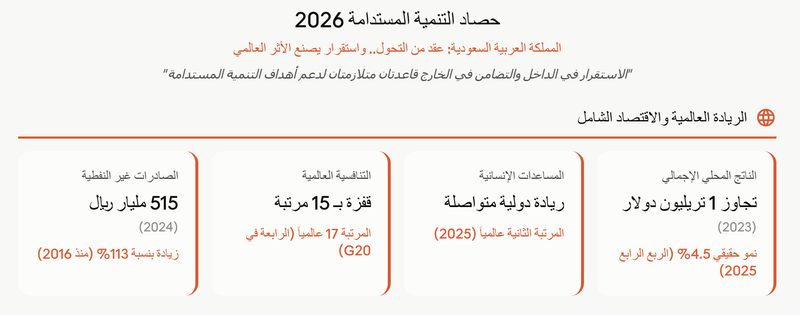
The Kingdom has crowned this role by ranking second globally in humanitarian aid for 2025, reflecting an international engagement based on a fundamental principle: "Stability at home and solidarity abroad are two interrelated foundations for supporting sustainable development goals."
This was highlighted in the "Third Voluntary National Report of the Kingdom for 2026," which was prepared through a comprehensive participatory process based on the developmental principle of "no one left behind." Below is a summary of the key developmental achievements documented in the report with numbers and indicators:
Water and Food Security: Resource Efficiency and Doubling Production
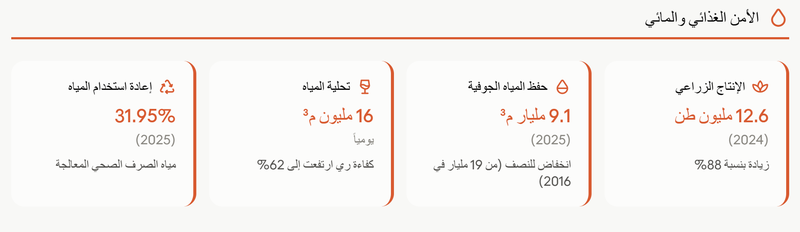
In an achievement that reflects the success of resource conservation policies, the Kingdom has managed to reduce the use of non-renewable groundwater in the agricultural sector by half, decreasing from 19 billion cubic meters in 2016 to 9.1 billion cubic meters in 2025.
This conservation coincided with a remarkable leap in agricultural production, which recorded an increase of 88% to reach 12.6 million tons in 2024. Additionally, desalinated water production exceeded 16 million cubic meters per day, and irrigation efficiency improved from 53% in 2016 to 62% in 2025, while the percentage of treated wastewater reuse rose from 17.26% in 2019 to 31.95% in 2025.
Energy and Climate Action: International Initiatives and Ambitious Targets
The Kingdom is making steady progress towards energy transformation, aiming to achieve 50% of total electricity generation capacity from renewable energy sources and storage systems by 2030. In a parallel path, the "Green Saudi Initiative" has successfully mobilized investments exceeding 186 billion USD, aiming to reduce, avoid, and remove 278 million tons of CO2 equivalent annually by 2030.
Protecting Natural Habitats: Global Leadership in Combating Desertification
The area of protected regions in the Kingdom has significantly expanded, rising from 4.33% of the total national area in 2016 to 18.8% in 2025. Vegetation cover has experienced exceptional growth, increasing 13-fold, with over 150 million seedlings planted.
In recognition of its environmental efforts, the Kingdom hosted the sixteenth session of the Conference of the Parties to the United Nations Convention to Combat Desertification (UNCCD COP16) in December 2024, launching the "Riyadh Action Agenda" for global land restoration, in addition to leading the international coral reef initiative.
Longer and Healthier Lives: Advances in Medical and Traffic Indicators
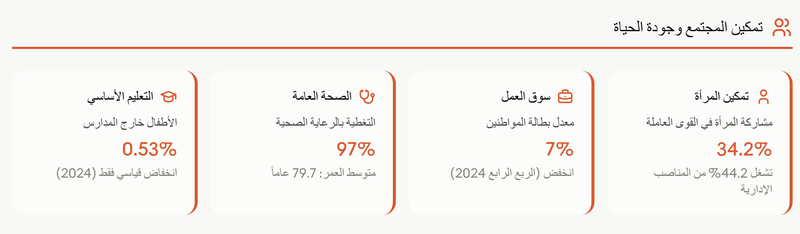
Quality of life and public health indicators have shown significant improvement, with the average life expectancy reaching 79.7 years in 2024. Health coverage expanded from 84% in 2019 to 97% in 2024, surpassing the set targets.
In terms of traffic safety, fatalities from accidents have decreased by 57% since 2016. Additionally, 16 Saudi cities have received World Health Organization accreditation as "Healthy Cities."
Empowering Citizens: Quality Education and Record Female Participation
The dropout rate among children has sharply declined from 3.41% in 2021 to just 0.53% in 2024. In an indicator reflecting the success of empowerment programs, the female participation rate in the workforce reached 34.2% in 2025, exceeding the national target of 30%, while women held 44.2% of managerial positions in the same year.
Thriving Cities and Economic Competitiveness
Saudi cities continue their path towards smart and sustainable transformation, with the actual operation of the "Riyadh Metro" and the advancement of 6 Saudi cities in the Smart Cities Index for 2025. Medina achieved an unprecedented milestone as the first Arab city and the third city globally to receive the "Gold Rating" for sustainable development cities from UN-Habitat.
In the industrial and mining sectors, non-oil exports reached 515 billion riyals in 2024, an increase of 113% since 2016. The Kingdom jumped from 32nd to 17th place in the Global Competitiveness Index between 2023 and 2025, ranking fourth among G20 countries. Additionally, the number of small and medium enterprises exceeded 1.68 million in the first quarter of 2025.
Inclusive Growth Exceeding One Trillion Dollars
Economically, the GDP surpassed the one trillion USD mark in 2023. The real GDP recorded a growth of 4.5% in the fourth quarter of 2025 compared to the same period in 2024. The unemployment rate among citizens decreased to 7% in the fourth quarter of 2024, with over 562,000 citizens entering private sector jobs during 2025, marking an annual increase of 29%.
Towards a New Development Horizon: The Kingdom concludes its report with an ambitious message affirming its commitment to accelerating achievements and maintaining its resilience and leadership in global coordination despite the geopolitical uncertainty facing the world. The Kingdom extends an open invitation to enhance international cooperation and build stronger global frameworks to ensure the efficient achievement of sustainable development goals, reinforcing principles of transparency and corporate sustainability to ensure a better future for all humanity.

Comments (6)
No comments yet. Be the first to comment!