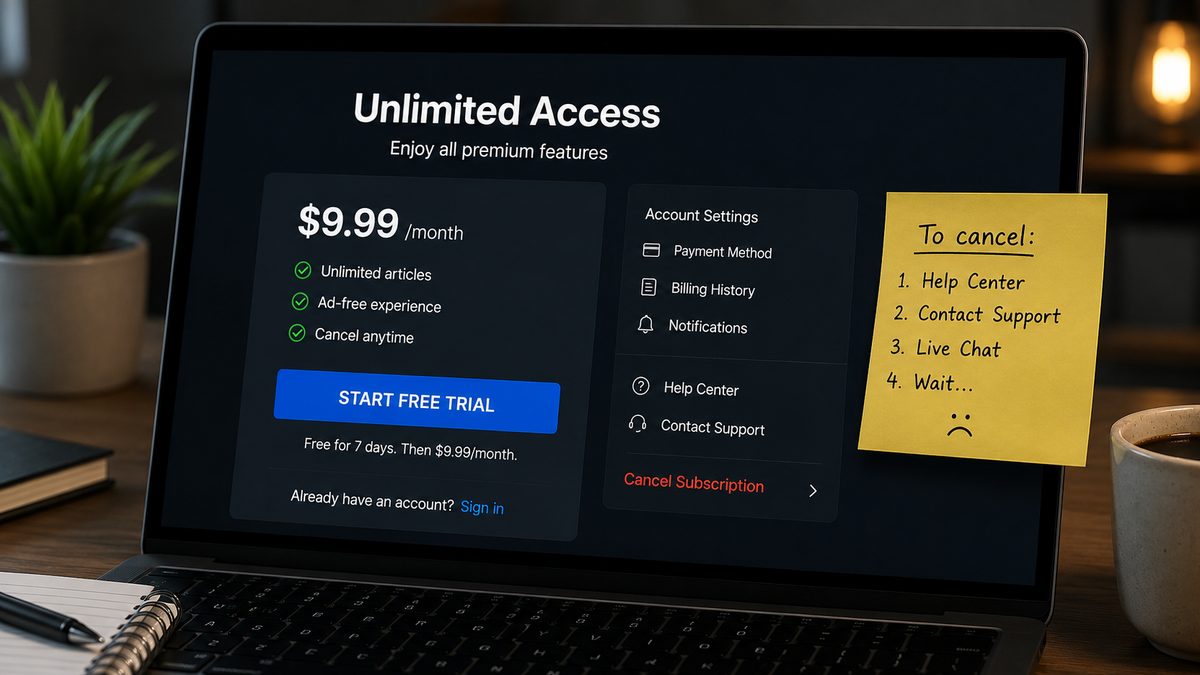

A small monthly subscription, a free trial, and one click to get started. It doesn’t seem like a major decision.
But months later, you may discover that you’re still paying for a service you barely use, or that the free trial turned into a paid subscription some time ago.
What seems like nothing more than a forgotten subscription conceals a larger economic question: What happens when a company no longer needs to persuade a customer to make another purchase, and all it needs is for the subscription to continue?
This is where the story of the subscription trap begins.
Why has the subscriber become so valuable?
The subscription model has changed the relationship between companies and customers. In a traditional sale, a company needs a new purchase to generate additional revenue from a customer. A subscription, by contrast, allows payments to continue according to its terms, without requiring a separate purchase each time.
Adobe illustrates how important this model is to some companies. In March 2026, Reuters reported that subscriptions accounted for 97% of Adobe’s $6.4 billion in revenue in the quarter ended February 27.
Adobe’s heavy reliance on subscription revenue coincided with a case involving its subscription practices. In March 2026, the company reached a $150 million settlement to resolve a U.S. government lawsuit filed in June 2024, which accused it of concealing termination fees and making it difficult to cancel certain subscriptions.
The settlement consists of a $75 million civil penalty and $75 million in free services for customers, and required court approval. Adobe did not admit wrongdoing and said it had worked to simplify and increase the transparency of its subscription and cancellation processes.
The issue extends beyond a single company. From a business-model perspective, the more dependent revenue becomes on subscriptions, the more important the company’s ability to retain subscribers becomes.
But the question is: When is customer retention the result of the service’s value, and when does it become a trap?
The trial is free—but what happens afterward?
The Organisation for Economic Co-operation and Development (OECD) places subscription traps among what it calls Dark Commercial Patterns—practices in digital interfaces that can steer, deceive, or pressure consumers into making choices that may not be in their best interests.
Examples cited by the OECD include subscription traps, hidden fees, and countdown timers, along with other digital practices that may influence consumer decisions.
The scale of the phenomenon is striking. In an OECD survey of more than 35,000 participants across 20 countries, the organization found that 9 out of 10 consumers had been affected by one of the dark commercial patterns. This does not mean that all of them fell into subscription traps; the finding also covers other digital practices.
The European Commission, meanwhile, points more specifically to the fact that around 10% of consumers in the European Union have previously been drawn into an unwanted subscription.
This is where the economic paradox of the subscription model emerges:
With a one-time purchase, consumers need to make a new decision to pay again. With an automatically renewing subscription, payment may continue until they decide to stop it.
Thus, a continuing subscription does not necessarily mean that the consumer has made the purchase decision again each month.
When time becomes part of the cost
The cost of leaving a subscription does not have to be financial; time and effort have value too.
When the cancellation process becomes more complicated, it adds a nonfinancial cost to the consumer’s decision to stop using the service.
From an economic perspective, this can be viewed as an additional cost of exit, and it may be related to switching costs when a customer considers moving to an alternative service.
This changes how we interpret customer retention. A customer who stays because they believe the service is worth its price is different from one who stays because leaving requires additional time or effort.
From a forgotten subscription to a broader issue
The effects of these practices do not stop at a monthly charge that consumers may fail to notice.
If the process of leaving adds time and effort to the decision to switch from one service to another, comparing and switching between alternatives may become more difficult.
Here, the issue can extend from consumer protection to competition, because barriers to switching may affect a customer’s ability to choose the service that best suits them.
That is why consumer-protection authorities in Europe have taken action to address the problem of recurring subscriptions, including pushing for clearer information about recurring payments before consumers enter into a subscription.
The goal is not to prevent the subscription model, but to make the consumer’s decision clearer: to know what they will pay, when the payment will recur, and how they can stop it.
Would you stay if leaving were easy?
A subscription is not inherently a trap.
It can provide consumers with convenience and continuous access to a service, while giving the company a longer relationship with the customer and recurring revenue streams.
The problem begins when the continuation of the relationship depends not only on the value the service provides, but also on factors such as unclear fees or difficult cancellation.
This reveals a simple test for the subscription model:
What if leaving the service were just as easy as joining it?
If the customer chooses to stay, value is what keeps them there. But if their continued subscription is linked to the difficulty of leaving, the number of subscribers alone does not tell the whole story.
This is precisely where the line falls between a subscription model and a subscription trap.


Comments (5)
No comments yet. Be the first to comment!