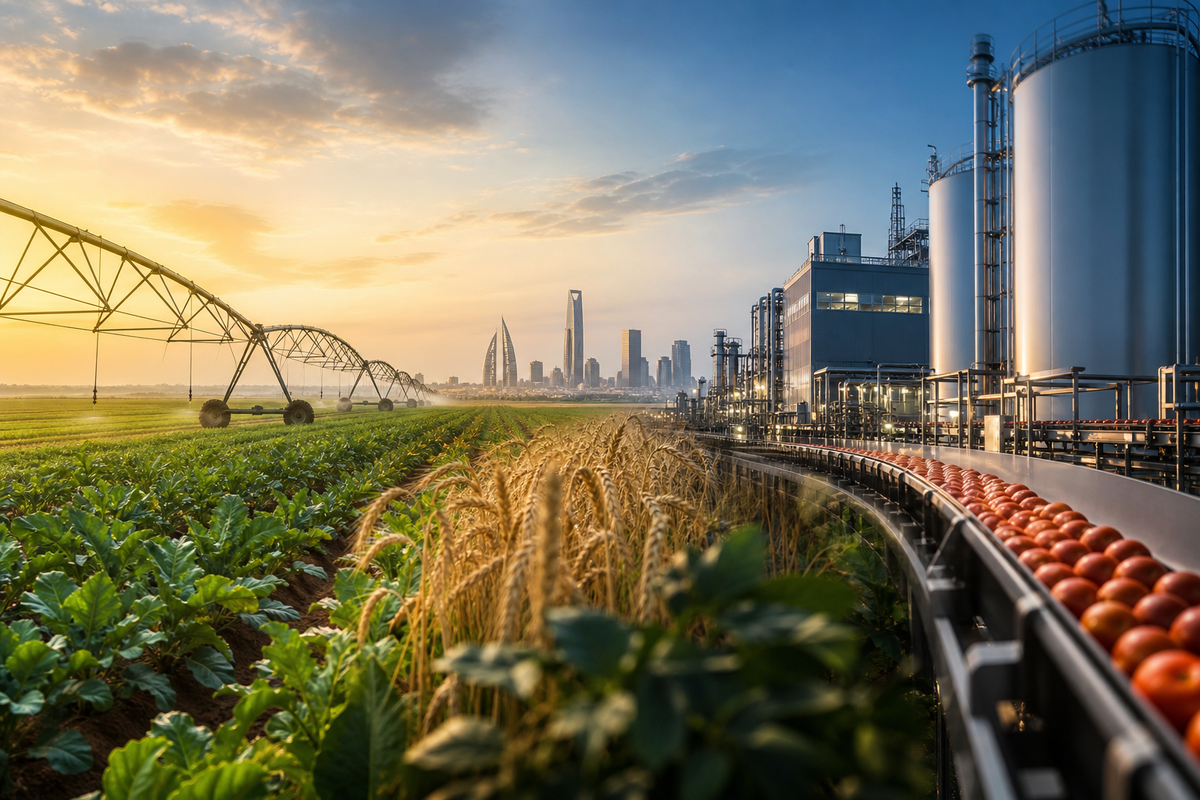

A few decades ago, Saudi Arabia faced a simple but harsh question: how do you feed a rapidly growing desert country? Today, the question has changed. The Kingdom no longer wants merely to secure its food supply, but to turn it into an export industry, a value chain, and a tool for economic diversification. Between these two questions lies one of the most compelling stories of Saudi Arabia’s industrial transformation.
Less than a century ago, “the food industry” in Saudi Arabia was not an industry in the modern sense of the word. Food was a direct reflection of what geography permitted: dates from oases, camel and livestock milk, limited grain from the highlands, and fish from the coasts. The distance between producer and consumer was short, while rainfall, seasons, and trade caravans determined what reached the table and when.
Today, the scene looks so different that it is difficult to see the connection between the two pictures. Saudi Arabia’s food manufacturing sector is estimated to be worth around SAR 200 billion, comprising more than 1,900 factories and providing over 120,000 direct jobs. Cumulative investment in food products manufacturing has exceeded SAR 110 billion, in addition to approximately SAR 26.8 billion in beverage manufacturing. Food exports reached SAR 15 billion in 2025.
But the most important figure is not SAR 200 billion. The important question is how Saudi Arabia got there.
When Oil Upended the Food Equation
The major transformation began with oil, but not in the direct way the phrase might suggest.
Higher incomes, expanding cities, and accelerating population growth transformed the food problem from one of limited local production into a strategic challenge for a modern state growing at a rapid pace. Cities that once held tens of thousands came to hold millions. And consumers who once bought what the local environment provided could now afford products from around the world.
In other words, oil created the ability to buy food, but it also created much greater demand for food.
Importing therefore became a natural solution. Yet reliance on external markets raised a question that was not merely economic: what happens if global markets are disrupted, prices rise, or exporting countries decide to keep their food at home?
This marked the beginning of Saudi Arabia’s long search for a balance among three things that do not always easily coexist: food security, water scarcity, and economic efficiency.
Wheat: A Success That Exposed a Problem
In the 1970s and 1980s, the Kingdom chose a direct answer to the food challenge: increase domestic production.
The government provided generous support for agriculture, particularly wheat, until Saudi Arabia became, in a striking paradox, a wheat exporter during the 1980s.
From a food-security perspective, the achievement was impressive. But economics does not assess products only by the kilogram; it also accounts for the resources used to produce them.
And wheat requires water.
In a country where water is a scarce resource, the success of wheat cultivation exposed a larger problem: a state can achieve self-sufficiency in a particular commodity, but that does not necessarily mean domestic production is the optimal use of resources.
This moment helped change the philosophy of Saudi food security later on. The question was no longer: How much can we produce within our borders? It became: What should we produce within our borders?
The difference between the two questions is significant.
The Factory Instead of the Field
Alongside the agricultural experiment, a more sustainable revolution was growing away from the fields: food processing.
Almarai was established in 1977, while companies such as Savola and SADAFCO rose to prominence, and the roots of Halwani Bros. date back to the middle of the last century. Over time, the issue was no longer simply about producing milk, oil, or sugar. An integrated ecosystem began to take shape, comprising factories, brands, packaging, refrigeration, warehouses, fleets, and points of sale.
This marked an important economic shift.
Agriculture generally sells raw materials. Industry sells added value.
A liter of milk is no longer simply milk once it enters a factory, carries a brand, is packaged and chilled, and distributed to thousands of stores. Raw dates are not the same as a premium box of dates intended for export. Grain is not the final product when it becomes flour, then baked goods, and then a branded product.
Saudi Arabia thus gradually moved from trying to produce food to trying to capture as much of the value surrounding it as possible.
More than anything else, this is the story of the modern food industry.
The 2008 Crisis Changed the Meaning of Food Security
Then came the global food crisis of 2008.
Many importing countries discovered then that having money does not always guarantee access to a commodity. When prices rise sharply or countries impose export restrictions, the global market becomes less reassuring than it appears in normal times.
For Saudi Arabia, the shock helped drive a new understanding of food security.
In 2009, the Saudi Agricultural and Livestock Investment Company (SALIC) was established as an investment arm to secure part of the supply chains from abroad.
A more sophisticated equation emerged than the pursuit of complete self-sufficiency:
Produce domestically what offers an advantage or strategic necessity, and import or invest abroad in products whose domestic production consumes scarce resources.
That is why Saudi Arabia’s food system may initially appear contradictory, but it is not.
The Kingdom achieves very high levels of self-sufficiency in dairy, eggs, and dates, and is expanding poultry production. Yet it imports grains, animal feed, crude oils, and raw sugar, while also investing abroad in agricultural assets and sources of supply.
Imports here are not an admission of failure. In some cases, they are part of the strategy.
Dairy Reveals the Saudi Paradox
Perhaps no industry encapsulates this story better than dairy.
According to the report’s data, the Kingdom achieves approximately 129% self-sufficiency in dairy products, meaning it produces more than its domestic needs and exports part of the surplus.
A dairy surplus in a desert country initially seems paradoxical. But it is the result of a highly organized industrial model: large farms, integrated processing, cold chains, distribution fleets, and strong brands.
It also illustrates why it is not enough to measure the food industry by what leaves the farm. In the modern food economy, the ability to process, preserve, transport, and market products may be more important than producing the raw material itself.
And in Saudi Arabia, where temperatures exceed 45 degrees Celsius in summer, the cold chain has become a core part of the country’s industrial infrastructure. A food product has no economic value if it does not reach the consumer in a fit condition.
A New Generation Is Changing the Table Again
The next transformation will not be made by factories alone. Consumers will make it.
According to the figures used in the report for 2025, the Kingdom’s population is approximately 35.3 million, with nearly 92% living in cities. Those under the age of 30 account for around 63% of citizens.
These figures matter to food companies not as demographic statistics, but as a forecast of demand.
Young urban consumers do not eat in the same way as the previous generation did. Time is scarcer, working outside the home is more widespread, the phone has become a purchasing channel, and health plays a greater role in consumption decisions.
That is why ready-made meals, frozen foods, delivery, online grocery shopping, specialty coffee, high-protein products, and healthy foods are growing.
The Saudi table itself is changing.
This means the next chapter in the food story will not be solely about producing more, but about producing different things.
From Meeting Needs to Building an Export Industry
This is where the story reaches its most important transformation.
For many years, the success of food policy was measured by its ability to prevent shortages. Today, the ambition is greater: to make food an industrial and export sector as part of the broader drive to diversify the economy.
Food exports reached SAR 15 billion in 2025. Saudi dates reach more than 125 countries, while dairy products are exported to regional markets.
The Kingdom aims to localize 85% of food industries, in addition to developing a major food cluster targeting 800 factories with investments of approximately SAR 20 billion by 2035.
These goals reveal a shift in thinking.
In its first phase, food security meant ensuring that food was available.
In its new phase, it means something more complex: building factories, developing companies, creating jobs, financing supply chains, replacing some imports, and then seeking foreign markets.
In other words, food has moved from the security agenda to the industrial policy agenda.
The Desert Has Not Disappeared
Even so, it would be wrong to read Saudi Arabia’s food story as a final victory over geography.
The desert is still there, as is water scarcity. Much of the raw material still comes from abroad. Global commodity, energy, and shipping prices can put pressure on companies’ margins. Climate change and disruptions to trade routes also serve as constant reminders that food security is not a condition that can simply be declared complete.
But perhaps the most important change is that Saudi Arabia is no longer trying to ignore these constraints.
Instead, it has built its modern model around them.
It is not seeking to grow everything it eats, but to control as much of the value chain as possible: importing where imports make the most sense, producing where it has an advantage, investing abroad where it needs to secure supply, and manufacturing locally whenever it can add value.
That is why the distance between the date oasis and the modern food factory is not merely a story about rising incomes or population growth.
It is a story of economic learning that took decades.
Half a century ago, Saudi Arabia’s question was: How do we produce enough to eat?
The question that will define the next decade is entirely different:
How much of the value on the table can Saudi Arabia create itself—and then sell to the world?


Comments (6)
No comments yet. Be the first to comment!