

Term: Discounted Cash Flow Model (Discounted Cash Flow - DCF)
A simplified definition (DCF and the discount rate together):
The (DCF) model is a comprehensive financial methodology used to estimate the "fair price today" of any company or investment asset, based on the money it will generate in the future.
For this model to work, it relies entirely on its core engine, the "Discount Rate". The model gathers all expected future profits and cash flows, then uses the discount rate as a "mathematical sieve or filter" to discount the value of those future funds to what they are actually worth today, compensating for three factors: inflation, opportunity cost, and the level of risk.
Simply put: (DCF) is the calculator, and the (discount rate) is the percentage you enter into that calculator to determine the true value today of future riyals.
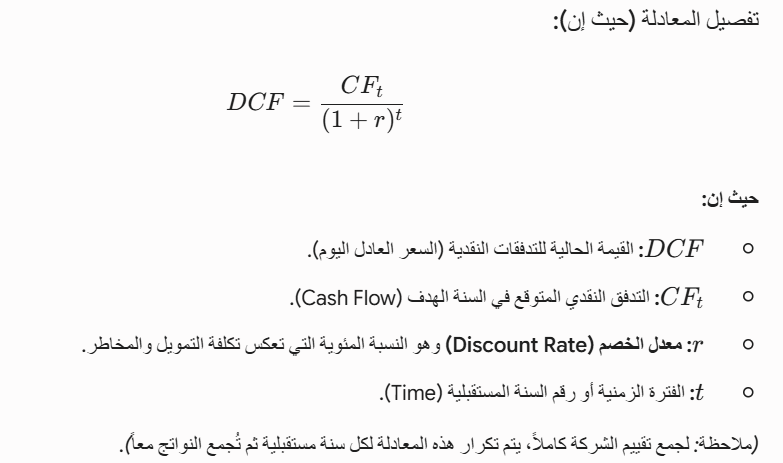
How is the model calculated mathematically?
The (DCF) model sums the present value of each future year, with the impact of the discount rate ($r$) at the heart of this equation:
A real-world market example (applying the model and discount rate together):
In the semiannual valuation report of a real estate fund, the fair value of five hotels, including Vettori and Raffles Ascott, was valued at approximately SAR 1.10 billion. To arrive at this figure, the valuer applied the (DCF) methodology step by step as follows:
- Forecasting cash flows (CF): The valuer forecast the future rents and profits that these hotels would generate in the coming years, assuming an occupancy rate of 70%-72%.
- Determining the discount rate (r): The valuer built the model's discount rate cumulatively:
- 2.7% inflation + 4.6% government bond yield + market and regulatory risk premiums.
- Result: The final discount rate settled between 10.20% and 10.70%, depending on the asset.
- Final result (DCF): The valuer took all future cash flows (step 1) and applied the discount rate to them (step 2), resulting in a fair value today for all the hotels of SAR 1.10 billion.
What does this mean for you as an investor?
- Valuation moves inversely to the discount rate: Within the (DCF) model, the relationship is inverse: if you set a high discount rate because the asset is high-risk or bank interest rates are high, the company's (DCF) valuation will decline. If you use a low discount rate, the valuation will rise.
- Risk makes the difference: In the hotel example mentioned above, the gap between current occupancy (60%) and the target (72%) is considered a risk. The financial valuer translates this risk by increasing the discount rate within the (DCF) model to protect the investor from overpricing the asset today.
- Understanding the causes of market crashes: When central banks raise interest rates, financing costs rise, as reflected in bond yields, forcing analysts to raise the discount rate in their (DCF) models. This increase reduces the present value of companies, especially growth and technology companies that depend on distant future earnings, causing their share prices on the screen to plunge and align with the new valuation.

Comments (6)
No comments yet. Be the first to comment!