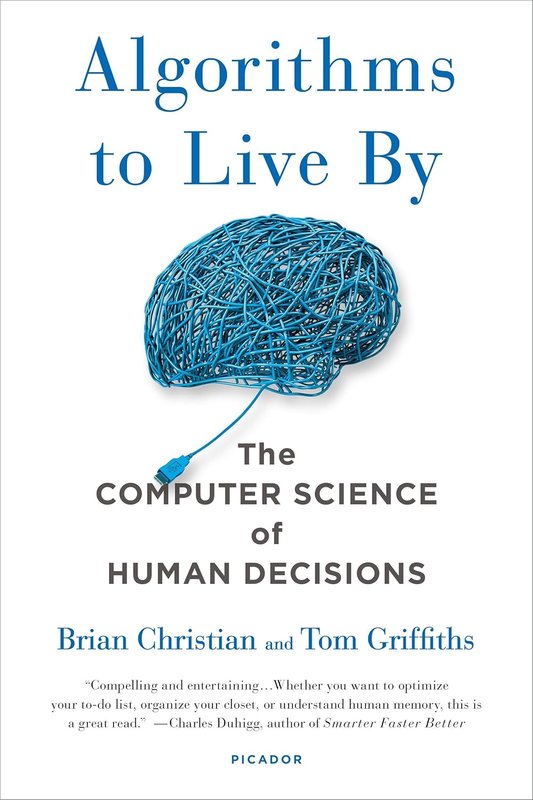

Book "Algorithms to Live By": Computer Science for Solving Our Daily Problems
Authors: Brian Christian & Tom Griffiths
The Idea in a Number
37%! This is the magic number for the "Optimal Stopping Rule." If you have a month to search for the best apartment to rent, or you're conducting interviews to hire an employee from among 100 applicants, when do you stop searching and make a decision? Algorithms tell us that you should spend the first 37% of your time (or choices) in "exploration" only without making any decision, then after exceeding this percentage, choose the first option that outperforms everything you've seen before. This number mathematically guarantees you the highest probability of capturing the best option!
The Big Idea
Algorithms are not merely programming codes that operate inside computers; at their core, they are "clever ways to solve problems." This book brilliantly combines computer science and human psychology to show how we can use machine logic and mathematics to make better decisions in our daily lives, whether in organizing our offices, managing our time, or even choosing life partners.
3 Life Lessons from This Book
- The Trade-off Between Exploration and Exploitation: Do you go to your favorite restaurant (exploiting past knowledge that guarantees happiness), or do you try a new restaurant (exploring which might give you a better option)? Algorithms tell us that the decision depends on "remaining time." If you're in a new city for just one day, "exploit" and don't risk. But if you'll be living there for years, "explore" as much as possible at the beginning to maximize your future gains.
- The Art of Organizing Things (Caching): Computers suffer from storage and search problems just like humans. The best solution processors use is temporary storage (keeping recently used files in a very accessible place). You can apply this to organizing your closet or desk: don't arrange things alphabetically; instead, keep the things you used recently at the front, because the probability of needing them tomorrow is mathematically higher than others.
- When Should You Ignore the Details? (Relaxation): In computer science, when a problem is too complex and impossible to solve in reasonable time, the algorithm eases constraints (Relaxation) and ignores some details to reach a "good enough solution." In life, pursuing perfection and absolute idealism in your decisions is irrational waste of energy; sometimes the good quick decision is mathematically better than the perfect delayed decision.
Unforgettable Quotes
"Sometimes, giving up trying to find the perfect answer is itself the perfect answer."
"The biggest mistake we can make in decision-making is not choosing the wrong decision, but spending too much time trying to make the right decision."
Who Is This Book For?
For productivity enthusiasts, programmers, managers, and anyone who struggles with decision-making (whether momentous or simple decisions like choosing a movie for the evening), and seeks a strict mathematical and logical framework to ease the confusion of choice.
 Ask Yamami
Comments (6)
No comments yet. Be the first to comment!