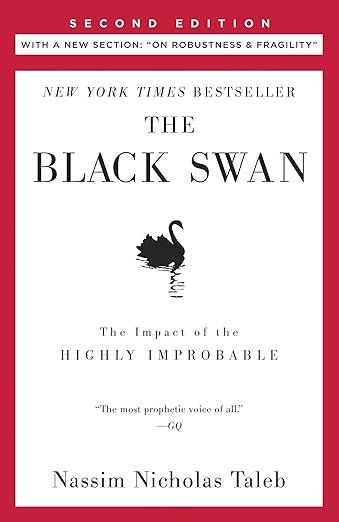

Book "The Black Swan": Consequences of Unexpected Events
Author: Nassim Nicholas Taleb
The Idea in Numbers
One Event (1)! That's all it takes to destroy thousands of complex statistical models and change the course of history. A single financial crisis (like 2008) or one pandemic, capable of erasing all the predictions built over decades. This number reminds us that historical data, no matter how massive, may be completely unable to predict "one" extreme event never seen before.
The Big Idea
We live in a world governed by rare, random, and highly impactful events (what the author calls Black Swans). Traditional statistical models and over-reliance on the normal distribution curve deceive us and give us an "illusion of safety and prediction", while the truth is that the unknown and what past numbers don't tell us is what shapes the course of economies and our lives in general.
3 Life Lessons from This Book
- Illusion of Predictability (The Illusion of Predictability): The past is not a sure guide to the future. Just because you've only seen white swans your whole life, and you have millions of data points confirming it, this mathematically and logically does not rule out the possibility of a "black swan" appearing that destroys your theory in an instant. Financial experts are not as skilled at prediction as their models claim.
- Narrative Fallacy (The Narrative Fallacy): The human mind hates randomness and uncertainty, so after a catastrophic event (the black swan), we rush to invent stories and justifications to convince ourselves the event was predictable and that "the numbers pointed to it", and this self-deception prevents us from truly preparing for upcoming shocks.
- Focus on Robustness Instead of Prediction (Robustness vs. Prediction): Instead of wasting time and resources trying to predict when the next catastrophe will strike (because you won't be able to), build financial and personal systems capable of withstanding severe shocks. Having a "wide safety margin" is much more important than having an "accurate prediction".
Unforgettable Quotes
"Absence of evidence is not evidence of absence."
"History does not creep, it jumps; yet we act as if it evolves in small, calculated steps."
Who Is This Book For?
For risk managers, investors, strategic decision-makers, and anyone dealing with data who wants to protect themselves and their organization from "the illusion of statistical certainty", and learn how to live and thrive in a world full of the unknown.
 Ask Yamami
Comments (9)
No comments yet. Be the first to comment!