

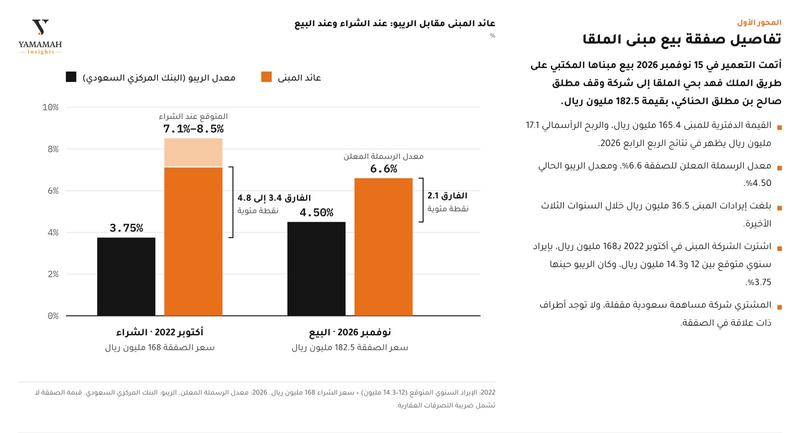
Within days, Riyadh Development made two contrasting decisions about managing its cash. It completed the sale of its office building on King Fahd Road in the Al Malqa district of northern Riyadh to Mutlaq Saleh bin Mutlaq Al-Hanaqi Endowment Company, a closed Saudi joint-stock company, for SAR 182.5 million, excluding real estate transaction tax and with no related parties involved. The deal represents a capitalization rate of about 6.6% and a capital gain of SAR 17.1 million over the building’s book value of SAR 165.4 million.
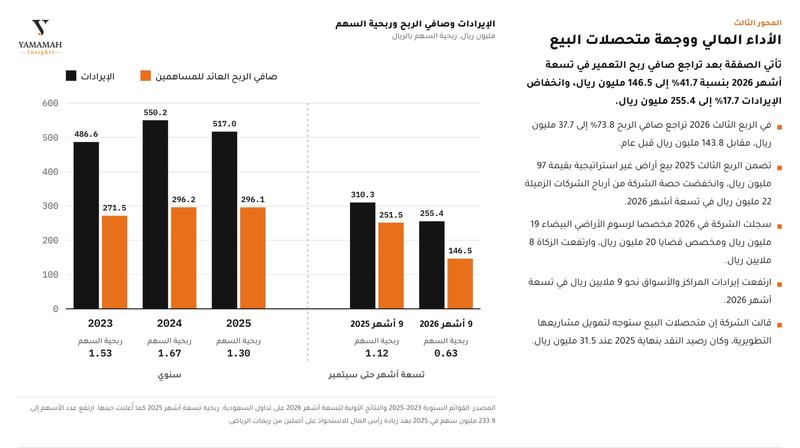
The company bought the building in October 2022 for SAR 168 million, excluding real estate transaction tax. Its total revenue over the past three years was SAR 36.5 million. The company expects the deal to affect its fourth-quarter 2026 results through the capital gain and a SAR 182.5 million cash increase, with the proceeds earmarked for development projects. The sale comes as the repo rate stands at 4.50% and the company’s net profit for the first nine months of 2026 has fallen 41.7% to SAR 146.5 million.
At the same time, the extraordinary general assembly approved the purchase of up to 11.7 million shares, representing 5% of the company’s shares, to be held as treasury shares. The board believes the share price is below fair value. The assembly authorized the board to complete the purchase using the company’s own resources within a maximum of 18 months, and the company may hold the purchased shares for up to five years.

In this context, students from Al Yamamah University discussed the implications of these decisions and their impact on the company’s investment value:
Redeploying Capital and the Opportunity Cost
Colleague Lujain Al-Qurashi @Lujain Algorashi believes the move reflects a shift of capital toward higher returns, rather than simply exiting a real estate asset. She added: "Selling a building yielding 6.6% for more than its book value, while moving to buy treasury shares, suggests management sees better opportunities in redeploying capital than in holding the asset. But the strategy’s success is not measured by the sale and purchase decisions alone. It depends on whether new projects can earn more than the cost of capital and whether the treasury share purchase creates real value for shareholders."
Measuring Recycling Success Through Actual Results
Student Rabiah Al-Mugait @Rabiah Almugait said she favors selling assets if the resulting cash is invested in projects that earn more than the property’s current income. She cautioned: "The key is to track revenue, profit and cash-flow growth from the new projects, because successful capital recycling shows up in financial results, not in the sale alone."
Invested Capital Efficiency and Balancing the Options
Student @Omar Al-Sheikh noted that selling the Al Malqa building for SAR 182.5 million, with a capital gain of SAR 17.1 million, reflects the company’s aim to recycle capital. He said: "Although the property’s 6.6% yield is higher than the repo rate of 4.50%, the comparison is not direct because the risk levels and returns differ. The sale gives the seller liquidity and the chance to invest in projects that may yield more, while the buyer gets an income-generating asset.
Selling the property while approving the purchase of 11.7 million treasury shares also signals management’s confidence that the share is undervalued. The key is to ensure the buyback does not affect liquidity earmarked for future projects.
From an industrial engineering perspective, the goal is to direct capital toward the most efficient, highest-return assets and projects, not simply to increase the number of assets. Success should be measured by cash-flow growth and return on invested capital."
Balancing Stable Rental Income with Development Risk
Student Yazan Al-Hamoud @Yazan Hamoud said selling an asset yielding 6.6% a year while approving a share buyback because management believes the share is undervalued is a notable move. He added: "Recycling capital is a good step if it delivers returns above those of the asset sold. Giving up stable rental income for new investment opportunities also carries risks, so the priority is using the cash efficiently and achieving real returns."
How Execution Affects Long-Term Value
Student Rand Al-Khalaf @Rand Alkhalaf believes selling the Al Malqa building above its book value is a positive move, especially if the company can invest the proceeds in projects yielding more than the building’s current return.
She added: "The treasury share purchase suggests management believes the share is undervalued, but the success of both moves depends on execution, not just timing. The priority is to track the new projects, their returns, and the impact of the buyback on company value and shareholders’ interests over the long term."
The Case for Quick Liquidity and Reversing Profit Declines
Student Dana Al-Saadoun @Dana Alsadoun said the sale of the Al Malqa office building for SAR 182.5 million is a logical and justified step at this time to recycle capital. She explained: "This is especially relevant given that cash stood at SAR 31.5 million at the end of 2025 and net profit fell 41.7% in the first nine months of 2026 to SAR 146.5 million, following the absence of exceptional gains and an increase in provisions.
Although I would normally favor holding completed, income-generating assets as a safer option, I support this exit at a 6.6% yield to secure quick liquidity—provided the company later demonstrates that it can direct the cash into viable new development projects that deliver sustainable operating returns, make up for the current decline and exceed the lost rental income."
Weighing Expected Returns Against Rental Income
Student Noof Al-Anazi @Noof Alanazi said selling the building above its book value is a good move because it generates a gain and provides liquidity, especially since the company can invest the funds in new opportunities.
She continued: "Buying treasury shares may reflect management’s confidence that the company’s share is below fair value. Whether to hold or sell real estate depends on expected returns. If new projects yield more than current rental income, redeploying capital may be the better choice, but their results must be monitored to confirm the decision was successful."
Managing Execution Risks and Construction Costs
Student Jana Al-Shahrani @Jana Alshahrani noted that selling a property yielding 6.6% could be a good decision if the cash is invested in higher-return opportunities. She cautioned: "The treasury share purchase should not affect funding for future projects. From an engineering perspective, new projects face risks such as rising construction costs and delays. The strategy’s success therefore depends on sustainable returns that make up for the property’s lost income, not just temporary gains."
The Developer’s Role and the Quality of Operating Earnings
Student Ahmed Al-Jadaan@AHMED ALJADAAN explained the real estate developer’s business model: "A developer’s job is to build and enhance an asset’s value, then exit when it matures. Holding a building that yields only 6.6% when interest rates are at 4.50% turns the company into a mere landlord and limits its growth. Recycling capital is therefore very logical, especially given the previous cash shortage of SAR 31.5 million.
As an investor, I won’t judge the move today or by the SAR 17.1 million capital gain due to appear in the fourth quarter. The real test will be two things we need to see later: where the cash actually goes and the quality of operating earnings."
Prioritizing Recurring Revenue Over One-Off Gains
Student Mohammed Al-Ghaihab @Mohammad Alghaihab believes selling the Al Malqa building for SAR 182.5 million is a good move if the company has development opportunities yielding more than the building’s current 6.6% return. However, new projects carry greater risks and take time to generate revenue.
He added: "The sale coinciding with approval to buy 5% of the company’s shares reflects management’s belief that the share trades below fair value, but it does not necessarily mean the sale proceeds will be used to buy shares. With net profit down 41.7% over the first nine months, the priority is to invest the cash in projects that increase recurring revenue and operating earnings, rather than relying on one-off gains from asset sales."
Measured Expansion Without Increasing Risk
Student Dina Al-Arjani @Dina Alarjani said the company’s move is positive, particularly since it sold the property above its book value. She said: "The sale alongside the share buyback decision may reflect management’s confidence that its share is undervalued. I support selling some assets to fund higher-return projects, but success depends on the company delivering returns above the previous yield without taking on excessive risk."
Justifying Development Risk and Preserving Manageable Debt
Student @Anaghi Atarji said she tends to favor holding income-generating real estate because it provides relatively stable cash flows, unless new projects offer expected returns high enough to justify the development risks. She added: "Investors need to track how the sale proceeds are used, the return on investment, and whether new projects can replace lost rental revenue without significantly increasing the company’s debt."
The Time Value of Money and the Impact of Treasury Shares
Student Mays Alawi @Mays Alawi noted that by selling the building, the company gave up an estimated SAR 12 million in annual operating income in exchange for immediate liquidity of SAR 182.5 million. She said: "Achieving a return above 6.6% from new projects is not, by itself, enough to justify the sale. The time value of money, development period and additional risks must also be considered.
Buying treasury shares may increase earnings per share by reducing the number of shares outstanding, but that does not necessarily mean operating performance has improved. As an investor, I would therefore focus on cash-flow growth and operating earnings."
Capital Management Flexibility and Investment Trade-Offs
Student Al-Batoul Bedairi @Albatool Bedairi believes the two decisions made together reflect Riyadh Development’s move toward more flexible capital management. She explained: "Selling the building provides liquidity, while buying back shares may offer a chance to benefit from a share price that management considers below fair value. But the sale proceeds will not necessarily be used directly to buy shares.
The key is to compare the expected return from buying back shares with returns from new projects. Using cash to buy shares may support shareholder value, but it leaves less money available for expansion. Holding rental properties offers relative stability, but recycling capital is preferable when clear opportunities are available. Success will be reflected in return on invested capital and sustainable earnings that replace the lost rental income."
Balancing Higher Returns with Stable Revenue
Student @Thanaa Al-Shayeb was struck by the fact that the sale and share buyback decisions came in the same week. She said: "The deal works for both parties: the buyer gets an annual yield of 6.6%, above the repo rate, while Riyadh Development sold the asset for about 10% more than its book value and secured liquidity for other opportunities.
The sale coinciding with the treasury share decision reflects management’s confidence that the company’s true value is above its market value. I support capital recycling, provided the pursuit of higher returns does not come at the cost of revenue stability. New projects carry greater risks."
Efficient Capital Allocation and Real Value Creation
Student Mohammed Al-Mudbil @Mohammed Almudbil believes the key is not the sale or share buyback on its own, but how the company allocates its capital among the available options. He said: "Selling an asset yielding 6.6% makes sense if the company can reinvest the cash in projects with a risk-adjusted return higher than the one it gave up.
At the same time, if the share trades below fair value, buying treasury shares is a good use of capital because it increases the ownership stake of remaining shareholders, but it does not generate new operating cash flows by itself. The real test is not the one-off SAR 17.1 million gain, but higher returns on invested capital and growth in cash flows and recurring operating earnings that replace the lost rental income."
Property Pricing Factors and Deploying Cash Without Development Risk
In an analytical view, financial and economic analyst Hamad Al-Saeed @Hamad Alsaeed adds:
"Riyadh Development’s move comes at a time when three factors are reshaping property valuations in the capital: a 4.50% repo rate, the suspension of annual increases in residential and commercial rents in Riyadh until 2030, and white land fees that led the company to book a SAR 19 million provision this year.
With rents frozen, the building’s income becomes nearly fixed. Selling it at a 6.6% capitalization rate and at a 10% premium to book value locks in a good price and shifts liquidity toward land that can withstand a longer wait.
Buying treasury shares while the share trades below book value gives management a way to deploy cash without development risk, and signals confidence after nine-month profits fell 41.7%. Ultimately, the move will be judged by how quickly the land is converted into recurring income to replace about SAR 12 million a year in building revenue."

 Ask Yamami
Comments (1)
No comments yet. Be the first to comment!