

Tabuk Agricultural Development Company (TADCO) announced on October 5, 2026, that it had signed a non-binding memorandum of understanding with 386 Vibrant Solar Solutions, an independent solar power producer in the Kingdom, to study and develop a photovoltaic solar power plant and associated electrical infrastructure at the company’s site in the Tabuk region. According to the company’s announcement, the project aims to generate approximately 195,000 megawatt-hours annually for self-consumption, delivering sustainable operational savings. The project has received two study permits from the Saudi Electricity Regulatory Authority for plants with a licensed capacity of up to 25.5 megawatts each, and the company confirmed that the memorandum has no financial impact at this stage.
This initiative is part of national companies’ efforts to transition to renewable energy and reduce operating costs over the long term, in line with Saudi Vision 2030 objectives to improve energy efficiency and develop sustainable agriculture.
In an exclusive statement to Yamamah Insights, Professor Nasser Al-Ruhaili, Chairman of Tabuk Agricultural Development Company, said:
“The memorandum will certainly have a positive impact on the company. However, it is a memorandum of understanding, contingent on both parties completing the necessary studies and assessing the financial impact. The company will then make the appropriate decision.”

Comparing the project’s targeted operational impact in reducing costs and enhancing sustainability with the company’s current financial position, Yamamah University students discussed the implications of this move and what it could mean for the company’s operational future, as follows:
Restructuring Costs and a Financial Lifeline
Student Ryouf Alsewailim@Ryouf Alsewailim opened the analysis, saying: “In my view, TADCO’s move toward renewable energy through its partnership with 386 Vibrant Solar could be an operational and financial lifeline, particularly after accumulated losses reached a level that required an 80.47% capital reduction to write them off.
Reducing the energy bill and activating self-consumption licenses are fundamental to addressing the high-cost structure. This would directly reduce operating expenses and improve target profit margins, helping the company emerge from its financial crisis.
There is no doubt that this move would not only support the company’s internal performance but would also strongly align with national vision objectives to enable the private sector to adopt environmentally sustainable solutions.”
Execution Efficiency and the Limits of the Immediate Impact
Student Rabiah Almugait@Rabiah Almugait outlined the operational assessment, saying: “Moving to solar energy is a positive step for TADCO, especially since lower energy costs could help the company improve profit margins and reduce operating expenses over time.
But given the high level of accumulated losses, the project alone will not be enough to address them. Its success depends on the actual savings achieved, implementation costs, and operational efficiency.
If the expected impact materializes, it will support the company’s sustainability and align with Saudi Vision 2030 objectives for renewable energy.”
Cost Management and Environmental Sustainability
Student Suad Al-Wali analyzed the company’s financial readiness, saying: “In my view, TADCO’s partnership with 386 Vibrant Solar is a positive step toward supporting Saudi Vision 2030 in renewable energy and environmental sustainability.
I also expect that relying on solar energy will help reduce electricity costs and operating expenses, positively affecting the company’s profitability over the long term.
I believe this step may help the company limit its accumulated losses, but it also needs to manage costs and increase revenue to achieve sustainable financial improvement.”
Integrating the Financial Plan and Addressing the Cash Drain
Student Zikra Abdulkareem@Zikra Abdulkareem commented on the strategic considerations, saying: “I believe TADCO’s partnership with 386 Vibrant Solar is a positive step toward strengthening sustainability and improving operational efficiency.
Reliance on solar energy is expected to reduce electricity costs and operating expenses over the long term, supporting improved profit margins.
Self-consumption arrangements also improve energy-use efficiency. Despite the importance of this step, addressing the losses that prompted an 80.47% capital reduction to write them off will require a comprehensive financial plan that includes cutting costs, increasing production efficiency, and improving revenue.”
Self-Consumption and the Impact of Upfront Costs
Student Shahad Alkhamis@Shahad Alkhamis shared her analysis of the economic feasibility, saying: “In my opinion, TADCO’s partnership with 386 Vibrant Solar is a step in the right direction, but it is not a magic solution.
Financially, lowering electricity costs—which are a significant operating expense—could improve profit margins, but the impact will not be immediate because there is an upfront investment cost.
As for self-consumption, electricity regulations allow companies to generate and consume their own power, with any surplus exported to the grid, improving efficiency.
However, halting the losses that prompted an 80.47% capital reduction to write them off will require a comprehensive financial plan that includes cutting costs, increasing production efficiency, and improving revenue.”
An Operational Safety Net and Reduced Pressure on the Grid
Student Fay Aldossari@Fay Aldossari outlined the financial considerations, saying: “Energy bills are a major expense in agriculture, and switching to clean energy will directly reduce operating costs and improve profit margins over the long term.
Licenses from the Saudi Electricity Regulatory Authority improve internal efficiency and ease pressure on the public grid.
As for the accumulated losses, which reached 77% before the capital reduction, lowering energy costs is a key step and a lifeline for stemming the financial drain and helping restructure expenses to address the losses.”
Linking Sustainability with Competitive Efficiency
Student Albatool Bedairi@Albatool Bedairi highlighted the sector’s competitiveness, saying: “I believe TADCO’s partnership with 386 Vibrant Solar reflects the private sector’s growing focus on investing in renewable energy.
More importantly, using solar energy in agricultural activities connects environmental sustainability with economic efficiency, as companies can reduce their reliance on conventional energy sources and improve their competitiveness.
The success of projects like this could encourage other agricultural and industrial companies to adopt similar solutions.”
Moving to Implementation and the Non-Binding Nature of the Memorandum
Student Jumana Alshehri@Jumana Alshehri added: “TADCO’s move toward solar energy is positive because it helps reduce reliance on conventional electricity and lower operating expenses.
Self-consumption arrangements help companies efficiently generate part of the energy they need.
But since accumulated losses required an 80.47% capital reduction to write them off, the project alone will not be enough to address the company’s financial position, particularly as it is still at the stage of a non-binding memorandum of understanding. The priority, therefore, is to implement the project and achieve clear savings while controlling other costs.”
Cash Liquidity and Financing Structure
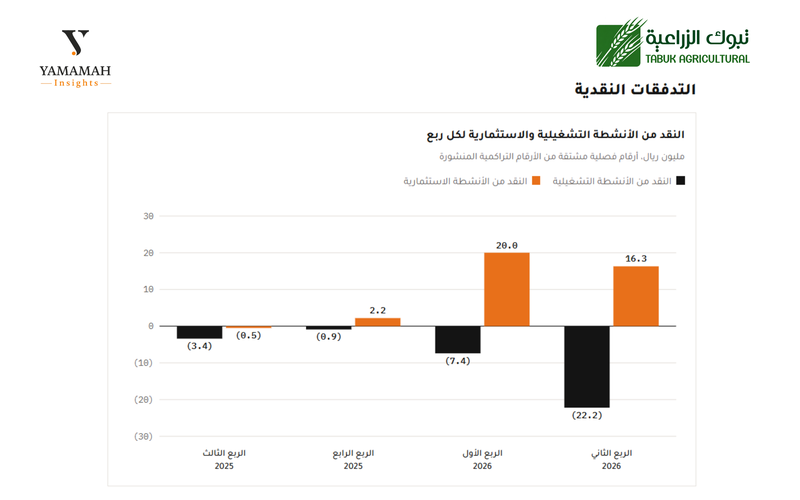
Student Ghadah Alwallan@Ghadah Alwallan emphasized the importance of liquidity, saying: “More important than the electricity savings, in my view, is how the project is financed, particularly since TADCO’s operating cash flow was negative SAR 22.2 million in the second quarter.
Will the company bear the project’s cost, or will the partner? The difference could have a significant impact on its liquidity.”
Integrating Production and Sales to Address Losses
Student Raneem Asiri@Raneem Asiri commented on the need for a comprehensive financial solution, saying: “This project is a good opportunity for Tabuk Agricultural Development Company to benefit from solar energy, reduce operating costs, and improve its profit margin.
As for accumulated losses, I believe cutting electricity costs alone will not be enough. The company should also focus on increasing production and sales and reducing other expenses to gradually improve its financial results.”
Strategic Foundations and Preparing for the Future
Student Dana Alsadoun@Dana Alsadoun offered a direct assessment of the key issues, saying: “I believe TADCO’s move to sign the memorandum of understanding is a strategic and well-judged step. It is a key measure for reducing operating expenses and addressing accumulated losses, which had reached 77% of capital before the capital reduction. In addition, self-consumption—at a capacity of 195,000 megawatt-hours annually—will reduce direct energy costs and improve profit margins.
Although the memorandum is non-binding, it lays the groundwork for a better operational future.”
Improving Consumption Efficiency and Supporting Local Growth
Student Noof Alanazi@Noof Alanazi discussed energy efficiency, saying: “I believe moving to solar energy is a strategic step that supports Vision 2030 objectives and helps TADCO reduce operating costs and improve profit margins over the long term.
Self-consumption arrangements also improve energy-use efficiency and support the local economy. With accumulated losses reaching 77% before the capital reduction, the project may help improve financial performance, but it will require effective cost management and actual savings.”
Improving Negative Operating Cash Flows
Student AHMED ALJADAAN @AHMED ALJADAAN shared his financial and operational analysis, saying: “Agriculture is highly energy-intensive, and the company’s plan to self-consume 195,000 megawatt-hours annually could achieve two things at once: significantly reduce the electricity bill and improve operating cash flows, which have been negative in recent periods (including the second quarter of 2026, when they stood at negative SAR 22.2 million).
This would ease pressure on the company and give it room to improve its profit margins.”
Financial Stability and More Efficient Operations
Student nada Asiri@nada Asiri highlighted what is needed for stability, saying: “TADCO’s move toward renewable energy is a strategic step that will help reduce operating costs and improve profitability, in line with national objectives.
I believe lower energy costs may help limit accumulated losses, but achieving financial stability will also require increasing revenue and improving operational efficiency, supporting the company’s long-term sustainability and growth.”
Operational Productivity and Protecting Savings
Student @ثناء الشايب shared her view on how to assess the financial impact, saying: “This is a positive step, especially if TADCO can use solar energy to run its operations and reduce its electricity bill.
But with accumulated losses that required an 80.47% capital reduction to write them off, I don’t expect lower electricity costs alone to be enough. Productivity must also improve and the causes of the losses must be addressed so the savings aren’t swallowed up by other expenses.
Since the project is still at the stage of a non-binding memorandum of understanding, its value will be clearer after implementation.”
Payback Period and Return on Investment
Student Yazan Hamoud@Yazan Hamoud explained the financial assessment, saying: “I believe the project’s impact should be measured by comparing the investment cost with the expected annual electricity-bill savings, after deducting operating, maintenance, and financing costs.
In other words, we should calculate the payback period and monitor the return on investment and cash flows.
With accumulated losses reaching 77% in the second-quarter 2026 results, the project should deliver clear savings and a reasonable payback period, because any long-term or high-cost investment could put further pressure on liquidity.”
Conditions for the Transition and Cash Readiness
Student Dina Alarjani@Dina Alarjani outlined what is needed for operational success, saying: “TADCO’s move to solar energy is a good step, particularly because agricultural operations require a continuous energy supply.
However, the current agreement is a non-binding memorandum of understanding and has no financial impact at this stage; we therefore need to know the project’s cost and expected savings before assessing its benefits.
With accumulated losses reaching about 77% before the capital reduction of more than 80% to write them off, the company also needs to improve operational efficiency and diversify its income sources.”
Shareholder Equity and Financing Pressures
Student Mohammad Alghaihab@Mohammad Alghaihab concluded the financial analysis by reviewing shareholders’ equity, saying: “Agriculture relies heavily on electricity for irrigation and cooling, so any cost reduction will have a lasting effect on expenses.
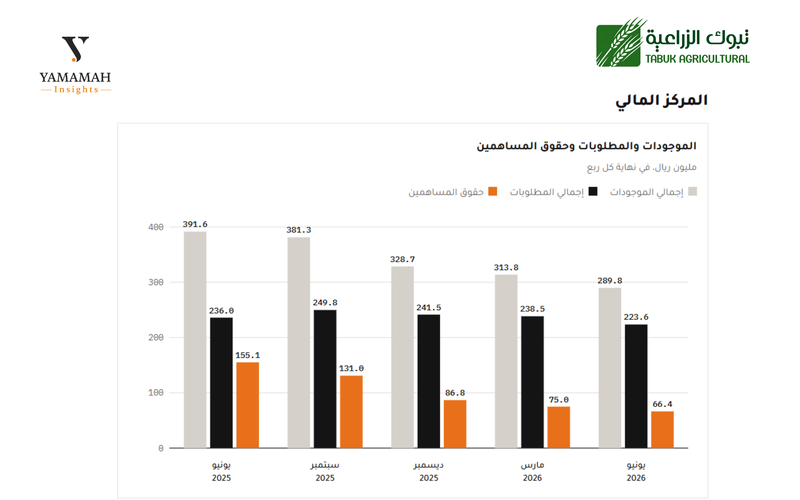
What caught my attention more, however, was the company’s financial position: shareholders’ equity fell from SAR 155 million in June 2025 to SAR 66 million in June 2026, while losses continued and operating cash flows remained negative. I believe the company needs to balance investment in new projects with preserving liquidity. The priority now should be improving cash flows, so the solar project helps improve the financial position rather than becoming a new burden.”
Operational Restructuring and Potential Financing Model
In an analysis, financial and economic analyst Hamad Alsaeed @Hamad Alsaeed added: “The memorandum between Tabuk Agricultural and 386 Vibrant Solar should be viewed in a broader context than its immediate scope: the role of energy in the costs of an agricultural company restructuring its operations. In desert agriculture, energy is used to pump water and provide cooling. It is one of the cost items behind revenue costs that were 5.6 times revenue in the second quarter. Reducing it should therefore improve margins in proportion to its share of costs, with the full impact becoming apparent once production returns to a level that covers fixed costs.
Implementing the project is tied to the company’s current financial position: cash stands at just SAR 7.9 million against liabilities of SAR 223.6 million. This makes it more likely that the developer will finance the plant and sell electricity to the company under a long-term contract, without requiring capital expenditure from TADCO.
At the economic level, the move is consistent with the Ministry of Energy’s program to displace 95% of liquid fuels in electricity, industry, and agriculture by 2030. The memorandum’s value will ultimately depend on whether it becomes a binding power purchase agreement.
Second-Quarter 2026 Results
 Ask Yamami
Comments (3)
No comments yet. Be the first to comment!