

Will you go to work tomorrow, or will work breathe around you? By the middle of the twenty-first century, the term "going to the office" may become an obsolete expression belonging to the pre-Silicon era.
In a comprehensive global study released by the leading IWG group for flexible work solutions under the title "Work Reimagined: The Office of 2050", a survey of employee and human resources (HR) manager opinions worldwide revealed a stunning fact:
72% of employees believe that technology in the work environment will be completely unrecognizable compared to today's standards.
We are not talking here about merely faster screens, but a radical transformation in the nature of productivity, a restructuring of commercial real estate markets, and the emergence of a work environment that not only accommodates the employee, but anticipates their needs and integrates with their vital functions.
Neural Interfaces: From Science Fiction to Corporate Budgets
Brain-computer interfaces (Neural Interfaces) have long been fertile ground for science fiction narratives, but data from the IWG report indicates that these technologies have become part of organizations' long-term strategic plans.
With major companies like Neuralink and Synchron entering trial and early application phases, the view of brain implants is changing.
In a surprising statistical finding, neural implants were classified as the most anticipated emerging technology in the workplace for 2050; with expectations for their adoption:
- 33% of HR leaders globally.
- 26% of employees.
The economic goal here goes beyond well-being; smart systems linked to these interfaces will be able to process complex work flows, customize professional environments instantly, and accelerate clinical and financial decision-making processes at rates far exceeding the capabilities of current digital tools.
Artificial Intelligence as "Coworker": Reengineering Human Value
According to the report, artificial intelligence will not remain merely an auxiliary productivity tool, but will move to the seat of "partner colleague" in daily operations. The figures point to alignment of labor and management vision in this regard:
| Target Group | Percentage Expected for Job Restructuring by AI and Automation |
|---|---|
| HR Leaders | 70% |
| Employees | 73% |
These high percentages anticipate artificial intelligence taking on precise logistic tasks, such as determining "where and when" people should meet for collaboration based on the nature of required outputs and team dynamics. Additionally, AI-powered training and onboarding processes will see enormous abbreviation of learning curves, enabling new employees to reach full productivity at unprecedented speed.
Where does human value go then?
With automation of routine tasks, human capital value will concentrate in distinctive areas:
Solving complex problems, creative innovation, and managing decisions under conditions of economic "uncertainty".
The New Geography of Work: Death of the "9 to 5" and the Central Office
Financial data from the administrative real estate sector points to a silent earthquake; the traditional structure of the workday is drawing its last breath. The IWG report confirms that long daily commutes and strict work schedules (from 9 a.m. to 5 p.m.) will fade away by 2050 according to 69% of HR leaders and 68% of employees.
Instead, work will be distributed across networks of decentralized locations:
- Multi-site Working:
70% of HR leaders and 75% of employees see it as an upcoming standard. - The depth of the Hybrid Model:
78% of HR executives and 64% of workers believe it will be the dominant model, meaning the complete disappearance of "mandatory return to office" policies in favor of absolute flexibility as an acquired right.
In this context, physical meetings will shift to the virtual world, where 70% of HR leaders and 69% of employees see virtual and augmented reality technologies (VR/AR) as the official alternative to in-person meetings and side conversations, through interactive digital environments that bring remote and decentralized employees together simultaneously.
Responsive Architecture: Living Offices and Human-Centered Design
Future offices will not be merely silent concrete walls, but flexible environments that respond dynamically to their occupants.
The report documented clear aspirations for responsive office features:
- Adjusting lighting and environmental conditions
based on individual biological rhythms (28%). - Stress and fatigue monitoring systems
that automatically alert employees to the need for rest (30%). - Smart interactive walls
that transform completely into digital display screens and shared work spaces (24%).
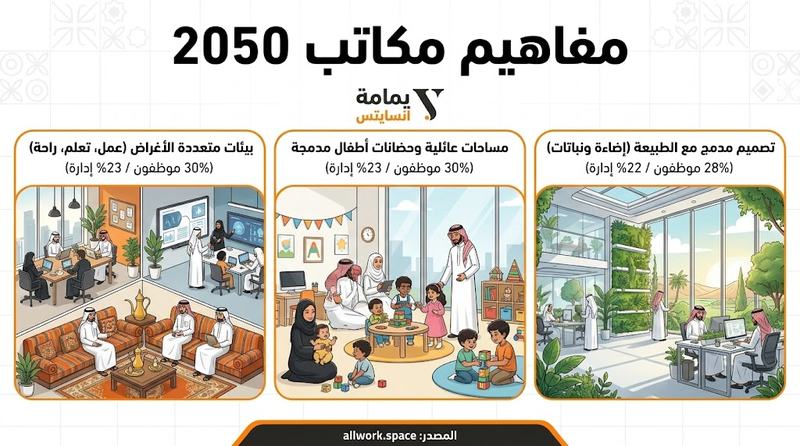
Despite this technological flood, organizations are rediscovering "humanized design" to ensure psychological sustainability and productivity; with new concepts emerging for space design focusing on well-being:
Flexibility: The Hard Currency for Attracting Talent in Tomorrow's Market
"Artificial intelligence and emerging technologies are transforming work environments at a pace that exceeds the rate of preparedness of many current organizations and companies"
All the threads of the IWG study converge at one economic truth:
Flexibility is the sole standard for survival.
Indeed, 75% of both HR leaders and employees agreed that providing a flexible work environment that grants employees autonomy and the ability to choose "how, where, and when to work" will be the decisive and fundamental element for attracting and retaining talent by 2050.
 Ask Yamami
Comments (6)
No comments yet. Be the first to comment!