

Al Kathiri Holding Company announced that its subsidiary, Musanadah Supply Company Limited, had received an award letter to carry out construction works as part of the Joud Residential Project in the Sultanate of Oman.
The award was issued by Talaat Moustafa Group Muscat Real Estate Development Company for a value of approximately SAR 110 million (equivalent to OMR 11.28 million), to build 160 residential villas over an execution period of up to 24 months.
This contract, which is subject to the completion of value engineering and is expected to begin contributing financially in the first quarter of 2027, is the company’s first project outside the Kingdom of Saudi Arabia.
The move supports the company’s strategy to diversify its revenue sources and capitalize on regional expansion opportunities in the contracting sector.
Students from Al Yamamah University discussed the financial and strategic aspects of this expansion and its impact on the company’s revenue growth, as follows:
Taking national expertise abroad and valuing the stock by profit margin, not contract size
Student Meshail Al-Anazi @Meshail ALANazi shared her perspective, saying: "I believe that Al Kathiri Holding Company’s regional expansion is a positive step, as it creates new revenue opportunities and reduces reliance on the domestic market.
International projects also support the Saudi economy by transferring expertise and strengthening the competitiveness of national companies.
The SAR 110 million contract is expected to support revenue growth starting in the first quarter of 2027, while effective cost and cash flow management will be essential.
As for the stock, the contract’s size relative to capital is a positive indicator, but its impact on fair value will depend on the profit margin, execution capacity, and earnings sustainability—not on the contract value alone."
Financing challenges and balancing cash flows amid accumulated losses
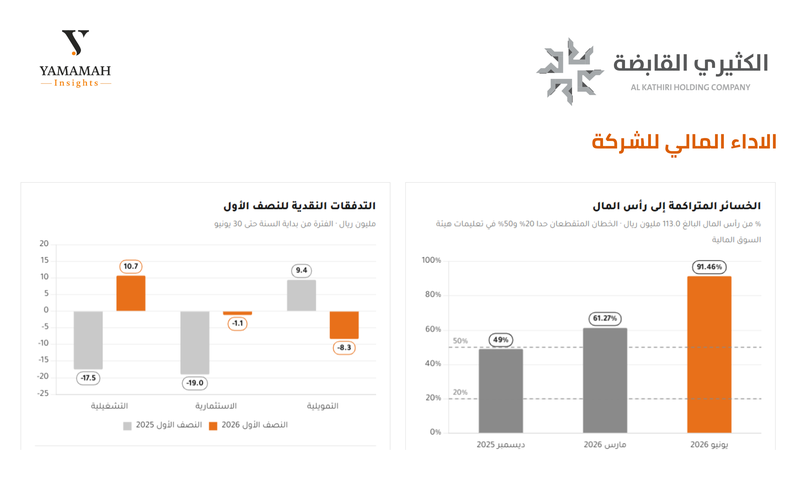
Student Ghadah Alwallan @Ghadah Alwallan also shared her view, noting: "What caught my attention was the company securing a contract worth SAR 110 million, despite its accumulated losses reaching 91.46% of capital.
I believe the real challenge is not just generating new revenue, but the company’s ability to finance the project during execution without putting additional pressure on its liquidity and debt levels.
This is especially true because the timing of collecting payments due for the project may not align with the timing of paying its costs."
Investor confidence and the need to assess actual earnings when evaluating the regional contract
Student Rahaf Al-Anazi @Rahaf Alanazi said: "I believe the contract’s value compared with the company’s capital indicates the project’s importance and scale relative to its business, and may strengthen investor confidence in its ability to expand.
However, fairly valuing the stock requires looking at expected earnings, cash flows, and financial obligations—not the contract value alone."
Execution efficiency as a prerequisite for returns from international projects
Student Dina Alarjani @Dina Alarjani added: "In my view, Al Kathiri’s contract in Oman is a positive step because it opens up a new market for the company and diversifies its income sources. Its substantial value relative to capital gives it an opportunity to grow.
But the contract’s value does not mean that the entire amount represents profit; the outcome depends on execution costs, meeting the timeline, and collecting payments due.
If the project is executed efficiently, it could support the company’s performance and improve its chances of securing other regional projects."
Managing operational and logistical risks to maintain stable profit margins
Student Zikra Abdulkareem @Zikra Abdulkareem emphasized: "In my view, the contract represents a positive step for Al Kathiri Holding, particularly as it is set to take effect in 2027, giving the company an opportunity to build more stable cash flows over the medium term.
Regional expansion also strengthens the company’s presence and opens up new markets, but success will depend on its ability to manage operational and logistical risks and maintain healthy profit margins."
A qualitative leap supporting medium-term cash flow stability
Student Ryouf Alsewailim @Ryouf Alsewailim remarked: "The announcement represents an excellent step. Since the project will run for 24 months and its financial impact is expected to begin in the first quarter of 2027, it will provide excellent stability for the company’s cash flows over the medium term.
The contract’s value being close to the company’s capital indicates the scale of the qualitative leap expected in the company’s performance and stock valuation.
The company’s first expansion outside the Kingdom also highlights the ability of Saudi companies to compete with major regional developers and take national expertise abroad."
Controlling costs to ensure substantial returns translate into real profits
Student Nada Asiri @nada Asiri shared her view, saying: "In my opinion, Al Kathiri Holding Company securing a contract worth SAR 110 million is a positive step that will help expand its business and increase its revenue.
Entering regional markets also strengthens the presence of Saudi companies and supports the national economy.
I believe the contract could positively affect the company’s financial performance starting in the first quarter of 2027, but this depends on successful project execution and cost control.
Generating good profits from the contract could strengthen investor confidence in the company and support future stock growth."
How the award converts into cash flows as a measure of future growth
Student Albatool Bedairi @Albatool Bedairi said: "I believe securing a project worth nearly as much as the company’s capital reflects its ability to compete and capture significant opportunities, and may raise investor expectations for business growth.
However, the contract value alone is not enough to determine the stock’s fair value. What matters more is the expected profit margin, execution costs, and whether the project translates into actual profits and cash flows."
Financing the project and avoiding higher debt to secure operating returns
Student Yazan Hamoud @Yazan Hamoud added: "What caught my attention is that the project’s value of SAR 110 million is close to the company’s capital, while its accumulated losses have reached approximately 91.46%. This makes overseas expansion both an opportunity and a financial challenge.
I believe the project’s success depends not just on its value, but on the company’s ability to finance its execution, control costs, and collect payments on time—especially as the project will run for 24 months.
In my view, the priority now is to turn this award into a final contract that generates actual profits and cash flows, without adding pressure to the company’s debt."
Liquidity challenges amid declining operating cash flows
Student Ahmed Al-Jadaan @AHMED ALJADAAN emphasized: "It is a bold move by the company to carry out a project to build 160 residential villas in Oman as its first international project.
Regional expansion is excellent for diversifying income, but the biggest challenge is the waiting period, since the financial impact will not begin until the first quarter of 2027.
Given that the company is currently experiencing a decline in operating cash flows, how will it finance this major project over the next 24 months?"
Understanding the new market environment and adapting to regional regulatory differences
Student Rabiah Almugait @Rabiah Almugait noted: "I believe this project could be a turning point for Al Kathiri Holding, as it gives the company an opportunity to expand beyond the Saudi market and build relationships in new markets.
However, it is important for the company to pay attention to execution costs, differing regulations, and the nature of business in the new market.
As for the financial impact, I expect the project’s success to depend on the company’s ability to execute the contract efficiently and generate actual profits from it—not simply on the contract value. This will determine how much the company benefits from it in the long term."
The competitiveness of “Made in Saudi Arabia” and the need for sustainable regional cash flows
Student Fay Aldossari @Fay Aldossari shared her view, saying: "Expansion and risks: The direction is positive for diversifying revenue; the real test will be how effectively supply chains and operations are managed abroad.
The private sector: National companies winning regional projects enhances the presence and competitiveness of the “Made in Saudi Arabia” brand.
Financial sustainability: Financial statements will reflect greater stability and ongoing cash flows over the medium term, starting in the first quarter of 2027.
Stock valuation: The contract, valued at SAR 110 million, is close to the size of the company’s capital; it is a pivotal milestone that supports future growth and earnings per share."
Comparing revenue with liabilities and the ability to finance operating costs
Student Mohammad Alghaihab @Mohammad Alghaihab said: "I believe Al Kathiri winning a project in the Sultanate of Oman is a positive step, especially since it is the company’s first project outside the Kingdom and could open up greater opportunities in the Gulf market in the future. What caught my attention most, however, was the contract’s size compared with the company’s current financial performance.
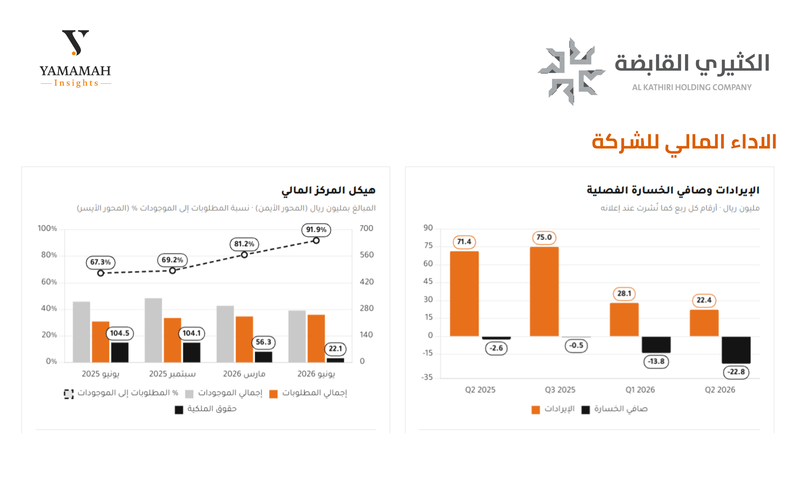
The project is worth approximately SAR 110 million, while company revenue in the second quarter was only SAR 22.4 million, meaning the contract is equivalent to roughly five times quarterly revenue.
This gives an idea of the scale of the opportunity, particularly since execution will span two years, and could therefore support revenue in the coming periods.
However, looking at the financial position, we see that equity has fallen to SAR 22.1 million, and liabilities now account for approximately 92% of assets.
Therefore, I believe the biggest challenge is not winning the project, but being able to finance its execution and manage its costs, particularly with losses continuing.
In my view, the contract could be a turning point for the company if it can execute it with good profit margins and collect its payments regularly. However, I do not believe its value alone is enough to conclude that the company’s position has improved or its fair value has increased. What matters in the coming period is the project’s impact on earnings and cash flows, not just revenue."
Higher logistics costs and their impact on the company’s financial performance
Student Raneem Asiri @Raneem Asiri added: "I believe Al Kathiri Holding Company securing a contract of this size is a positive step that will help it develop its business and improve its financial performance.
Expansion into international markets also opens up new opportunities, but may involve challenges such as regulatory differences and higher operating and transportation costs.
In my view, the project could have a positive impact on the stock in the future if the company can generate actual profits and overcome these logistical challenges."
Turning an initial opportunity into actual liquidity amid volatility in the Omani market
Student Thanaa Alshayib @Thanaa Alshayib emphasized: "I believe the biggest benefit for Al Kathiri is that success on this project could open the door to other contracts outside the Kingdom and strengthen the regional presence of Saudi expertise. However, expansion requires controlling execution and transportation costs and understanding the new market’s regulations in order to translate it into actual profits.
A project spanning two years provides greater visibility into expected revenue from 2027 onward, while liquidity stability depends on the timing of payment collections relative to execution expenses.
The project’s value being close to the company’s capital indicates its scale, but does not automatically mean an increase in the stock’s fair value. What matters more is the profit margin and the amount of financing required.
One point worth noting is that the announcement concerns an award only, and the final value remains subject to agreement. In my view, the company’s ability to turn this opportunity into profits and liquidity is what will make a difference for shareholders."
Short-term financing challenges amid risks of international operations
Student Shahad Alkhamis @Shahad Alkhamis remarked: "I believe Al Kathiri Holding’s move to expand overseas is a positive strategic step because it opens up new income sources and diversifies the business beyond the domestic market. The project in Oman, worth SAR 110 million, is a large contract relative to the company’s size, which is an achievement in itself.
At the same time, I have some short-term concerns:
- The financial impact will not appear until 2027, meaning the company will need to finance and operate the project for a long period before receiving returns.
- The company already has significant accumulated losses, and its capital is close to the contract value, increasing pressure on liquidity.
- Operational and logistical risks in a new market are not insignificant, particularly when managing projects outside the Kingdom."
Balancing expansion commitments with internal capital restructuring
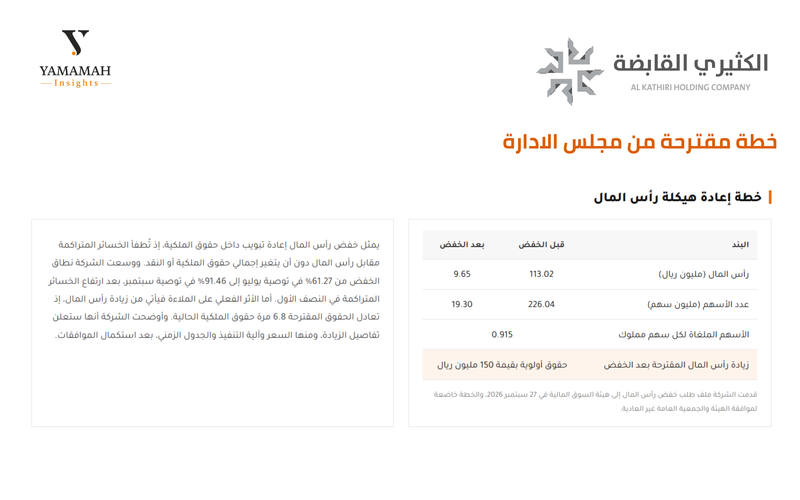
Student Dana Alsadoun @Dana Alsadoun concluded the comprehensive analysis by saying: "The real turning point here lies in the timing: the project’s financial impact will begin in the first quarter of 2027 and continue for 24 months, coinciding precisely with critical plans to restructure capital by reducing it and then increasing it.
In my view, the challenge is not the quality of the project itself, but the company’s ability to manage cash flows and meet its overseas expansion commitments while simultaneously addressing its internal financial position during this period."
Strategic alignment between regional expansion and financial restructuring
In an analytical assessment, financial and economic analyst Hamad Alsaeed @Hamad Alsaeed adds: Just weeks before the deadline for convening the extraordinary general assembly that will consider reducing Al Kathiri Holding’s capital by 91.46%, the award of the Joud Residential Project in Oman has provided an operational rationale for the restructuring plan to raise SAR 150 million through a rights issue. The reduction wipes out accumulated losses on paper, while the increase is what will finance working capital for a contract worth SAR 110 million at a company with cash holdings of approximately SAR 4 million.
Assuming an even pace of execution over 24 months, the project would add approximately SAR 14 million each quarter starting in 2027—around 60% of what the company generated in the second quarter, after its revenue declined by 67%. Profits from this work will contribute to the Kingdom’s gross national product, not its gross domestic product. This is the path Vision 2030 is betting on for exporting services, with negligible foreign-exchange risk given the two currencies’ peg to the US dollar.
The deal shifts the company’s focus from managing losses to testing its execution, and its impact will be determined more by the margin established through value engineering than by its nominal value.
 Ask Yamami
Comments (3)
No comments yet. Be the first to comment!