

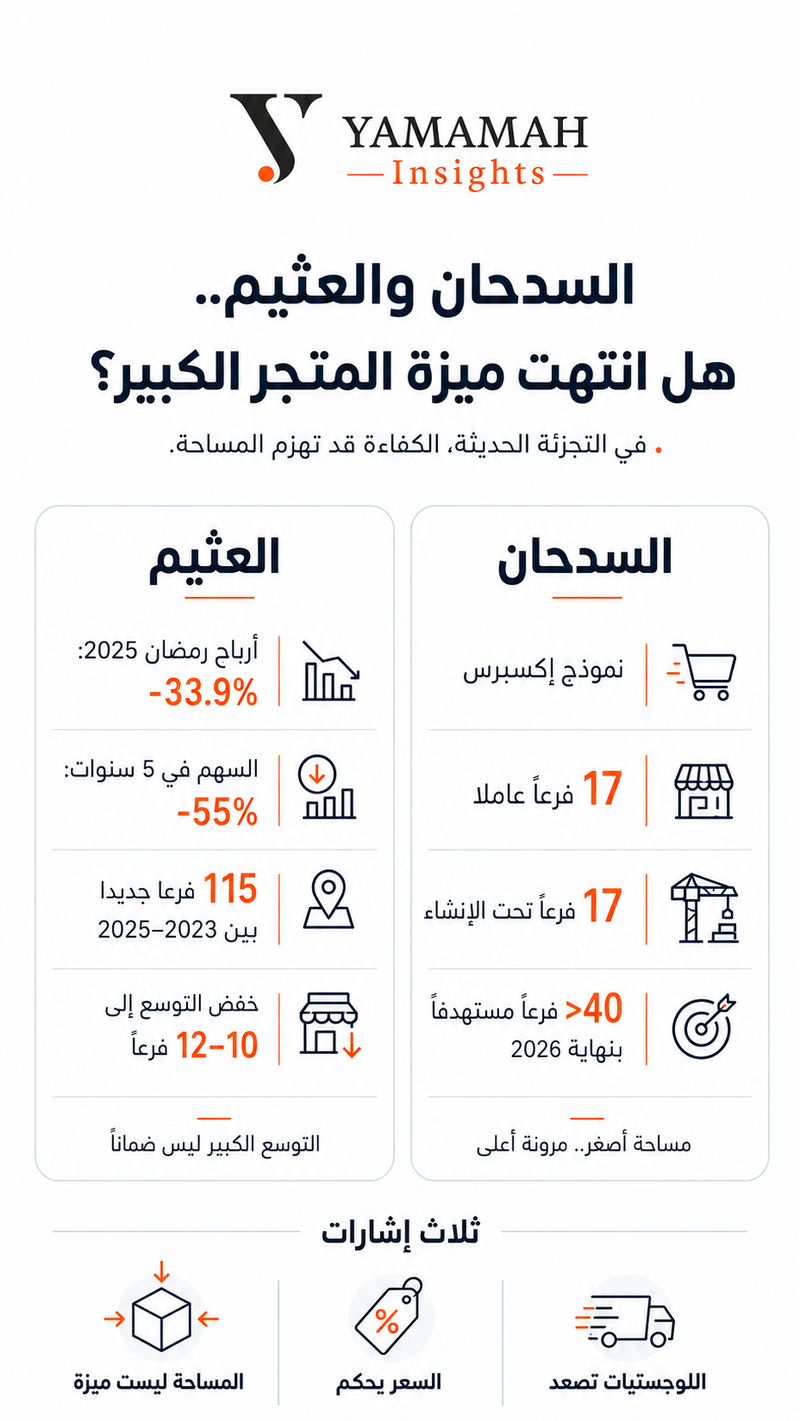
The retail map is witnessing a radical transformation that reshapes competition concepts; vast spaces and massive distribution are no longer the sole guarantee of profitability. Today, new data emerges proving that operational efficiency and flexibility can defeat size, which is evident when comparing the current directions of two giants in the Saudi market: "Al Otheem" and "Al Sadhan".
The current scene presents us with two completely contradictory strategies:
Al Sadhan: Smaller Space.. Higher Flexibility
"Al Sadhan" is moving toward a more agile model based on "Express", betting on proximity to consumers and speed of movement:
- Current status: It owns 17 operating branches.
- Ongoing expansion: There are 17 other branches under construction.
- Future goal: It targets reaching more than 40 branches by the end of 2026.
Al Otheem: Large-Scale Expansion Is Not a Guarantee
On the other hand, the large-store model and wide distribution face clear pressures evident in "Al Otheem" indicators:
- Profit decline: Ramadan 2025 profits recorded a decline of 33.9%.
- Stock performance: The stock fell by 55% over 5 years.
- Expansion slowdown: Despite opening 115 new branches between 2023 and 2025, the company shifted to reducing future expansion to only 10 to 12 branches, reflecting a revision of the previous strategy.
Three Signals That Shape the Future of Retail
This disparity captures three main facts that govern the market today:
- Logistics rises: Supply chain and delivery efficiency has become more important than the size of the showroom.
- Price governs: The consumer has become more price-sensitive and seeking value for money.
- Space is not an advantage: Mega stores carry high operating costs that may not be reflected in sales per square meter.
In summary:
The question in the retail sector is no longer "How many branches do you own?" but "How efficiently do you manage these branches?". The rules of the game have changed, and future growth will be an ally to those who possess flexibility and the ability to adapt to new consumer behavior, not just to those who own the most space.
 Ask Yamami

Comments (5)
No comments yet. Be the first to comment!